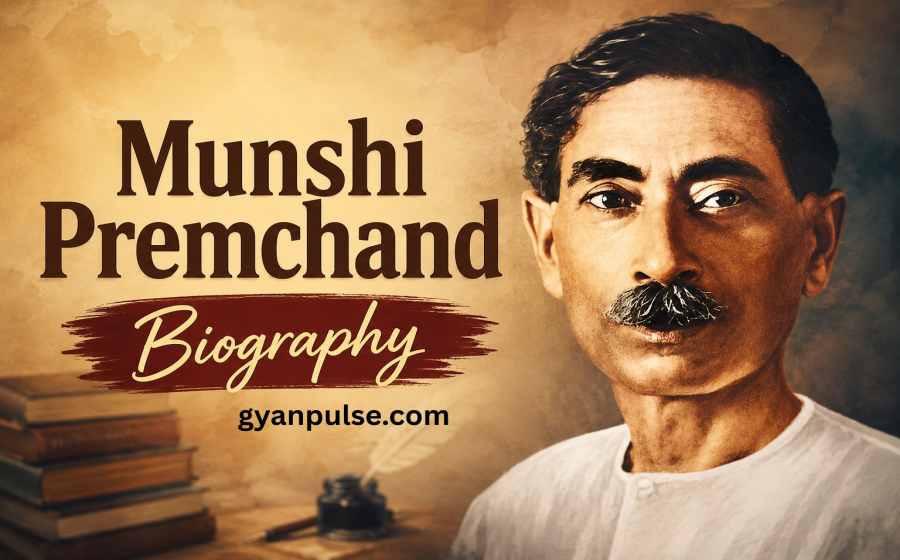
Munshi Premchand Biography – Life, Works, Legacy and Inspiring Journey of the Upanyas Samrat
Discover the inspiring Munshi Premchand Biography covering his life, major works, struggles, achievements and lasting legacy in Indian literature.
Munshi Premchand Biography
Munshi Premchand, often celebrated as the “Upanyas Samrat” (Emperor of Novels), is one of the most influential figures in Indian literature. His writings captured the heartbeat of rural India and portrayed the complexities of society with unmatched simplicity, honesty, and emotional depth. Whether through his short stories or novels, Premchand gave readers a mirror to Indian life-rich with realism, humanity, and profound moral lessons.
Table of Contents
Early Life and Background
Munshi Premchand was born as Dhanpat Rai Srivastava on 31 July 1880 in Lamhi village near Varanasi, Uttar Pradesh. His father, Ajaib Lal, worked as a post office clerk, while his mother, Anandi Devi, was a homemaker. Childhood was far from easy for young Premchand. The loss of his mother at a very early age deeply impacted him, leaving him to grow up with emotional hardship and limited family support.
Despite financial struggles, he developed a strong love for reading. He spent hours reading Hindi, Urdu, and Persian literature, which shaped the foundation of his future writing. His early exposure to social inequalities, poverty, and everyday human struggles later became central themes in his stories.
Education and Early Struggles
Premchand’s life took a difficult turn when his father also passed away. At a young age, he had to shoulder family responsibilities. He took up a job as a teacher to support himself and his stepmother while continuing his education.
His early marriage, arranged at a young age, was unsuccessful, but he later found stability after marrying Shivrani Devi, who encouraged him to focus on writing. The early hardships he faced became powerful inspirations, enabling him to understand common people and express their lives authentically.
Journey into Writing
Premchand began writing under the pen name Nawab Rai. His first significant work, Soz-e-Watan (1907), a collection of patriotic stories, was banned by British authorities for promoting nationalism. This forced him to adopt the name Munshi Premchand, which later became immortal.
His writings were grounded in realism and social reform. He wrote about poverty, exploitation, caste discrimination, gender inequality, corruption, and the struggles of ordinary Indians. He believed literature should not only entertain but also inspire change.
Major Works
Munshi Premchand’s contribution to Indian literature is vast. He authored more than 300 short stories, 12 novels, numerous essays, plays, and translations.
Some of his most notable works include:
- Godaan – Considered his masterpiece, portraying rural India’s social and economic struggles.
- Gaban – A story exploring greed, moral dilemmas, and human values.
- Nirmala – A powerful depiction of dowry issues and societal pressures.
- Karmabhoomi – Focuses on political awakening and youth responsibility.
- Shatranj Ke Khiladi – Later adapted into a famous film by Satyajit Ray.
His short stories like “Kafan,” “Panch Parmeshwar,” “Bade Ghar Ki Beti,” and “Poos Ki Raat” remain timeless, studied across generations.
Themes in His Writing
Premchand’s literary style was grounded in simplicity, realism, and deep moral insight. His works highlighted:
- Rural and urban social problems
- Human compassion and values
- The struggles of farmers and laborers
- The power of truth and justice
- Women’s rights and dignity
He believed literature should reflect society and contribute to its improvement.
Later Life and Legacy
Premchand left his government job to dedicate himself fully to writing. He moved to Bombay for a short period to work with the growing Indian film industry, but eventually returned to writing books and editing literary magazines.
He passed away on 8 October 1936, but his legacy continues to influence Indian literature profoundly. His stories remain part of school syllabi, literary discussions, and adaptations in theatre, cinema, and television.
Today, Munshi Premchand is remembered as a writer who brought the soul of India into words. His contribution is not only literary but also social, as he encouraged generations to think, question, and reform.
5 Inspirational Lessons from Munshi Premchand’s Life
1. Hardships Can Shape Greatness
Premchand turned personal struggles into powerful stories that transformed Indian literature.
2. Simplicity Has Power
His simple writing style proved that clarity and honesty can create the deepest impact.
3. Stand for Social Change
He used his pen to fight against injustice, reminding us that creativity can be a tool for reform.
4. Never Stop Learning
Despite financial difficulties, he continued reading, studying, and growing intellectually.
5. Follow Your Passion Fearlessly
Leaving his government job to become a full-time writer showed immense courage and commitment.
Munshi Premchand’s Lasting Influence on Indian Literature
Munshi Premchand’s literary legacy extends far beyond his lifetime, as his works continue to inspire readers, writers, and social thinkers across generations. His realistic portrayal of everyday life, combined with powerful messages of justice, equality, and compassion, made his stories timeless. Through memorable characters and meaningful narratives, he highlighted the struggles of ordinary people while encouraging positive social change. Even today, his novels and short stories remain relevant, reflecting values and issues that continue to shape Indian society and literature.
Summary
Munshi Premchand was one of India’s greatest literary figures, whose realistic stories and novels gave voice to the lives of ordinary people. Through his powerful writing, he addressed social issues such as poverty, inequality, and injustice while promoting compassion and moral values. His timeless works continue to educate, inspire, and influence readers, securing his place as a cornerstone of Indian literature and a symbol of meaningful social reform.
Also Check: Biography