
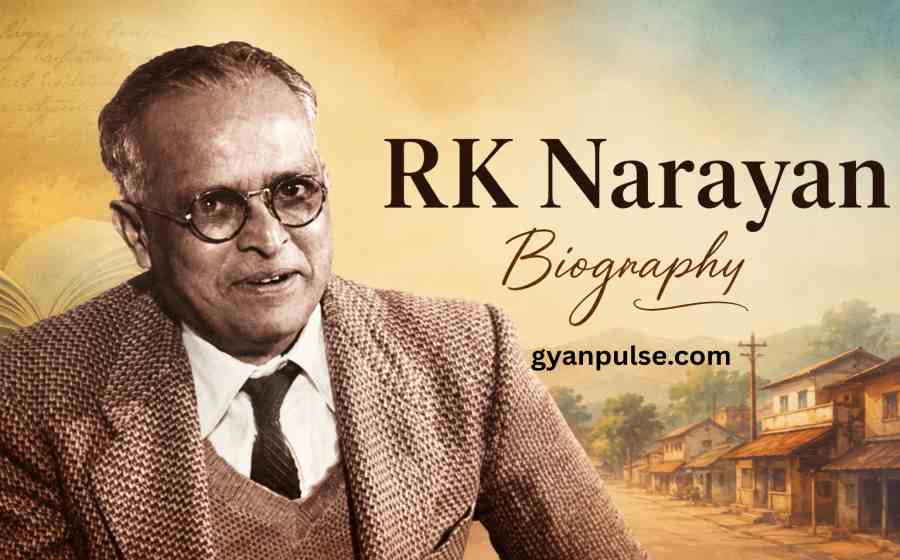
RK Narayan Biography – Life, Career, Books, Achievements and Inspiring Journey
Discover RK Narayan Biography, exploring his life, famous works, Malgudi, achievements, writing style, legacy and lasting impact on Indian literature.
RK Narayan Biography
Rasipuram Krishnaswami Iyer Narayanaswami, widely known as R. K. Narayan, stands among the most celebrated Indian English writers of the 20th century. Born on October 10, 1906, in Madras (now Chennai), he went on to become the literary genius behind the fictional town Malgudi, a place that shaped modern Indian storytelling. Narayan’s writing was notable for its simplicity, gentle humor, deep emotional understanding, and the ability to portray everyday Indian life with extraordinary clarity.
Table of Contents
Early Life and Education
Narayan spent most of his childhood in the care of his grandmother, as his father worked as a school headmaster in another town. His grandmother played a major role in shaping his early education, teaching him traditional subjects such as arithmetic, mythology, stories from epics, and basic reading skills. These simple yet profound experiences later influenced his storytelling style.
He later joined Mysore Maharaja College, where he completed his Bachelor of Arts degree. The city of Mysore became an important part of his life and later inspired the creation of Malgudi, one of the most iconic fictional settings in Indian literature.
Beginning of a Literary Journey
Narayan developed a passion for writing early on. He started by contributing articles to newspapers and small publications. However, his journey to becoming a published author was not easy. His first novel, “Swami and Friends”, faced multiple rejections before it finally reached the hands of British writer Graham Greene, who became a lifelong friend and supporter. Greene helped the novel get published in 1935, marking Narayan’s official entry into the world of literature.
“Swami and Friends” received wide praise for its simplicity and authenticity. It captured the innocence of childhood and introduced readers to Malgudi, a small town that felt real even though it existed only on paper.
Rise to Fame and Important Works
Over the years, Narayan wrote numerous novels, short stories, essays, and travelogues. Some of his most famous novels include:
- The Bachelor of Arts
- The Guide
- The Financial Expert
- The English Teacher
- The Man-Eater of Malgudi
What set Narayan apart was his ability to describe ordinary people and everyday situations with warmth and humor. His characters were relatable-schoolboys, teachers, vendors, priests, financial advisers, and wanderers-each reflecting the complexity of Indian society.
One of his masterpieces, “The Guide,” won the Sahitya Akademi Award and was later adapted into an award-winning film. The story explored human emotions, redemption, and transformation, making it one of his most impactful works.
Malgudi – The Heart of Narayan’s Storytelling
Malgudi, though fictional, became one of the most memorable literary towns in India. Readers felt it was real because Narayan infused it with relatable characters, detailed surroundings, and emotional depth. Through Malgudi, Narayan portrayed India’s cultural shifts, social values, and everyday experiences in a charming and timeless manner.
The town gained further popularity after the television adaptation “Malgudi Days” aired in the 1980s, introducing Narayan’s stories to millions of viewers.
Writing Style and Themes
Narayan’s writing style is often described as simple yet powerful. He preferred everyday language, focusing on emotions, relationships, and moral dilemmas rather than complex vocabulary. His stories often carried subtle humor and gentle irony, making them enjoyable for readers of all ages.
Some recurring themes in his works include:
- The challenges of modernity
- Family relationships
- Cultural traditions
- The innocence of childhood
- Human flaws and beauty
This unique style made Narayan one of the pioneers of Indian writing in English, standing alongside literary giants like Mulk Raj Anand and Raja Rao.
Achievements and Honors
Throughout his lifetime, R. K. Narayan received numerous prestigious awards, including:
- Sahitya Akademi Award (for “The Guide”)
- Padma Bhushan in 1964
- Padma Vibhushan in 2000
- Honorary Doctorate from the University of Leeds
- Nominated to the Rajya Sabha in 1989
His literary contributions earned him global appreciation, and his works continue to be studied in schools and universities across the world.
Later Life and Legacy
Narayan lived a long and peaceful life dedicated to writing. Even in his later years, he continued creating stories with the same warmth and artistic clarity. He passed away on May 13, 2001, leaving behind a legacy that continues to inspire generations of readers and writers. His books remain evergreen, and Malgudi continues to be a symbol of Indian literature’s golden era.
5 Inspirations from R. K. Narayan’s Life
- Simplicity can be powerful – Narayan proved that simple language can create extraordinary impact.
- Persistence leads to success – Despite rejections, he continued writing until his work was recognized.
- Roots matter – His deep connection to Indian culture enriched his storytelling.
- Creativity has no boundaries – He created an entire fictional world that became timeless.
- Stories are reflections of life – His ability to portray ordinary people showed that every life holds a story worth telling.
R. K. Narayan’s Influence on Indian English Literature
R. K. Narayan played a defining role in establishing Indian English literature on the global stage. Through his memorable characters, realistic storytelling, and the timeless world of Malgudi, he demonstrated that ordinary lives could inspire extraordinary literature. His works continue to influence aspiring writers, scholars, and readers by showcasing the richness of Indian culture, values, and human emotions. Even decades after their publication, his novels remain relevant, making him one of the most respected and enduring voices in Indian literary history.
Summary
R. K. Narayan remains one of India’s greatest literary icons, celebrated for his simple yet profound storytelling and his unforgettable fictional town of Malgudi. His works beautifully capture the essence of everyday life, human relationships, and Indian culture with warmth and humor. Through perseverance, creativity, and a deep understanding of society, he left a lasting legacy that continues to inspire readers and writers around the world. His timeless novels ensure that his contribution to Indian English literature will be remembered for generations.
Also Check: Biography