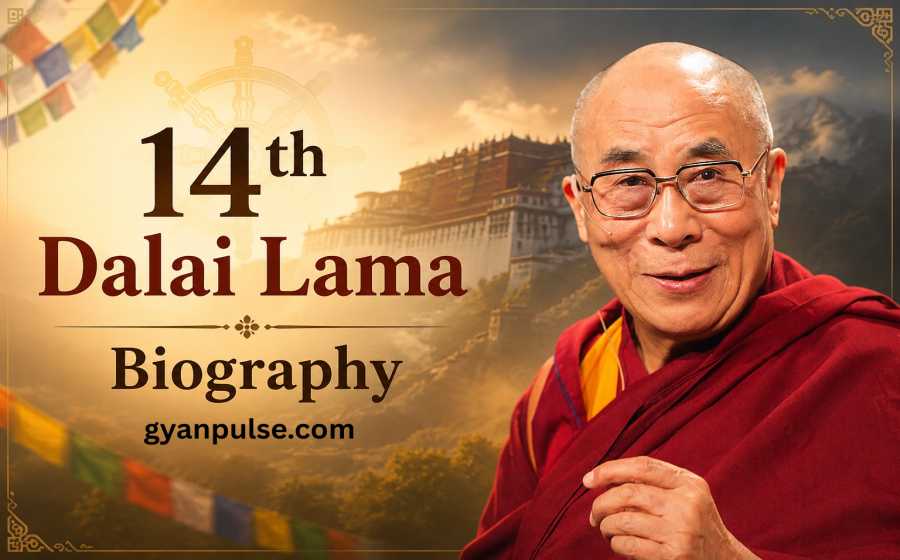
14th Dalai Lama Biography – Life, Teachings and Inspiring Legacy of the Spiritual Leader
Discover the inspiring 14th Dalai Lama Biography, covering his early life, exile, teachings, leadership, Nobel Peace Prize and lasting legacy of compassion.
14th Dalai Lama Biography
The Dalai Lama, born as Tenzin Gyatso, is one of the most respected spiritual leaders in the world and the global symbol of peace, compassion, and nonviolence. As the 14th Dalai Lama of Tibet, he guided his people through one of the most challenging periods in Tibetan history. His messages of kindness, humanity, and inner peace have inspired millions across the globe. Even in exile, he continues to stand as a beacon of hope, spreading the values of harmony and universal brotherhood.
Table of Contents
Early Life and Background
The Dalai Lama was born on 6 July 1935 in the small village of Taktser, in the Amdo region of Tibet. Born into a simple peasant family, he was originally named Lhamo Thondup. His early life was modest, surrounded by the natural beauty of rural Tibet and a close-knit farming community.
Even as a child, he showed unusual calmness, compassion, and curiosity, qualities that later became central to his identity.
He began his education at the age of six, studying Buddhist philosophy, logic, Tibetan literature, Sanskrit, arts, and meditation. His spiritual training laid the foundation for his future role as Tibet’s religious and political guide.
Recognition as the 14th Dalai Lama
After the death of the 13th Dalai Lama, Tibetan monks searched for his reincarnation, following ancient traditions and signs. Their search led them to young Lhamo Thondup, who passed all spiritual tests, including identifying items that belonged to his predecessor.
In 1940, he was officially enthroned as the 14th Dalai Lama and given the monastic name Tenzin Gyatso.
Although he was still a child, the responsibility placed on him was immense, he was to serve as both the spiritual and temporal leader of Tibet.
Leadership and the Tibet–China Conflict
By the age of 15, the Dalai Lama assumed full political responsibility due to rising tensions between Tibet and China. The 1950s were a turbulent period, as Tibet faced increasing pressure and military presence from China.
Despite being very young, the Dalai Lama attempted to negotiate peacefully, hoping to protect Tibetan culture and autonomy.
Unfortunately, the situation escalated, culminating in the 1959 Tibetan uprising, which put his life at serious risk.
To protect Tibetans and ensure the continuation of their culture, he made a historic decision.
Life in Exile
In 1959, the Dalai Lama fled Tibet and sought refuge in India, where he was warmly welcomed. He settled in Dharamshala, Himachal Pradesh, and established the Tibetan government-in-exile.
From exile, he worked tirelessly to preserve Tibetan language, culture, religion, and identity.
He became the global voice of the Tibetan people, promoting nonviolence as the only path forward.
Over the years, he travelled extensively, meeting world leaders, inspiring millions, and advocating for:
- Human rights
- Religious freedom
- Peaceful coexistence
- Dialogue over violence
- Universal compassion
His gentle words and humble lifestyle won the hearts of people worldwide.
Global Influence and Teachings
The Dalai Lama’s teachings revolve around simple yet powerful principles:
- Kindness is the highest form of religion
- Peace comes from within
- Compassion can change the world
- Happiness is created through positive actions
- Every individual can make a difference
His messages transcend religion and culture, touching people of all backgrounds.
Books written by him, such as The Art of Happiness and The Universe in a Single Atom, became global bestsellers, inspiring readers with their simplicity and wisdom.
He also promoted interfaith harmony, environmental protection, and the importance of emotional well-being in modern life.
Awards and Recognition
The Dalai Lama has received numerous international honours, the most notable being:
- Nobel Peace Prize (1989) for his nonviolent struggle for Tibet
- Templeton Prize
- Ramon Magsaysay Award
- Congressional Gold Medal (USA)
- Honorary doctorates from universities worldwide
These recognitions celebrate his lifelong dedication to peace, compassion, and global harmony.
Personal Life and Beliefs
Despite being a world icon, the Dalai Lama leads a simple and disciplined life. He follows a daily routine of meditation, prayers, reading, and meetings.
He describes himself not as a “superior spiritual being,” but simply as a Buddhist monk who tries to help others.
His humility, humour, and warmth make him deeply admired.
Legacy
The Dalai Lama’s influence stretches far beyond Tibetan Buddhism.
He transformed global understanding of spirituality, showing that kindness, love, and compassion are universal values.
He remains:
- A symbol of nonviolence
- A defender of human rights
- A guardian of Tibetan identity
- A global messenger of peace
Even in exile, he built a legacy that continues to inspire millions around the world.
5 Inspirations from the Dalai Lama
- Lead with compassion – His life shows that kindness is the greatest strength.
- Stay peaceful in adversity – Even during conflict and exile, he chose nonviolence.
- Value inner happiness – He teaches that true happiness comes from within, not material success.
- Embrace simplicity – A simple life can lead to deep clarity and contentment.
- Stand for truth – Despite immense challenges, he continues to protect Tibetan culture and values.
The Dalai Lama’s Enduring Message of Compassion
The life of the 14th Dalai Lama demonstrates that true leadership is rooted in wisdom, empathy, and unwavering commitment to peace. Despite facing exile and political challenges, he has remained dedicated to promoting compassion, religious harmony, and nonviolence across the world. His teachings encourage people to cultivate inner peace, respect diverse cultures, and resolve conflicts through dialogue rather than aggression. Through his inspiring example, the Dalai Lama continues to influence generations, proving that kindness and understanding can create lasting positive change in society.
Summary
The 14th Dalai Lama Biography highlights the remarkable life of Tenzin Gyatso, a global symbol of peace, compassion, and nonviolence. From his recognition as Tibet’s spiritual leader to his years in exile, he has dedicated his life to preserving Tibetan culture while inspiring millions with his teachings on kindness, inner peace, and human values. His enduring legacy continues to encourage people worldwide to embrace compassion, promote harmony, and work toward a more peaceful and understanding world.
Also Check: Biography