
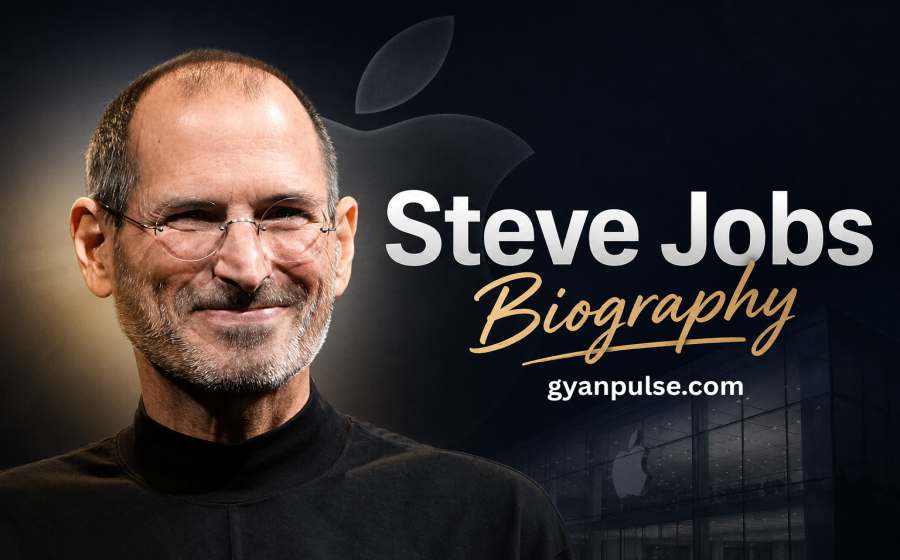
Steve Jobs Biography – The Visionary Who Revolutionized Technology and Design
Discover the inspiring life of Steve Jobs in this detailed Steve Jobs Biography, covering his early life, Apple journey, failures, comeback and lasting legacy.
Steve Jobs Biography
Steve Jobs was more than just an entrepreneur-he was a visionary who transformed the worlds of technology, design, and entertainment. From co-founding Apple in a garage to building it into one of the world’s most valuable companies, Jobs’ life story is a blend of innovation, perseverance, and an unshakeable belief in thinking differently. His journey shows how passion and bold ideas can change the world, even when the path is filled with challenges and failures.
Table of Contents
Early Life and Childhood
Steven Paul Jobs was born on February 24, 1955, in San Francisco, California. Soon after he was born, Paul and Clara Jobs adopted him. Growing up in Mountain View, located in what is now known as Silicon Valley, Jobs developed an early interest in mechanics and electronics, often spending hours tinkering with machines in the family garage. His adoptive father encouraged this curiosity, teaching him how to take apart and rebuild electronic devices.
Jobs attended Homestead High School, where he met Steve Wozniak, the brilliant engineer who would later become his partner in creating Apple. Although Jobs was intelligent, he struggled with traditional schooling. His creativity and strong personality often clashed with the rigid education system, but these early experiences shaped his unconventional thinking.
College Dropout but Lifelong Learner
Jobs began studying at Reed College in Oregon in 1972, but he dropped out after a single semester. However, he continued attending classes unofficially, choosing subjects that genuinely interested him-especially calligraphy. This class later influenced Apple’s focus on beautiful typography and elegant design, proving that no learning ever goes to waste.
After leaving college, Jobs traveled to India in search of spiritual meaning. This journey played a major role in shaping his minimalist philosophy, which would later define Apple’s simple yet powerful product designs.
The Birth of Apple
In 1976, Steve Jobs and Steve Wozniak founded Apple Computer in Jobs’ family garage. Their first product, the Apple I, gained attention among hobbyists. But it was the Apple II that truly launched the company into success, becoming one of the first mass-produced personal computers.
By age 25, Jobs was already a millionaire. Apple went public in 1980, making history in the tech world. But success came with challenges. Jobs’ intense personality and perfectionist nature led to conflicts within the company.
The Macintosh Revolution
In 1984, Apple introduced the Macintosh, the first computer designed for everyday users with a graphical user interface and a mouse. The “1984” Super Bowl commercial announcing the Mac became legendary. However, internal disagreements escalated, and in 1985, Steve Jobs was forced out of the company he co-founded.
This moment could have ended his journey-but Jobs believed setbacks are opportunities in disguise.
The Wilderness Years: NeXT and Pixar
After leaving Apple, Jobs founded NeXT, a computer company focused on education and business markets. While NeXT’s hardware wasn’t commercially successful, its software laid the foundation for the future macOS and iOS.
In 1986, Jobs purchased Pixar, a small graphics unit from Lucasfilm. Under his leadership, Pixar produced groundbreaking films like Toy Story, Finding Nemo, and The Incredibles. Pixar’s success reshaped the animation industry and later led to its acquisition by Disney.
Return to Apple and the Second Revolution
Apple’s acquisition of NeXT in 1997 marked the moment Steve Jobs rejoined the company and began a new chapter. After that, he made a return that is still considered one of the biggest turnarounds in business history. Jobs simplified the product line, focused on innovation, and introduced new products that changed the world.
Under his leadership, Apple launched a series of iconic devices:
- iMac (1998) – A colorful, user-friendly computer that revived Apple’s brand
- iPod (2001) – Revolutionized music listening
- iPhone (2007) – Transformed smartphones forever
- iPad (2010) – Created an entirely new product category
Jobs’ ability to merge technology with design, emotion, and simplicity made Apple products a global phenomenon.
Leadership Style and Philosophy
Steve Jobs was known for his demanding leadership, attention to detail, and pursuit of perfection. He believed in creating products that weren’t just functional, but delightful. His famous motto, “Stay Hungry, Stay Foolish,” reflects his belief in continuous learning and daring to dream big.
Final Years and Legacy
In 2003, Jobs was diagnosed with pancreatic cancer. Despite his illness, he continued working and presenting new innovations until stepping down as Apple’s CEO in 2011. He passed away on October 5, 2011, leaving behind a legacy that continues to influence technology, design, and entrepreneurship.
Today, Apple stands as one of the world’s most valuable companies-proof of Steve Jobs’ vision and determination.
5 Inspirational Lessons from Steve Jobs
- Think Different – True creativity emerges when you challenge what’s considered normal.
- Failures are stepping stones – Getting removed from Apple led him to create NeXT and transform Pixar.
- Stay Hungry, Stay Foolish – Never stop exploring, learning, and dreaming big.
- Design matters – Success comes from focusing on user experience, not just technology.
- Believe in your vision – Even when others doubt you, your belief can shape the future.
Steve Jobs’ Impact on Innovation and the Digital World
Steve Jobs’ influence extends far beyond the products he created. His relentless focus on innovation, simplicity, and user experience reshaped industries including personal computing, music, smartphones, and digital entertainment. By combining cutting-edge technology with elegant design, he inspired countless entrepreneurs and businesses to think differently. Even years after his passing, his vision continues to shape modern technology, making the Steve Jobs Biography a timeless story of creativity, resilience, and the power of pursuing extraordinary ideas.
Steve Jobs Net Worth
At the time of his death in 2011, Steve Jobs had an estimated net worth of around $10.2 billion. Surprisingly, most of his wealth did not come from Apple but from his majority stake in Pixar, which became immensely valuable after Disney acquired the animation studio in 2006. Although Jobs owned relatively few Apple shares, his vision and leadership helped transform the company into one of the world’s most valuable businesses, leaving behind a legacy that far exceeded his personal fortune.
Summary
The Steve Jobs Biography is the remarkable story of a visionary entrepreneur who revolutionized technology through innovation, creativity, and determination. From co-founding Apple and overcoming major setbacks to leading one of the greatest business comebacks in history, his journey continues to inspire millions worldwide. His legacy proves that bold ideas, persistence, and a passion for excellence can transform industries and leave a lasting impact on the world.
Also Check: Biography