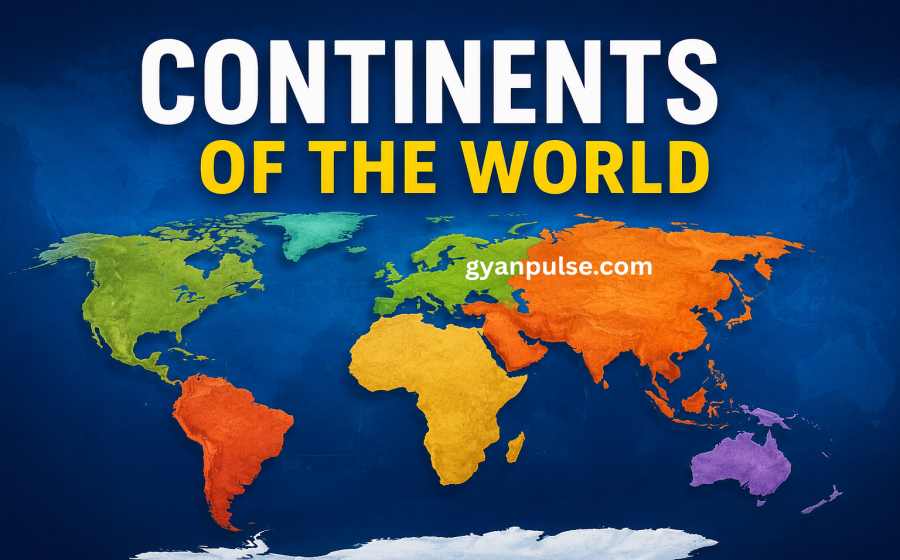
Continents of the World – Formation, Area, Population, Countries and Key Facts
Explore Continents of the World with details about their history, land area, population, countries and the key features of each continent.
Continents of the World
Earth is made up of huge land areas called continents, which together form the main surface of our planet. These continents are not just geographical regions but also represent different cultures, climates, ecosystems, and human civilizations. At present, the world is commonly divided into seven continents. Each continent differs in size, population, number of countries, natural features, and historical development.
Table of Contents
Formation of Continents
Millions of years ago, all land on Earth was joined together as a single supercontinent called Pangaea. Over time, due to the movement of tectonic plates, Pangaea broke apart into smaller landmasses. This process, known as continental drift, led to the formation of the present-day continents.
The movement of these plates continues even today, though very slowly, causing earthquakes, volcanoes, and the gradual shifting of continents.
How many Continents are there?
There are seven continents in the world:
- Asia
- Africa
- North America
- South America
- Antarctica
- Europe
- Australia
Each continent has its own unique physical and human characteristics.
List of Continents
Asia – The Largest Continent
Asia is the biggest continent on Earth and is home to the largest population in the world.
- Area: About 44.5 million sq km
- Population: Over 4.7 billion
- Number of Countries: 48
Asia is home to the world’s highest mountain Mount Everest, the longest river systems, and ancient civilizations like the Indus Valley and Mesopotamia. It contains diverse climates, from the frozen tundra of Siberia to tropical rainforests in Southeast Asia.
Africa – The Cradle of Humanity
Africa is the second-largest continent and is often called the birthplace of humankind.
- Area: About 30.3 million sq km
- Population: Around 1.4 billion
- Number of Countries: 54
Africa has vast deserts like the Sahara, long rivers such as the Nile, and rich wildlife. It is also known for its cultural diversity, with thousands of languages spoken across the continent.
North America – A Continent of Diversity
North America lies entirely in the Northern Hemisphere and includes some of the world’s most developed nations.
- Area: About 24.7 million sq km
- Population: Around 600 million
- Number of Countries: 23
It includes large countries like the United States, Canada, and Mexico. North America has varied landscapes including mountains, plains, forests, and deserts.
South America – Land of Rainforests and Rivers
South America is known for its natural beauty and rich biodiversity.
- Area: About 17.8 million sq km
- Population: Around 430 million
- Number of Countries: 12
The continent is home to the Amazon Rainforest, the world’s largest tropical rainforest, and the Amazon River, one of the longest rivers on Earth.
Antarctica – The Frozen Continent
Antarctica is the coldest, driest, and least populated continent.
- Area: About 14 million sq km
- Population: No permanent population
- Number of Countries: No countries (governed by international treaty)
It is covered almost entirely by ice and is mainly used for scientific research. Despite harsh conditions, it plays a vital role in regulating Earth’s climate.
Europe – A Continent Rich in History
Europe is known for its historical influence and cultural heritage.
- Area: About 10.2 million sq km
- Population: Around 750 million
- Number of Countries: 50
Although small in size, Europe has played a major role in world history, politics, science, and art. It has a moderate climate and a high standard of living in many countries.
Australia – The Smallest Continent
Australia is the smallest continent and is sometimes called Oceania when including nearby islands.
- Area: About 8.5 million sq km
- Population: Around 45 million (including Oceania)
- Number of Countries: 14 (in the Oceania region)
Australia is famous for its unique wildlife, such as kangaroos and koalas, and large desert areas known as the Outback.
Comparison of Continents – Quick Facts
- Largest Continent: Asia
- Smallest Continent: Australia
- Most Populous: Asia
- Least Populated: Antarctica
- Most Countries: Africa
Importance of Continents
Continents help us understand:
- Earth’s physical structure
- Distribution of population
- Climate patterns
- Natural resources
- Cultural and political divisions
They are essential for education, navigation, environmental studies, and global planning.
Why Learning About Continents is Important
Understanding the continents of the world provides a strong foundation for learning geography and global studies. Each continent has unique landforms, climates, ecosystems, cultures, and economic activities that shape life in different ways. Studying continents helps students understand the distribution of natural resources, population patterns, international boundaries, and environmental challenges. It also improves knowledge for school exams, competitive examinations, and general awareness by offering a clearer picture of how Earth’s major landmasses influence human civilization and the natural world.
Summary
The continents of the world represent the foundation of Earth’s geography. Each continent has its own identity shaped by nature, history, and human activity. From the vast lands of Asia to the icy plains of Antarctica, continents play a crucial role in shaping life on Earth. Understanding continents is not only important for students and competitive exams but also for gaining a broader perspective of our planet and its diversity.
Also Check: General Knowledge