
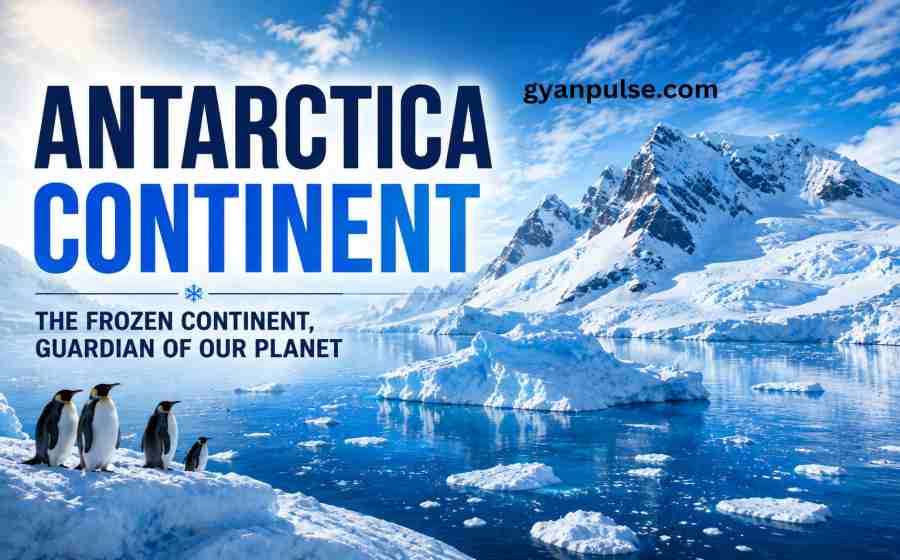
Antarctica Continent – Area, Climate and Important Facts
Explore Antarctica Continent with facts about its area, climate, wildlife, treaty system, scientific research and vital role in Earth’s climate balance.
Antarctica Continent
Antarctica is the most extreme and fascinating continent on Earth. Known as “The Frozen Continent” it lies at the southernmost part of the planet and is almost entirely covered with thick ice sheets. Antarctica is the coldest, driest, and least populated continent, making it completely different from all other continents. Unlike Asia, Africa, or Europe, Antarctica has no permanent human population and no countries. Instead, it is dedicated mainly to scientific research and environmental protection, playing a crucial role in understanding Earth’s climate and natural systems.
Table of Contents
Geographical Location and Area
Antarctica surrounds the South Pole and is located entirely in the Southern Hemisphere. It is the fifth-largest continent in the world, with an area of about 14 million square kilometers. Nearly 98% of Antarctica is covered by ice, and in some places, the ice is more than 4 kilometers thick. This massive ice cover stores around 70% of the world’s fresh water, making Antarctica extremely important for global sea levels.
Climate: The Coldest Place on Earth
Antarctica has the harshest climate on the planet. It holds the record for the lowest temperature ever recorded on Earth, which dropped below -89°C. The continent is also considered a desert because it receives very little snowfall each year. Strong icy winds, long months of darkness, and freezing temperatures make survival extremely difficult. Despite these harsh conditions, Antarctica plays a vital role in regulating Earth’s climate and ocean currents.
Population and Human Presence
Antarctica has no permanent population. However, during the summer season, around 1,000 to 5,000 scientists and researchers temporarily live in research stations. In winter, this number drops sharply due to extreme weather. These people come from different countries and stay only for research purposes. There are no native residents, cities, or villages on the continent.
Number of Countries and Governance
Antarctica does not belong to any country. Instead, it is governed by the Antarctic Treaty System, signed in 1959 by multiple nations. This treaty ensures that Antarctica is used only for peaceful purposes, especially scientific research. Military activity, nuclear testing, and mining are strictly banned. The treaty promotes international cooperation, making Antarctica a symbol of global unity.
Scientific Importance of Antarctica
Antarctica is one of the most important places on Earth for scientific research. Scientists study climate change, ice cores, marine life, space weather, and Earth’s geological history. Ice samples collected from Antarctica help researchers understand climate patterns from millions of years ago. The continent acts like a natural laboratory that helps scientists predict future environmental changes.
Flora and Fauna
Despite its extreme climate, Antarctica supports some unique forms of life. There are no trees or large plants, but mosses, algae, and lichens grow in certain coastal areas. Animal life mainly exists near the ocean and includes penguins, seals, whales, krill, and seabirds. Penguins are the most iconic animals of Antarctica and have adapted perfectly to the freezing environment.
Culture and Lifestyle
Antarctica has no traditional culture like other continents because it has no native population. However, a unique research-based culture exists among scientists working there. Life in research stations is based on teamwork, discipline, and adaptation. People from different countries live together, sharing food, ideas, and responsibilities, which promotes global cooperation and cultural exchange.
Transportation and Infrastructure
Transportation in Antarctica is limited and highly specialized. There are no roads or railways like other continents. Travel is done using snow vehicles, aircraft, and research ships. Research stations are equipped with advanced technology, satellite communication, and renewable energy systems to survive in extreme conditions.
Role of Antarctica in Earth’s Climate
Antarctica plays a crucial role in regulating global temperatures and ocean circulation. Its ice reflects sunlight back into space, helping keep the planet cool. Melting Antarctic ice can significantly affect global sea levels, making its protection essential for the future of Earth.
Interesting Facts About Antarctica
Antarctica is a continent of remarkable natural wonders and global importance. It contains nearly 90% of the world’s ice and about 70% of its fresh water, making it essential for maintaining Earth’s environmental balance. During summer, the sun can remain visible for 24 hours a day, while winter brings months of continuous darkness.
The continent has no permanent residents, no official capital, and no national government. Protected by the Antarctic Treaty System, Antarctica remains dedicated to peaceful scientific research, helping scientists better understand climate change, weather patterns, and the future of our planet.
Summary
Antarctica is not just a frozen land of ice; it is a continent of scientific importance, environmental balance, and international cooperation. With no countries, no permanent population, and no traditional culture, it stands as a symbol of peace and shared responsibility. Despite its harsh conditions, Antarctica continues to help scientists unlock the secrets of Earth’s past, present, and future. Protecting this frozen continent is essential for maintaining the health of our planet.
Also Check: General Knowledge