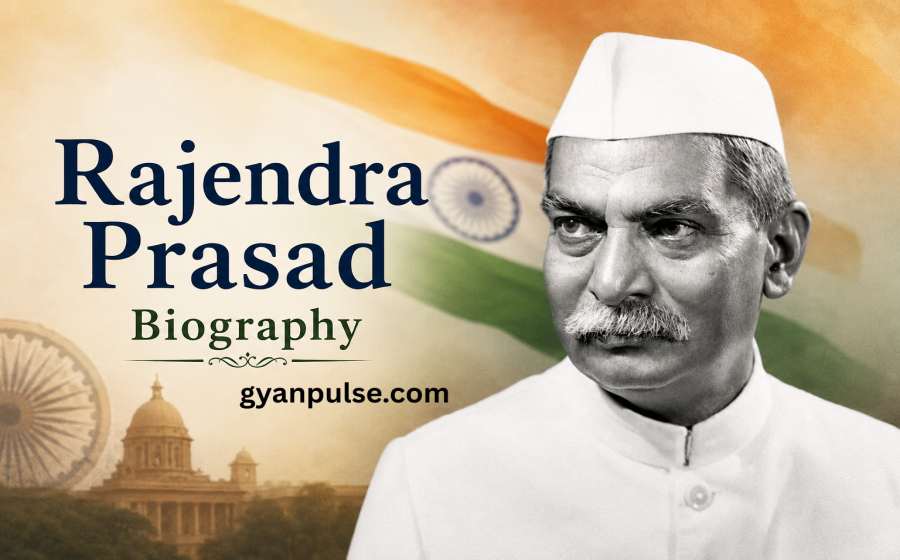
Rajendra Prasad Biography – Life, Legacy and Values of India’s First President
Rajendra Prasad Biography explores his early life, freedom struggle, role in constitution-making, presidency, achievements, values and lasting legacy.
Rajendra Prasad Biography
Dr. Rajendra Prasad was one of the most respected leaders of India’s freedom movement and the first President of independent India. Known for his simplicity, integrity, and deep commitment to democratic values, he played a crucial role in shaping modern India. His life stands as a powerful example of selfless service, moral leadership, and dedication to the nation.
Table of Contents
Early Life and Family Background
Rajendra Prasad was born on 3 December 1884 in Ziradei village, Siwan district of Bihar, into a well-educated and religious family. His father, Mahadev Sahai, was a scholar of Persian and Sanskrit, while his mother, Kamleshwar Devi, was a deeply religious woman who instilled strong moral values in him from a young age. Growing up in a traditional Indian environment, Rajendra Prasad developed qualities of discipline, humility, and respect for learning early in life.
Education and Academic Excellence
Rajendra Prasad was an exceptionally bright student. He pursued his education at the University of Calcutta, where he excelled in academics. He completed his Master’s degree in Economics, followed by a Master’s in Law, and later earned a Doctorate in Law. His academic achievements were so remarkable that examiners reportedly awarded him full marks for his answers, praising his clarity of thought and depth of knowledge. Before entering politics, he worked as a successful lawyer, earning respect for his honesty and legal expertise.
Entry into the Indian Freedom Struggle
The turning point in Rajendra Prasad’s life came when he met Mahatma Gandhi in 1917 during the Champaran Satyagraha in Bihar. Inspired by Gandhi’s ideals of truth, non-violence, and service, he left his legal career and dedicated himself entirely to the freedom movement. From that moment onward, he became one of Gandhi’s most trusted followers.
Rajendra Prasad actively participated in major national movements such as the Non-Cooperation Movement, Civil Disobedience Movement, and Quit India Movement. He was arrested several times by the British authorities and spent years in jail, where he used his time for reading, writing, and reflection. Despite hardships, he remained committed to peaceful resistance and national unity.
Role in the Constituent Assembly
After independence, Rajendra Prasad’s leadership abilities were recognized when he was elected as the President of the Constituent Assembly of India. In this role, he presided over debates that shaped the Indian Constitution, ensuring that discussions remained democratic, balanced, and respectful. His calm demeanor and impartial approach helped bring consensus on many critical issues during constitution-making.
Rajendra Prasad as India’s First President
On 26 January 1950, when India became a republic, Rajendra Prasad was elected as the first President of India. He served two consecutive terms from 1950 to 1962, becoming the longest-serving President in Indian history.
As President, he upheld constitutional values and worked closely with Prime Minister Jawaharlal Nehru while maintaining the dignity and independence of his office. He believed that the President should act as a moral guide rather than a political authority. His presidency was marked by humility, accessibility, and respect for democratic traditions.
Simple Living and Personal Values
Despite holding the highest constitutional office, Rajendra Prasad lived a simple and disciplined life. He avoided luxury, wore traditional Indian clothing, and followed a modest lifestyle. He strongly believed that leaders should remain connected to the common people. His life reflected Gandhian values of simplicity, honesty, and service.
Literary Contributions
Rajendra Prasad was also a prolific writer. His most famous work, “India Divided”, provides a thoughtful analysis of the circumstances leading to the partition of India. He also wrote extensively on Indian culture, history, and constitutional issues, contributing significantly to intellectual discourse in post-independence India.
Later Life and Death
After completing his second term as President, Rajendra Prasad retired from public life and settled at Sadaqat Ashram in Patna. He spent his final years in reflection, reading, and spiritual pursuits. Dr. Rajendra Prasad passed away on 28 February 1963, leaving behind a legacy of integrity, wisdom, and national service.
5 Life Inspirations from Rajendra Prasad
- Simplicity in Leadership – True leadership does not require luxury or show of power.
- Commitment to Values – Integrity and honesty are essential for long-term respect.
- Service Before Self – Nation-building requires personal sacrifice.
- Lifelong Learning – Education and knowledge strengthen leadership.
- Respect for Democracy – Constitutional values must be upheld above personal opinions.
Legacy and Importance in Indian History
Rajendra Prasad is remembered as a leader who combined intellectual brilliance with moral strength. His role in India’s freedom struggle, constitution-making, and early years of the republic makes him one of the most respected figures in Indian history. He set high standards for public office and proved that power and humility can coexist.
Rajendra Prasad’s Enduring Influence
Rajendra Prasad’s life continues to inspire generations through his dedication to education, public service, and democratic principles. His journey from a scholar and lawyer to a freedom fighter and India’s first President reflects the power of humility and perseverance. His commitment to constitutional values, simple living, and national unity established a lasting example of responsible leadership that remains relevant in India today.
Summary
Rajendra Prasad was a distinguished freedom fighter, scholar, and the first President of independent India. From his early education and legal career to his participation in the freedom struggle and leadership in the Constituent Assembly, he made significant contributions to the nation. His two-term presidency, simple lifestyle, honesty, and commitment to democracy made him an enduring symbol of selfless leadership and national service.
Also Check: Biography