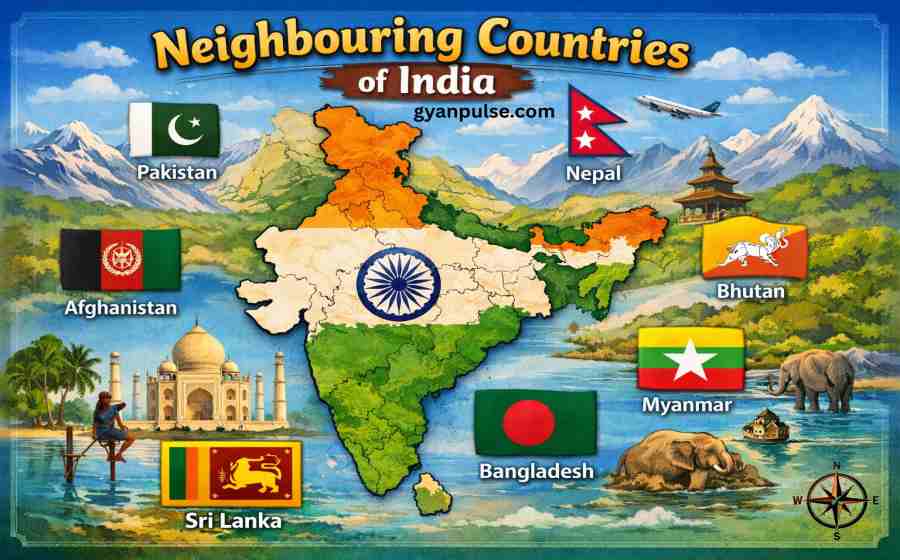
Neighbouring Countries of India and their Capitals
Learn Neighbouring Countries of India and their Capitals with key facts, border types, strategic importance, and exam-focused insights for general awareness and competitive exams.
Neighbouring Countries of India
India, located in South Asia, shares its borders with several countries, making it a strategically important nation both geographically and politically. Understanding the neighbouring countries of India and their capitals is a must-know topic for students, competitive exam aspirants (UPSC, SSC, Banking), and general awareness.
In this post, we will look at the countries that share land borders and maritime borders with India, along with important facts, maps, and capital cities.
Table of Contents
Countries Sharing Land Borders with India
India shares land boundaries with 7 countries. These countries are listed below with their capitals and some key facts:
| Country | Capital | Border Length (approx.) |
|---|---|---|
| Pakistan | Islamabad | 3,323 km |
| China | Beijing | 3,488 km |
| Nepal | Kathmandu | 1,751 km |
| Bhutan | Thimphu | 699 km |
| Bangladesh | Dhaka | 4,096 km (longest) |
| Myanmar | Naypyidaw | 1,643 km |
| Afghanistan | Kabul | 106 km (disputed, PoK) |
Countries Sharing Maritime Borders with India
India also has maritime boundaries with 2 countries:
| Country | Capital |
|---|---|
| Sri Lanka | Sri Jayawardenepura Kotte / Colombo |
| Maldives | Malé |
Total Neighbouring Countries of India: 9
| Type | Countries |
|---|---|
| Land Border | Pakistan, China, Nepal, Bhutan, Bangladesh, Myanmar, Afghanistan |
| Maritime Border | Sri Lanka, Maldives |
Key Facts and Insights:
- Longest land border shared with: Bangladesh (4,096 km)
- Smallest land border: Afghanistan (only 106 km – in Pakistan-occupied Kashmir)
- Only two countries that India shares both land and maritime ties with: Bangladesh and Myanmar
- Cultural ties: India (Bharat) has deep cultural, religious, and historical ties with neighbour Nepal, Bhutan, and Sri Lanka.
- Security relevance: Borders with China and Pakistan are of high strategic importance.
- Trade & Connectivity: India shares open borders with Nepal and Bhutan, allowing free movement of people and goods.
Summary Table – Neighbouring Countries of India
| # | Country | Capital | Border Type |
|---|---|---|---|
| 1 | Pakistan | Islamabad | Land |
| 2 | China | Beijing | Land |
| 3 | Nepal | Kathmandu | Land |
| 4 | Bhutan | Thimphu | Land |
| 5 | Bangladesh | Dhaka | Land + Maritime |
| 6 | Myanmar | Naypyidaw | Land + Maritime |
| 7 | Afghanistan | Kabul | Land (PoK area) |
| 8 | Sri Lanka | Colombo / S. J. Kotte | Maritime |
| 9 | Maldives | Malé | Maritime |
Why This is Important?
- Important because these topics are frequently asked in UPSC, SSC, Railways, Banking, and State PCS exams.
- Helps in understanding India’s foreign policy and neighborhood diplomacy.
- Supports awareness about trade, border issues, cultural connections, and international relations.
Importance of Neighbouring Countries of India
Knowing the neighbouring countries of India and their capitals is essential for understanding the nation’s geography, diplomacy, and strategic position in South Asia. These countries influence India’s security, trade routes, cultural exchange, and foreign policy decisions. For competitive exams and general awareness, this topic helps learners connect border facts with real-world issues like regional cooperation, defense preparedness, and economic development.
Strategic and Economic Significance
India’s neighbouring countries play a crucial role in shaping its strategic and economic landscape. Proximity to China and Pakistan has a direct impact on national security, requiring constant diplomatic engagement and defense preparedness.
At the same time, countries like Nepal, Bhutan, and Bangladesh are vital for regional trade, energy cooperation, and infrastructure projects such as cross-border railways, roads, and hydropower initiatives. Understanding these relationships helps in analyzing India’s foreign policy decisions and its approach toward regional stability.
Cultural and Environmental Connections
Beyond politics and trade, India shares deep cultural and environmental connections with its neighbours. Shared languages, religions, and festivals with countries like Nepal, Bhutan, and Sri Lanka highlight centuries of cultural exchange. Environmental cooperation is equally important, as rivers, forests, and wildlife corridors often cross borders, necessitating joint conservation efforts.
Awareness of these ties provides a holistic understanding of India’s position in South Asia, emphasizing that neighbouring countries are not only geopolitical partners but also part of a shared cultural and ecological heritage.
Also Check: General Knowledge