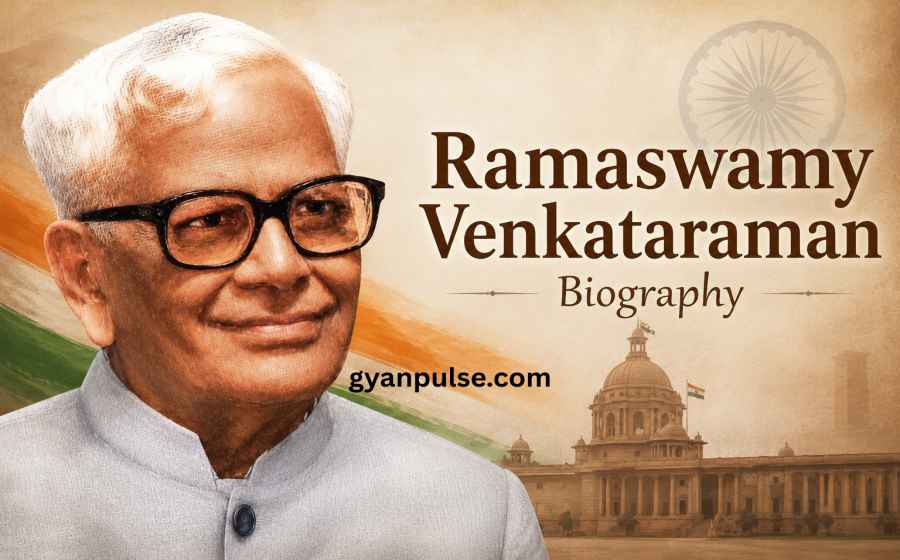
Ramaswamy Venkataraman Biography – Life, Presidency and Legacy of India’s 8th President
Ramaswamy Venkataraman Biography explores his early life, freedom struggle, political career, presidency, achievements, values and lasting legacy in India.
Ramaswamy Venkataraman Biography
Ramaswamy Venkataraman was one of India’s most respected statesmen, known for his integrity, constitutional wisdom, and lifelong dedication to public service. Serving as the 8th President of India (1987-1992), he played a crucial role during a politically sensitive phase in Indian democracy. His journey from a freedom fighter to the highest constitutional office reflects discipline, patriotism, and unwavering commitment to democratic values.
Table of Contents
Early Life and Education
Ramaswamy Venkataraman was born on 4 December 1910 in Rajamadam village, Thanjavur district, Tamil Nadu, into a traditional Brahmin family. From an early age, he displayed academic brilliance and strong moral values. He pursued his higher education in law and earned a degree in Law (LLB), which later became the foundation of his professional and political life.
Even as a young student, Venkataraman was deeply influenced by the Indian freedom movement. The ideas of Mahatma Gandhi and the struggle against British colonial rule inspired him to actively participate in nationalist activities.
Role in India’s Freedom Struggle
Ramaswamy Venkataraman joined the Indian National Congress during the freedom movement and actively participated in civil disobedience campaigns. His involvement led to imprisonment multiple times under British rule, reflecting his courage and commitment to India’s independence.
Unlike many leaders who focused only on mass movements, Venkataraman also worked behind the scenes, contributing intellectually and organizationally. His disciplined approach and legal knowledge made him a valuable asset to the Congress leadership during the freedom struggle.
Career as a Lawyer and Public Servant
After independence, Venkataraman began his professional career as a lawyer at the Madras High Court. He earned a reputation for honesty, clarity, and deep understanding of constitutional matters. His legal career further strengthened his belief in the rule of law and democratic governance.
Soon, he transitioned fully into public life, where his administrative capabilities and ethical conduct gained national recognition.
Political Career and Ministerial Roles
Ramaswamy Venkataraman served India in several important capacities before becoming President. He was elected to the Lok Sabha multiple times and held key ministerial portfolios, including:
- Minister of Finance
- Minister of Defence
- Minister of Industry
As Defence Minister, he played a vital role in strengthening India’s defence preparedness and promoting self-reliance in defence production. His tenure was marked by transparency, discipline, and strategic foresight.
Vice President of India (1984-1987)
In 1984, Venkataraman was elected as the Vice President of India, serving as the ex-officio Chairman of the Rajya Sabha. He conducted parliamentary proceedings with fairness and dignity, earning respect across party lines. His calm demeanor and constitutional expertise made him a natural choice for the presidency.
Presidency of Ramaswamy Venkataraman
Ramaswamy Venkataraman assumed office as the President of India on 25 July 1987. His presidential term coincided with a politically turbulent period marked by coalition politics, unstable governments, and constitutional challenges.
He is widely remembered for:
- Upholding the supremacy of the Constitution
- Exercising presidential discretion responsibly
- Ensuring stability during government transitions
Venkataraman strongly believed that the President should act as the guardian of the Constitution, not as a political authority. His decisions during times of political uncertainty set important precedents for future presidents.
Later Life and Death
After completing his presidential term in 1992, Ramaswamy Venkataraman retired from active public life. He spent his later years reflecting on India’s democratic journey and occasionally sharing insights on constitutional matters.
He passed away on 27 January 2009, at the age of 98. His death marked the end of an era of principled and disciplined leadership rooted in constitutional morality.
5 Key Inspirations from Ramaswamy Venkataraman’s Life
- Commitment to Constitutional Values – He proved that respect for the Constitution is the backbone of a strong democracy.
- Integrity in Public Life – His honesty and discipline set high standards for political leadership.
- Service Over Power – Despite holding powerful offices, he remained humble and duty-bound.
- Lifelong Learning – His legal knowledge and intellectual depth guided his decisions throughout life.
- Patriotism with Principle – From freedom struggle to presidency, his actions were guided by national interest.
Legacy and Significance
Ramaswamy Venkataraman’s legacy lies in his ethical leadership, constitutional discipline, and commitment to democracy. He is remembered as a President who never sought popularity but always upheld democratic institutions.
His life continues to inspire students, civil servants, lawyers, and political leaders who believe in service over power and principles over politics.
Ramaswamy Venkataraman’s Contribution to Indian Democracy
Ramaswamy Venkataraman’s life represents a remarkable blend of legal knowledge, public service, and constitutional responsibility. From participating in India’s freedom movement to serving as President, he consistently placed national interest above personal ambition. His calm leadership during periods of political uncertainty demonstrated the importance of constitutional principles, democratic institutions, and responsible decision-making. His journey remains an inspiring example for those who value integrity, discipline, and dedicated service to the nation.
Summary
Ramaswamy Venkataraman’s journey from a freedom fighter and lawyer to the President of India reflects a life devoted to democracy and public service. His contributions as a minister, Vice President, and President showcased his constitutional wisdom, integrity, and disciplined leadership. His legacy continues to inspire people through his commitment to the Constitution, national service, and democratic values.
Also Check: Biography