
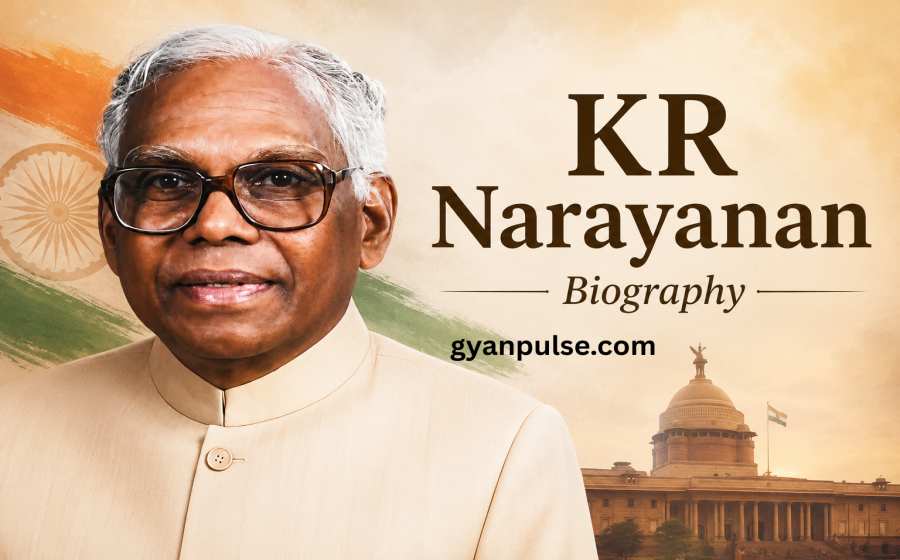
KR Narayanan Biography – The 10th President of India Who Redefined Indian Democracy
Explore KR Narayanan Biography, covering his early life, education, diplomacy, political career, presidency, achievements, values and lasting legacy in India.
KR Narayanan Biography
K. R. Narayanan was one of India’s most respected statesmen, remembered for his intellectual depth, moral courage, and unwavering commitment to constitutional values. Serving as the 10th President of India from 1997 to 2002, he became the first Dalit President of the country, symbolizing social transformation and democratic progress. His life story is a powerful example of how education, integrity, and perseverance can overcome the barriers of poverty and discrimination.
Table of Contents
Early Life and Background
Kocheril Raman Narayanan was born on 27 October 1920 in Uzhavoor, a small village in the princely state of Travancore (present-day Kerala). He was born into a poor family belonging to a socially marginalized community. Financial hardship marked his early years, and he often studied under streetlights due to the lack of electricity at home.
Despite these challenges, Narayanan showed exceptional academic brilliance. His determination to pursue education became the foundation of his extraordinary journey. His early struggles shaped his deep empathy for the underprivileged, which later reflected in his public life and policies.
Education and Academic Excellence
K. R. Narayanan completed his higher education at the University of Travancore and later received a prestigious scholarship to study in the United Kingdom. He pursued advanced studies at the London School of Economics (LSE), where he was taught by renowned political thinker Harold Laski.
During his time in London, Narayanan gained a deep understanding of democracy, political theory, and social justice. These ideas profoundly influenced his worldview and prepared him for a lifetime of public service.
Career in Diplomacy
Narayanan began his professional journey as a journalist but soon entered India’s foreign service, where he earned widespread respect. He served as India’s Ambassador to several countries, including Japan, Thailand, Turkey, and China. His diplomatic skills and intellectual clarity made him one of India’s most effective envoys abroad.
As a diplomat, he played a crucial role in strengthening India’s international relations, especially during periods of geopolitical tension. His tenure as Ambassador to China is particularly remembered for fostering mutual understanding between the two Asian nations.
Entry into Indian Politics
In 1984, K. R. Narayanan entered active politics when he was elected to the Lok Sabha. Soon after, he served as the Minister of State for Planning and Minister of State for External Affairs. His calm demeanor, sharp intellect, and ethical conduct set him apart in Indian politics.
In 1992, Narayanan was elected as the Vice President of India, becoming the first Dalit to hold the position. His role as Chairman of the Rajya Sabha was marked by fairness, dignity, and respect for parliamentary traditions.
President of India (1997-2002)
K. R. Narayanan assumed office as the President of India on 25 July 1997. His presidency is often described as a turning point in the moral authority of the office. He redefined the role of the President by actively engaging with constitutional principles rather than remaining a ceremonial figure.
Narayanan strongly believed that the President was the “guardian of the Constitution.” He used his discretionary powers with great care, especially during times of political instability. His insistence on transparency and accountability during government formation set important democratic precedents.
A President with a Conscience
One of the most remarkable aspects of Narayanan’s presidency was his willingness to question executive decisions when constitutional morality was at stake. He openly spoke against communalism, social injustice, and misuse of power. His speeches often highlighted the struggles of marginalized communities and emphasized inclusive development.
Unlike many before him, Narayanan addressed the nation on critical social issues, reinforcing the idea that democracy must serve its weakest citizens. His courage earned him the title of “People’s President.”
Personal Life and Values
K. R. Narayanan was married to Usha Narayanan, an accomplished academic and diplomat. The couple was known for their simplicity and intellectual companionship. Despite holding the highest constitutional office, Narayanan lived a life rooted in humility, discipline, and ethical values.
He was a firm believer in education as a tool for empowerment and consistently advocated for social equality throughout his life.
5 Life Inspirations from K. R. Narayanan
- Education Can Break All Barriers – His rise from poverty proves the power of learning.
- Integrity Matters in Leadership – He upheld constitutional values above political pressure.
- Humility Is True Strength – Despite his position, he lived simply and thoughtfully.
- Speak for the Marginalized – He used his voice to highlight social injustice.
- Democracy Needs Moral Courage – He showed that leadership requires conscience, not silence.
Death and Legacy
K. R. Narayanan passed away on 9 November 2005 in New Delhi. His death marked the end of an era of principled leadership. However, his legacy continues to inspire millions across India.
He remains a symbol of hope for those who believe that democracy can uplift the marginalized. His life is taught, discussed, and remembered as a benchmark of constitutional morality and ethical governance.
K. R. Narayanan’s Enduring Influence
K. R. Narayanan’s life remains a powerful example of how determination, education, and ethical leadership can transform an individual’s journey and inspire an entire nation. His rise from humble beginnings to the highest constitutional office reflected India’s democratic potential. Through his commitment to equality, constitutional principles, and the dignity of marginalized communities, Narayanan left a lasting legacy that continues to encourage citizens to value justice, education, and responsible leadership.
Summary
K. R. Narayanan’s life story reflects the power of education, perseverance, and principled leadership. From humble beginnings to becoming India’s 10th President, he demonstrated a strong commitment to democracy, equality, constitutional values, and social justice. His journey continues to inspire people to overcome challenges, uphold integrity, and work toward a more inclusive and responsible society.
Also Check: Biography