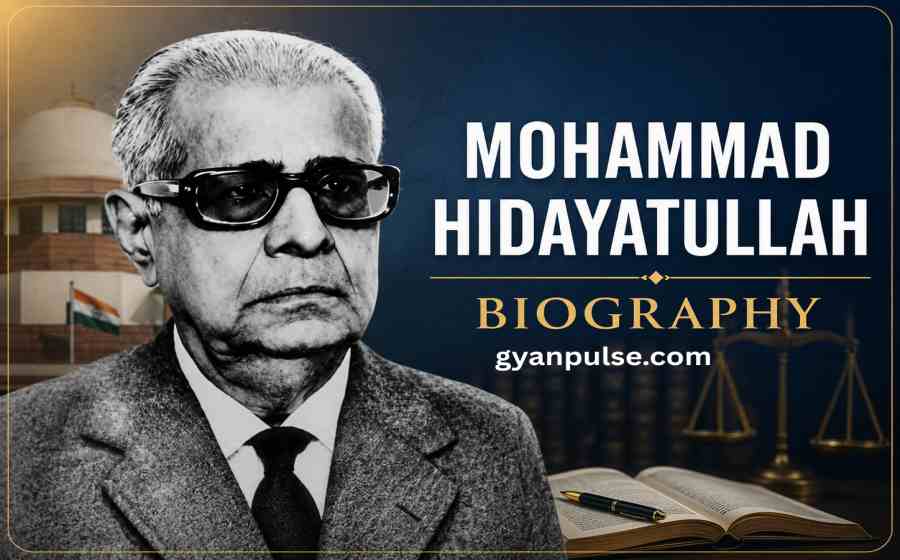
Mohammad Hidayatullah Biography – Life, Career and Legacy of 6th Vice President of India
Mohammad Hidayatullah Biography: Explore his journey as Chief Justice, Vice President, Acting President, jurist, scholar and his lasting legal legacy.
Mohammad Hidayatullah Biography
Mohammad Hidayatullah was one of the most respected jurists and constitutional experts in Indian history. Known for his integrity, sharp intellect, and deep commitment to justice, he played a crucial role in shaping India’s legal and democratic institutions. His life stands as a powerful example of how knowledge, discipline, and moral values can guide a nation toward fairness and constitutional stability.
Table of Contents
Early Life and Education
Mohammad Hidayatullah was born on 17 December 1905 in Lucknow, then part of British India. He belonged to an educated family that valued learning and public service. His father was a well-known lawyer, which greatly influenced Hidayatullah’s interest in law and governance from an early age.
He received his early education in India and later pursued higher studies in the United Kingdom. He studied at St. John’s College, Cambridge, where he excelled academically. He also qualified as a barrister at law from Lincoln’s Inn, London. His exposure to international legal systems helped him develop a broad and balanced understanding of constitutional law, which later benefited India immensely.
Early Legal Career
After returning to India, Mohammad Hidayatullah began practicing law at the Nagpur High Court. His legal arguments were known for their clarity, logic, and deep understanding of constitutional principles. Over time, he earned a reputation as a thoughtful and fair-minded advocate.
In 1942, he was appointed as a judge of the Nagpur High Court, marking the beginning of a remarkable judicial career. His judgments reflected impartiality and a strong commitment to justice, regardless of political or social pressure.
Rise in the Indian Judiciary
Mohammad Hidayatullah’s abilities did not go unnoticed. In 1958, he became the Chief Justice of the Madhya Pradesh High Court. His leadership strengthened judicial discipline and efficiency within the court.
In 1962, Mohammad Hidayatullah was elevated to the Supreme Court of India as a judge, marking a major milestone in his distinguished judicial career. His tenure in the Supreme Court was marked by landmark judgments that helped interpret and protect the Indian Constitution. He believed that the Constitution was a living document and must be interpreted in a way that served justice and democratic values.
Chief Justice of India
In 1970, Mohammad Hidayatullah made history by becoming the Chief Justice of India, also becoming the first Muslim Chief Justice of the country. His time as Chief Justice was characterized by independence, transparency, and respect for constitutional morality.
He firmly believed that the judiciary must remain free from political influence. Under his leadership, the Supreme Court upheld the rule of law and reinforced public trust in the judicial system.
Role as Acting President of India
Mohammad Hidayatullah holds the rare distinction of serving as the Acting President of India twice—first in 1969 and again in 1974. These appointments came during periods of political transition, and his calm, constitutional approach ensured stability in governance.
His role as Acting President demonstrated his deep understanding of constitutional responsibilities and his ability to rise above political divisions.
Vice President of India
In 1979, Mohammad Hidayatullah was elected as the Vice President of India, a position he held until 1984. As Vice President and Chairman of the Rajya Sabha, he conducted parliamentary proceedings with dignity, fairness, and strict adherence to democratic norms.
Members across political parties admired his neutrality and command over constitutional procedures.
Scholar, Author and Thinker
Apart from his public roles, Mohammad Hidayatullah was also a respected scholar. He authored several books on constitutional law, Islamic law, and legal philosophy. His writings continue to guide students, lawyers, and judges across India.
Even after retiring from public office, he remained active in academic discussions and legal education, emphasizing ethical conduct and responsibility in public life.
5 Inspirations from Mohammad Hidayatullah’s Life
- Integrity Above All – He showed that honesty and moral courage are the strongest foundations of leadership.
- Power of Education – His global education shaped his vision and helped him serve India effectively.
- Respect for the Constitution – He treated the Constitution as a guiding force, not a political tool.
- Calm Leadership in Crisis – His role as Acting President proved the value of patience and balance.
- Lifelong Learning – Even after retirement, he continued to teach, write, and inspire future generations.
Death and Legacy
Mohammad Hidayatullah passed away on 18 September 1992, leaving behind a legacy of integrity, scholarship, and constitutional wisdom. He is remembered as a man who served India with honesty and intellectual depth at every stage of his career.
His life proves that true leadership lies not in power, but in fairness, discipline, and unwavering commitment to justice.
Mohammad Hidayatullah’s Enduring Legacy
Mohammad Hidayatullah’s remarkable life continues to inspire generations of students, lawyers, judges, and public servants. His journey from a distinguished legal scholar to Chief Justice, Vice President, and Acting President reflects his exceptional dedication to constitutional values. His emphasis on integrity, impartiality, education, and justice made him a respected national figure whose contributions remain significant in India’s democratic and legal history.
Summary
Mohammad Hidayatullah was a distinguished Indian jurist, constitutional expert, and statesman who served as Chief Justice of India, Acting President, and Vice President. His career reflected integrity, wisdom, and dedication to constitutional principles. Through his judicial service, scholarship, and public leadership, he left a lasting legacy of justice, fairness, discipline, and respect for democratic institutions.
Also Check: Biography