Renewable and Non Renewable Resources – Understanding Nature’s Power and Its Limits
Learn Renewable and Non Renewable Resources, their types, examples, differences, advantages, importance and role in building a sustainable future.
Renewable and Non Renewable Resources
Natural resources are the backbone of human life. Everything we use in our daily lives, food, water, electricity, fuel, and even the materials used to build our homes, comes from nature. These resources are broadly classified into renewable and non-renewable resources based on their availability and ability to replenish over time. Understanding this classification is essential in today’s world, where environmental protection and sustainable development have become global priorities.
Table of Contents
What are Renewable Resources?
Renewable resources are natural resources that can be restored by nature in a short time and used again and again. They are not exhausted easily and can be used repeatedly if managed properly. These resources depend largely on natural cycles such as sunlight, wind patterns, rainfall, and biological growth.
Examples of Renewable Resources
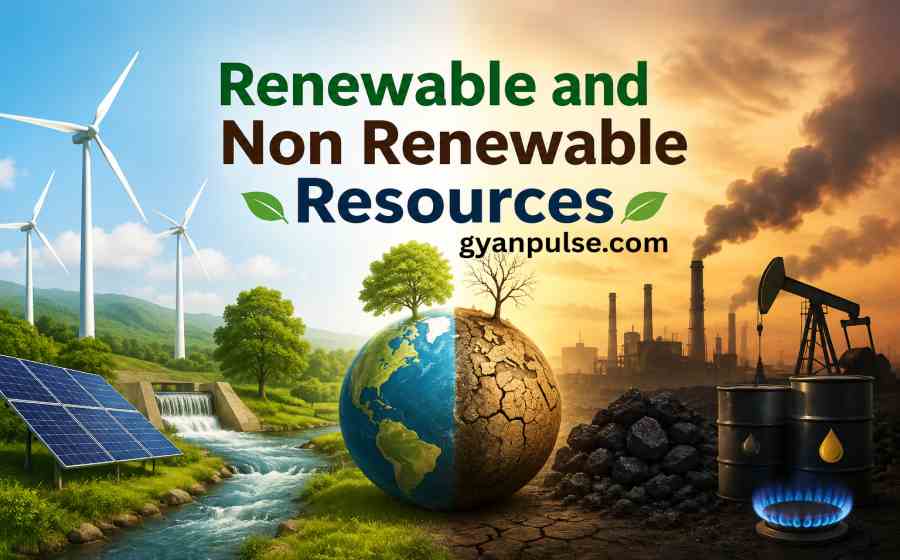
- Solar Energy – Energy obtained from sunlight, used for electricity and heating.
- Wind Energy – Power generated through wind turbines.
- Water (Hydropower) – Energy produced from flowing or falling water.
- Biomass – Organic matter like wood, agricultural waste, and animal dung.
- Forests – Trees and plants that can regrow when conserved properly.
Advantages of Renewable Resources
- They are environment-friendly and produce little to no pollution.
- They help reduce greenhouse gas emissions.
- They are sustainable for long-term use.
- They decrease dependency on fossil fuels.
- They support energy security and rural development.
However, renewable resources are not completely free from limitations. For example, solar energy depends on sunlight availability, and wind energy requires suitable wind conditions. Despite this, advancements in technology are rapidly improving their efficiency and accessibility.
What are Non Renewable Resources?
Non-renewable resources are natural resources that exist in limited quantities and take millions of years to form. Once they are used up, they cannot be replaced within a person’s lifetime. Excessive use of these resources leads to depletion, making them a serious concern for future generations.
Examples of Non Renewable Resources
- Coal – Widely used for electricity generation.
- Petroleum (Oil) – Used as fuel and in manufacturing plastics.
- Natural Gas – Used for cooking, heating, and power generation.
- Minerals – Iron, copper, gold, and other metals.
- Nuclear Fuels – Uranium is used as fuel in nuclear power plants.
Advantages of Non Renewable Resources
- They provide high energy output.
- They are easy to store and transport.
- They support industrial growth and economic development.
- Existing infrastructure is well developed.
Despite their benefits, non-renewable resources have major drawbacks. Their extraction and use cause air, water, and soil pollution, contribute significantly to climate change, and disturb natural ecosystems.
Key Differences Between Renewable and Non Renewable Resources
| Aspect | Renewable Resources | Non-Renewable Resources |
|---|---|---|
| Availability | Naturally replenished | Limited and exhaustible |
| Time to Renew | Short period | Millions of years |
| Environmental Impact | Low pollution | High pollution |
| Sustainability | Sustainable | Unsustainable |
| Examples | Solar, wind, water | Coal, oil, gas |
Importance of Renewable Resources in the Modern World
With the increasing global population and rising energy demands, reliance on non-renewable resources is proving unsustainable. Renewable resources play a vital role in addressing environmental challenges such as global warming, climate change, and resource depletion.
Governments across the world are promoting renewable energy through policies, subsidies, and international agreements. In countries like India, initiatives such as solar parks, wind farms, and bioenergy projects are transforming the energy sector while creating employment opportunities.
Conservation of Non Renewable Resources
Although non-renewable resources cannot be replaced, they can be used wisely and conserved. Conservation methods include:
- Reducing unnecessary consumption
- Recycling metals and minerals
- Improving energy efficiency
- Using alternative renewable sources
- Adopting sustainable industrial practices
Responsible use ensures that these resources last longer and remain available for essential needs.
Role of Individuals in Resource Management
Every person has a responsibility to help protect and conserve natural resources. Simple actions such as switching off unused lights, using public transport, conserving water, and supporting renewable energy can make a significant difference. Awareness and education are key to building a society that respects nature and understands the limits of Earth’s resources.
Why Understanding Natural Resources Matters
Understanding renewable and non-renewable resources is essential for making responsible choices about energy and the environment. As natural resources face increasing pressure from population growth, industrialization, and changing lifestyles, sustainable management has become more important than ever. Choosing cleaner alternatives, reducing unnecessary consumption, recycling materials, and conserving limited resources can help protect ecosystems and support future generations. A balanced approach to resource use can contribute to economic development while maintaining a healthier and more sustainable planet.
Summary
Renewable and non-renewable resources are equally important, but their availability and impact on the environment differ greatly. While non-renewable resources have fueled human progress for centuries, their excessive use has led to environmental degradation and resource scarcity. Renewable resources offer a cleaner, safer, and more sustainable alternative for the future.
To ensure a healthy planet for coming generations, it is essential to balance development with conservation, shift toward renewable energy, and use non-renewable resources responsibly. The choices we make today will shape the environmental health of tomorrow.
Also Check: Environment