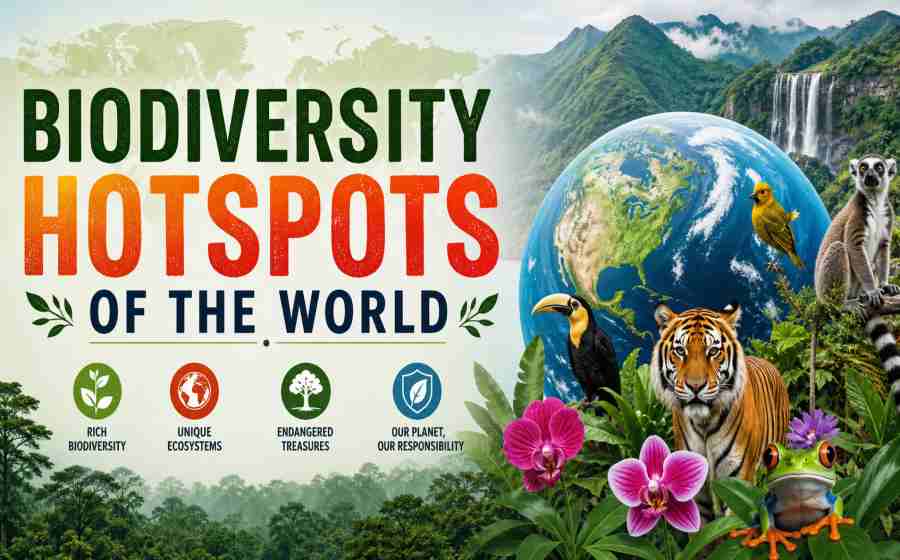
Biodiversity Hotspots of the World – Earth’s Most Valuable and Threatened Ecosystems
Explore biodiversity hotspots of the world, regions rich in unique species but under threat. Learn their importance, locations and conservation needs.
Biodiversity Hotspots of the World
Biodiversity hotspots are among the most biologically rich yet critically endangered regions on Earth. These areas are home to an extraordinary variety of plant and animal species, many of which are found nowhere else. At the same time, they face severe threats from human activities such as deforestation, urbanization, and climate change. The concept of biodiversity hotspots was introduced by ecologist Norman Myers in 1988 to prioritize global conservation efforts.
To qualify as a biodiversity hotspot, a region must meet two strict criteria: it must contain at least 1,500 species of vascular plants that are endemic (found nowhere else), and it must have lost at least 70% of its original natural vegetation. Today, there are 36 recognized biodiversity hotspots worldwide, covering only about 2.4% of Earth’s land surface but supporting more than half of the world’s plant species and nearly 43% of bird, mammal, reptile, and amphibian species.
Table of Contents
Why Biodiversity Hotspots Matter
Biodiversity hotspots are essential for maintaining ecological balance. They provide vital ecosystem services such as pollination, climate regulation, water purification, and soil fertility. These regions also support millions of people who depend on them for food, medicine, and livelihoods.
Moreover, hotspots act as natural laboratories for scientific research. Many life-saving medicines have been derived from plants found in these areas. Losing these ecosystems means losing potential cures, genetic diversity, and ecological stability.
Major Biodiversity Hotspots Around the World
1. Tropical Andes
The Tropical Andes is the richest biodiversity hotspot on Earth. Stretching across countries like Colombia, Peru, and Ecuador, it hosts thousands of plant and animal species, many of which are endemic. However, deforestation and mining activities pose serious threats.
2. Western Ghats and Sri Lanka
The Western Ghats along with Sri Lanka form one of the most important hotspots in Asia. This region is known for its rich flora, amphibians, and unique wildlife like the lion-tailed macaque. Rapid urbanization and agriculture are key challenges here.
3. Indo-Burma
The Indo-Burma region includes parts of India, Myanmar, Thailand, and Vietnam. It is home to rare species like the saola and Irrawaddy dolphin. Habitat loss and illegal wildlife trade are major concerns.
4. Madagascar and the Indian Ocean Islands
The island of Madagascar is famous for its unique wildlife, including lemurs and baobab trees. Over 90% of its wildlife is endemic. Unfortunately, slash-and-burn agriculture and deforestation have significantly reduced its natural habitats.
5. Amazon Rainforest
The Amazon Rainforest is often called the “lungs of the Earth.” It spans multiple countries including Brazil. It contains unmatched biodiversity but is under threat due to logging, agriculture, and climate change.
6. Cape Floristic Region
Located in South Africa, the Cape Floristic Region is the smallest yet one of the richest hotspots. It is known for its incredible plant diversity, especially fynbos vegetation.
Threats to Biodiversity Hotspots
Despite their importance, biodiversity hotspots are under constant threat. The primary causes include:
- Deforestation: Forests are cleared for agriculture, logging, and development.
- Climate Change: Alters habitats and affects species survival.
- Pollution: Harms ecosystems and wildlife.
- Overexploitation: Unsustainable hunting, fishing, and resource use.
- Urban Expansion: Leads to habitat fragmentation and loss.
These threats not only endanger wildlife but also disrupt ecological balance, affecting human life.
Conservation Efforts
Global and local initiatives are working to protect biodiversity hotspots. Organizations like Conservation International and World Wildlife Fund play a major role in conservation.
Efforts include:
- Establishing protected areas such as national parks and wildlife sanctuaries
- Promoting sustainable development practices
- Encouraging community participation in conservation
- Enforcing laws against illegal activities like poaching
Governments and individuals must work together to ensure these ecosystems are preserved for future generations.
Summary
Biodiversity hotspots are treasures of our planet, holding immense ecological, economic, and scientific value. Despite occupying a small portion of Earth’s surface, they support a vast array of life forms. However, their survival is at risk due to increasing human pressures.
Protecting these hotspots is not just about saving plants and animals, it is about securing the future of humanity. Sustainable practices, awareness, and strong conservation policies are essential to safeguard these irreplaceable ecosystems. The responsibility lies with all of us to act before it is too late.
Also Check: Environment