
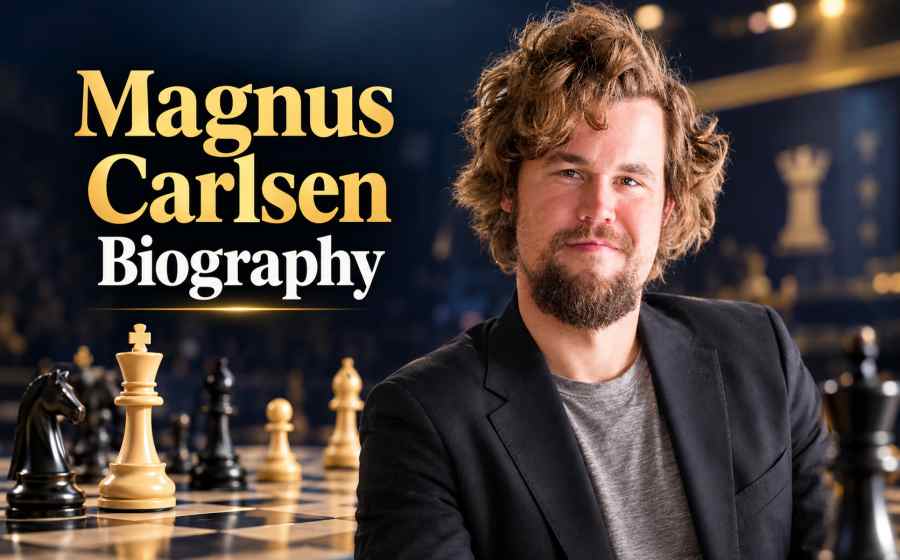
Magnus Carlsen Biography – The Genius Who Conquered the World of Chess
Discover Magnus Carlsen biography, early life, chess career, world titles, achievements and 5 inspiring lessons from the legendary Norwegian chess grandmaster.
Magnus Carlsen Biography
Magnus Carlsen is one of the most celebrated chess players in history. Known for his exceptional strategic thinking, remarkable memory, patience and ability to find winning opportunities in difficult positions, he has transformed the modern chess world. Born in Norway, Carlsen became a chess prodigy at a young age and rose to the highest level of international competition through talent, discipline and years of dedicated practice.
He became the World Chess Champion in 2013 and successfully defended his classical world title four times before deciding not to defend it again in 2023. His achievements in classical, rapid and blitz chess have established him as one of the most versatile players of his generation. In 2026, he added another major milestone by winning the inaugural FIDE-recognised Freestyle Chess World Championship.
His journey offers valuable lessons about hard work, confidence, adaptability and the importance of continuously improving one’s skills.
Table of Contents
Magnus Carlsen Quick Facts
| Detail | Information |
|---|---|
| Full Name | Sven Magnus Øen Carlsen |
| Date of Birth | November 30, 1990 |
| Age | 35 years (as of October 2026) |
| Birthplace | Tønsberg, Norway |
| Nationality | Norwegian |
| Profession | Professional chess player |
| Title | Grandmaster |
| Famous For | World chess titles and exceptional chess skills |
| Peak FIDE Rating | 2882 |
| Classical World Champion | 2013–2023 |
| Major Achievement | Multiple world titles across chess formats |
Early Life and Family Background
Magnus Carlsen was born on November 30, 1990, in Tønsberg, Norway. He grew up in a family that encouraged learning, curiosity and intellectual development. His father, Henrik Carlsen, played an important role in introducing him to chess, while his family supported his growing interest in the game.
From an early age, Magnus demonstrated a strong ability to remember information and solve complex problems. He enjoyed activities that challenged his mind and showed an unusual interest in understanding patterns and details.
His interest in chess developed when he was around five years old. Although he did not immediately become deeply interested in competitive chess, he gradually began to enjoy the strategic challenges the game presented. As his skills improved, he started playing more seriously and competing against stronger opponents.
His early development showed that natural ability can be valuable, but it needs practice, patience and the right environment to reach its full potential.
Education and Interest in Chess
Alongside his chess development, Carlsen continued his education and learned through experiences beyond the classroom. His family travelled for chess tournaments, giving him opportunities to compete against players from different countries and learn from a variety of playing styles.
As his chess career progressed, competitive opportunities increasingly shaped his daily routine. Training, tournament preparation and studying previous games became important parts of his development.
Carlsen’s progress was not simply about memorising opening moves. He developed a deep understanding of positions, pawn structures, endgames and the decisions that make a seemingly equal game difficult for an opponent.
His ability to learn from practical experience helped him grow into a player who could compete successfully in many different types of positions.
Beginning of Magnus Carlsen’s Chess Career
Carlsen began attracting attention as a young chess talent in Norway. His early tournament performances demonstrated that he could challenge experienced players despite his age.
A major milestone came in 2004, when he earned the International Master title and made a strong impression at international events. Later that year, he achieved the grandmaster title at just 13 years old, placing him among the youngest grandmasters in chess history.
Becoming a grandmaster requires outstanding competitive results and a high level of chess understanding. For Carlsen, the achievement marked the beginning of a career that would eventually take him to the top of the world rankings.
He continued to participate in major tournaments, gaining experience against elite grandmasters. Each competition presented new challenges and helped him improve his calculation, positional understanding and decision-making.
Rise to the Top of the Chess World
Carlsen’s rise continued throughout his teenage years. He competed against leading players and gradually established himself as one of the strongest young talents in international chess.
In 2009, he won the World Blitz Championship, demonstrating his ability to make strong decisions under severe time pressure. In January 2010, at the age of 19, he became the youngest player at that time to reach the top of the FIDE world rankings.
These achievements showed that his abilities extended beyond traditional, long-format games. He could adapt to different time controls while maintaining an exceptional level of competitive performance.
Carlsen’s playing style was particularly difficult for opponents because he could create problems even in positions that appeared equal. Rather than relying exclusively on spectacular attacks, he often applied steady pressure, improved his pieces and waited for small inaccuracies.
This practical approach became one of the defining features of his chess career.
Magnus Carlsen Becomes World Chess Champion
The defining moment in Carlsen’s early career arrived in 2013, when he challenged India’s Viswanathan Anand for the World Chess Championship.
The championship match took place in Chennai, India. Carlsen played with confidence and consistency, defeating the defending champion by a score of 6½–3½. At just 22 years old, he became the World Chess Champion.
His victory established him as the leading figure in classical chess and brought international attention to his talent.
Carlsen successfully defended his title in 2014 against Anand, in 2016 against Sergey Karjakin, in 2018 against Fabiano Caruana, and in 2021 against Ian Nepomniachtchi. His 2021 victory was especially dominant, ending with a score of 7½–3½.
After five successful classical world championship victories, Carlsen announced that he would not defend his title in the next championship cycle. He remained an elite competitor, however, continuing to participate in major tournaments and pursue titles in other formats.
Playing Style and Unique Chess Skills
Magnus Carlsen’s success comes from a combination of technical knowledge, practical judgement and psychological resilience.
His most important chess strengths include:
- Endgame mastery: He can turn small positional advantages into winning opportunities, even when only a few pieces remain.
- Positional understanding: He often recognises improvements that other players may overlook.
- Calculation: He evaluates possible moves and anticipates opponents’ responses.
- Adaptability: He is comfortable playing different openings and adjusting to unfamiliar positions.
- Mental toughness: He can remain focused during long games and recover from difficult situations.
One of Carlsen’s most remarkable qualities is his ability to keep a game competitive when opponents expect an easy draw. He frequently tests their patience by making the position uncomfortable and requiring accurate decisions over many moves.
His style demonstrates that success does not always require a dramatic breakthrough. Sometimes, careful planning and consistent pressure are enough to create a decisive advantage.
Major Achievements and Awards of Magnus Carlsen
Carlsen’s career is remarkable for the range of formats in which he has achieved success. His major accomplishments include the following:
- Five-time Classical World Chess Champion: He won the world championship in 2013, 2014, 2016, 2018 and 2021.
- Highest-ever FIDE rating: He reached a peak classical rating of 2882 in 2019, a record in the rating system’s history.
- World Rapid Chess Champion: He has won multiple world rapid championships, demonstrating his ability to combine speed with accuracy.
- World Blitz Chess Champion: His success in blitz chess highlights his quick thinking and tactical awareness.
- FIDE World Cup winner: He won the FIDE World Cup in 2023.
- Freestyle Chess World Champion: In February 2026, he defeated Fabiano Caruana 2.5–1.5 in the inaugural FIDE-recognised Freestyle Chess World Championship.
These achievements demonstrate his ability to remain competitive across different chess formats and changing generations of opponents.
Magnus Carlsen’s Record-Breaking Rating
In May 2014, Carlsen reached a rating of 2882, setting the highest peak classical FIDE rating ever recorded. This rating reflected his outstanding results against the world’s strongest players.
A FIDE rating is a numerical measure of a chess player’s competitive strength. It changes according to tournament results and the ratings of opponents. Reaching such a high level requires not only winning games but also consistently performing well against elite competition.
Carlsen’s record reflects years of preparation, practical experience and exceptional decision-making. His long period at the top of the world rankings further strengthened his reputation as one of chess’s greatest modern players.
Life Beyond the Chessboard
Although chess remains central to his public identity, Carlsen has also explored business and technology. He has supported ventures designed to make chess more accessible, entertaining and engaging for a wider audience.
Online chess platforms, streaming, digital tournaments and social media have helped introduce the game to people who may never have followed traditional chess championships.
Carlsen’s involvement in this changing chess landscape has helped connect the traditional competitive game with a younger, digitally connected audience.
He is also recognised for his competitive personality and strong self-belief. His approach to chess combines careful preparation with a willingness to trust his judgement when a position becomes complicated.
His career shows that professional excellence can extend beyond competition into innovation, communication and the development of new opportunities for a sport.
Personal Life of Magnus Carlsen
Magnus Carlsen generally keeps his private life separate from his professional career. He is best known publicly for his achievements in chess, his competitive mindset and his influence on the modern game.
Despite international recognition, his professional journey continues to revolve around preparation, tournaments and the challenge of competing against the world’s best players.
His story also illustrates the importance of maintaining interests beyond a single area of achievement. Carlsen’s activities outside classical chess show how expertise can create opportunities in business, technology and sports promotion.
5 Inspirational Lessons to Learn from Magnus Carlsen
1. Start Early and Keep Learning
Carlsen developed his chess abilities from childhood, but his success also required years of learning and practice. His journey reminds us that starting with an interest and developing it consistently can lead to remarkable progress.
2. Patience Can Lead to Success
Not every problem has an immediate solution. Carlsen’s playing style shows the value of remaining patient, examining possibilities carefully and waiting for the right opportunity.
3. Learn from Every Challenge
Difficult opponents and complicated positions provide opportunities to improve. Instead of treating every setback as a failure, use it to identify weaknesses and develop better strategies.
4. Consistency Matters More Than Short Bursts of Effort
Reaching an elite level requires sustained commitment. Regular practice, thoughtful preparation and the willingness to keep improving are valuable habits in education, sports and professional life.
5. Adapt to Change
Carlsen has competed successfully in classical, rapid, blitz and freestyle chess. His career demonstrates the value of adapting to new challenges rather than relying entirely on past achievements.
Summary
Magnus Carlsen’s biography is the story of a young Norwegian chess enthusiast who developed into one of the most successful players in the history of the game. From earning the grandmaster title at 13 to becoming world champion and winning the inaugural FIDE-recognised Freestyle Chess World Championship in 2026, his career reflects extraordinary skill, dedication and adaptability.
His achievements extend beyond trophies and records. He has helped bring chess to a wider international audience and demonstrated the importance of patience, strategic thinking and continuous learning.
Also Check: Biography