
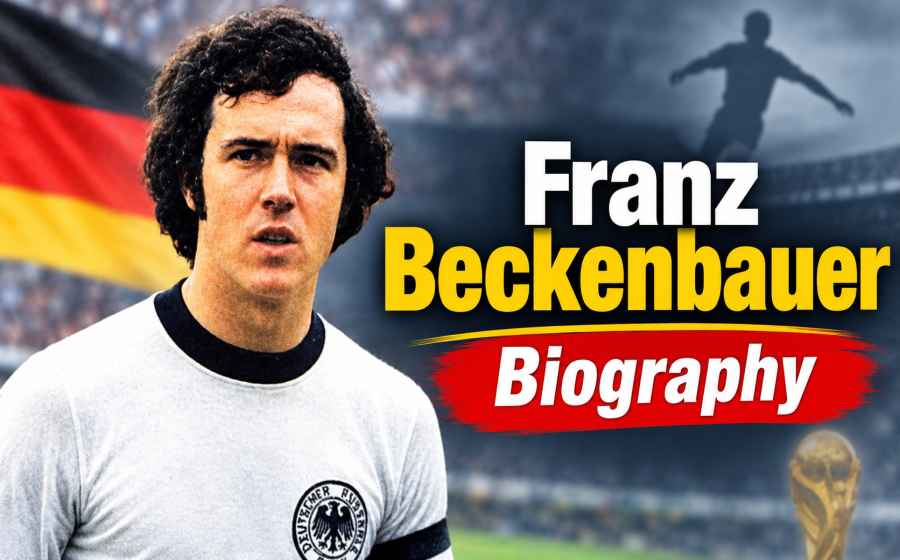
Franz Beckenbauer Biography – The Kaiser Who Revolutionized Football
Franz Beckenbauer Biography: Discover the legendary German footballer, World Cup-winning captain and coach, career achievements, legacy and inspirations.
Franz Beckenbauer Biography
Franz Beckenbauer was one of the greatest football personalities in history. Known worldwide as “Der Kaiser,” meaning “The Emperor,” he was a legendary German footballer, successful manager, and influential sports administrator. His remarkable talent, leadership, elegant playing style, and tactical intelligence made him a symbol of excellence in international football.
Beckenbauer achieved something extraordinary by winning the FIFA World Cup as both a player and a manager. He captained West Germany to victory in 1974 and later guided the national team to another World Cup triumph in 1990. His contributions helped transform modern football, particularly the role of the defender.
Table of Contents
Early Life and Childhood
Franz Anton Beckenbauer was born on September 11, 1945, in Munich, Germany, shortly after the end of World War II. He grew up in the Giesing district of Munich in a modest family environment. His father, Franz Beckenbauer Sr., worked as a postal employee. During his childhood, Germany was recovering from the destruction caused by the war, and opportunities were limited for many families. Despite these difficulties, Beckenbauer developed a strong passion for football. He spent much of his free time playing the game and gradually discovered his natural ability.
At first, he dreamed of joining TSV 1860 Munich, but an incident involving a player from the club changed his decision. In 1958, he joined the youth system of FC Bayern Munich instead. This decision became one of the most important turning points in his life. Bayern Munich eventually became the club most closely associated with his legendary career.
Beginning of His Football Career
Beckenbauer joined Bayern Munich’s senior team in 1964. At that time, Bayern was not yet the dominant force in European football that it would later become. Initially, he played as a winger before developing into a defensive midfielder and eventually a sweeper. His talent quickly became noticeable. He possessed excellent ball control, intelligent passing, remarkable vision, and the confidence to move forward from defensive positions.
In 1965, Bayern Munich secured promotion to the Bundesliga, Germany’s top football division. Beckenbauer played an important role in the club’s development. His performances helped Bayern establish itself as one of Germany’s strongest teams.
Rise to Football Stardom
During the late 1960s and early 1970s, Beckenbauer became one of the most influential players in world football. His playing style was different from traditional defenders. Rather than simply stopping opponents, he controlled the game from the back, organized the defence, and started attacking moves with accurate passes.
He helped Bayern Munich win several important trophies, including the Bundesliga and German Cup. His exceptional leadership and elegant performances earned him international recognition. Beckenbauer also received the prestigious Ballon d’Or in 1972 and 1976, becoming one of the few defenders to win football’s most famous individual award twice. His achievements established him among the greatest players of his generation.
International Career and World Cup Success
Beckenbauer made his senior international debut for West Germany in 1965. He represented his country in several major tournaments and became an essential part of the national team.
1966 FIFA World Cup
At the 1966 World Cup in England, Beckenbauer immediately attracted international attention. West Germany reached the final against England. Although Germany lost 4–2 after extra time, Beckenbauer’s performances demonstrated his extraordinary potential. The tournament helped establish him as one of football’s rising stars.
1970 FIFA World Cup
The 1970 World Cup in Mexico became another memorable chapter in his career. West Germany reached the semifinals against Italy in a dramatic match known as the Game of the Century.
Beckenbauer suffered a shoulder injury but continued playing with his arm supported. Although West Germany eventually lost 4–3 after extra time, his determination and courage became unforgettable.
1972 UEFA European Championship
In 1972, Beckenbauer captained West Germany to victory at the UEFA European Championship in Belgium. Germany defeated the Soviet Union 3–0 in the final, demonstrating outstanding teamwork and technical quality. The victory confirmed West Germany as one of Europe’s strongest football nations.
1974 FIFA World Cup
The greatest moment of Beckenbauer’s playing career came at the 1974 FIFA World Cup, hosted by West Germany. As captain, he led his team through a challenging tournament. West Germany reached the final against the Netherlands, who had impressed the world with their attacking football.
Despite falling behind early, West Germany recovered and won the match 2–1. Beckenbauer lifted the World Cup trophy, becoming a national hero. His leadership, composure, and tactical understanding played a significant role in the team’s success.
Legendary Career at Bayern Munich
Beckenbauer’s career at Bayern Munich was filled with remarkable achievements. He helped the club win four Bundesliga titles and four German Cups during his playing career. One of his greatest accomplishments was leading Bayern to three consecutive European Cup victories from 1974 to 1976.
These victories established Bayern Munich as a major European football powerhouse. Beckenbauer’s influence extended beyond trophies. His intelligent defensive positioning, accurate passing, and ability to control matches changed how defenders approached the game. He became a role model for future generations of footballers.
Playing for New York Cosmos and Hamburger SV
In 1977, Beckenbauer moved to the United States to join New York Cosmos. The club already featured famous football personalities, including Brazilian legend Pelé. Playing alongside international stars, Beckenbauer helped increase football’s popularity in America.
He won three North American Soccer League championships with New York Cosmos. In 1980, he returned to Germany and joined Hamburger SV. His experience and leadership helped Hamburg win the Bundesliga title in the 1981–82 season. Beckenbauer returned to New York Cosmos in 1983 and retired from professional football that year.
Managerial Career and 1990 World Cup
After retiring as a player, Beckenbauer began another successful chapter in football. In 1984, he became the manager of the West German national team. Although he lacked the conventional coaching qualifications expected at the time, his football knowledge, leadership, and experience helped him succeed.
West Germany reached the 1986 World Cup final in Mexico but lost to Argentina. Beckenbauer continued building the team and eventually achieved his greatest managerial success. At the 1990 FIFA World Cup in Italy, West Germany reached the final against Argentina.
Germany won 1–0, securing its third World Cup title. Beckenbauer became one of the few individuals to win the World Cup both as a player and as a manager. His achievement placed him among football’s most remarkable figures.
Achievements and Awards
Franz Beckenbauer’s career included numerous international and club honours.
- FIFA World Cup winner as a player in 1974.
- FIFA World Cup winner as manager in 1990.
- UEFA European Championship winner in 1972.
- Two-time Ballon d’Or winner in 1972 and 1976.
- Four Bundesliga titles with Bayern Munich as a player.
- Three consecutive European Cup victories with Bayern Munich.
- Bundesliga champion with Hamburger SV in 1982.
- Three North American Soccer League championships with New York Cosmos.
- UEFA Cup winner as Bayern Munich manager in 1996.
These achievements demonstrate his extraordinary contribution to football.
Leadership and Contribution to Football
After his managerial success, Beckenbauer became an influential football administrator. He served as president of Bayern Munich from 1994 to 2009 and helped guide the club through an important period of development. He also played a major role in Germany’s successful bid to host the 2006 FIFA World Cup.
As chairman of the tournament’s organizing committee, he helped prepare Germany for one of the most memorable football events in its history. The tournament became famous for its welcoming atmosphere, enthusiastic supporters, and celebrations across the country.
Beckenbauer’s leadership helped strengthen Germany’s international reputation and demonstrated that his influence extended far beyond the football field.
Personal Life and Death
Franz Beckenbauer was widely admired for his confidence, charisma, and passion for football. Although he achieved international fame, he remained closely connected to Munich and Bayern Munich throughout his life.
He was married several times and had children. His family remained an important part of his personal life. In his later years, Beckenbauer faced health difficulties and gradually withdrew from public appearances.
He passed away on January 7, 2024, at the age of 78, in Salzburg, Austria. His death was followed by tributes from football organizations, former teammates, players, and supporters around the world.
The football community remembered him as a remarkable athlete who changed the game through his intelligence, leadership, and creativity.
Legacy of Franz Beckenbauer
Franz Beckenbauer’s legacy continues to inspire football fans and aspiring players. He transformed the sweeper position by combining defensive responsibility with attacking creativity. His ability to read the game, maintain composure, and organize teammates made him one of football’s most influential leaders.
He also demonstrated that success in football could continue after retirement through management and administration. His achievements with Bayern Munich and the German national team remain important milestones in football history.
Beckenbauer will always be remembered as a player who combined technical brilliance with leadership and elegance. His nickname, Der Kaiser, reflects the respect and admiration he earned throughout his extraordinary career. Franz Beckenbauer was not simply a football champion; he was a pioneer whose influence helped shape the modern game.
5 Inspirations from Franz Beckenbauer’s Life
1. Believe in Your Abilities: Beckenbauer trusted his talent and continued developing his skills, even when football presented difficult challenges.
2. Think Beyond Traditional Limits: He transformed the role of a defender by combining defensive strength with creativity and intelligent attacking play.
3. Lead Through Confidence: His leadership showed that a successful team needs discipline, teamwork, communication, and belief.
4. Never Stop Growing: After retiring as a player, he achieved further success as a manager and football administrator.
5. Build a Lasting Legacy: His achievements demonstrate how dedication, innovation, and passion can influence generations beyond your own career.
Summary
Franz Beckenbauer remains one of the most celebrated personalities in football history. From his early days in Munich to becoming a World Cup-winning captain, manager, and respected football administrator, his journey represents dedication, innovation, and remarkable achievement. His success with Bayern Munich, West Germany, and New York Cosmos established him as a global football icon.
Winning the World Cup as both a player and manager placed him in an exclusive group of football legends. Even after his passing, his influence remains visible in the way modern defenders participate in building attacks and controlling the game.
Also Check: Biography