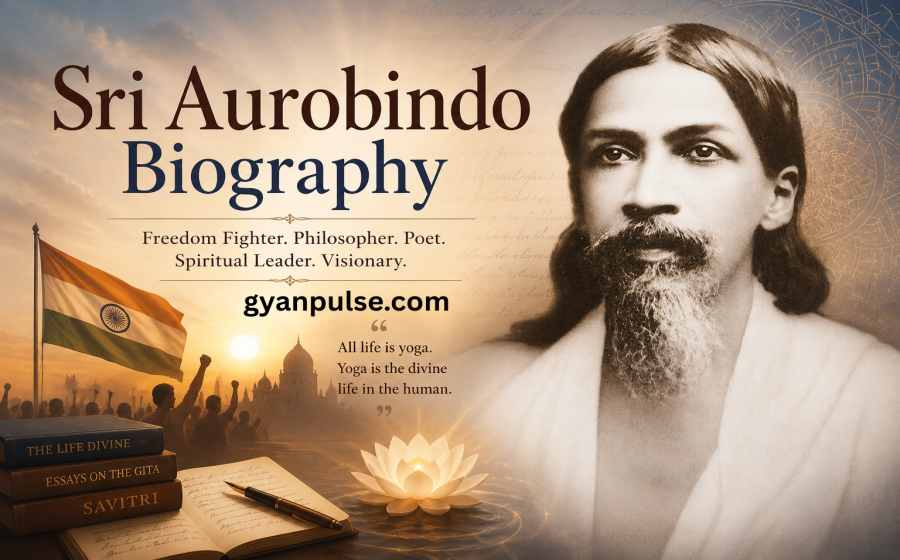
Sri Aurobindo Biography – Life, Teachings and Inspirations
Sri Aurobindo Biography: Explore the life of a freedom fighter, philosopher, poet and spiritual leader, along with his teachings and legacy.
Sri Aurobindo Biography
Sri Aurobindo (1872-1950) was a great Indian philosopher, poet, freedom fighter and spiritual leader. His life journey reflected a balance between political struggle for India’s independence and deep spiritual pursuit. He played a crucial role in awakening national consciousness during the freedom movement and later became a pioneer of Integral Yoga, guiding seekers toward inner transformation. Sri Aurobindo’s writings, vision, and teachings continue to inspire millions across the world.
Table of Contents
Early Life and Education
Sri Aurobindo Ghose was born on 15 August 1872 in Kolkata (then Calcutta). His father, Dr. Krishna Dhun Ghose, sent him to England at a young age for education. Aurobindo studied at St. Paul’s School, London, and later at King’s College, Cambridge. His mastery of English, Greek, and Latin was remarkable, and he also developed a keen interest in Indian culture, spirituality, and languages such as Sanskrit and Bengali.
Contribution to Indian Freedom Movement
On his return to India in 1893, Sri Aurobindo joined Baroda State Service and later became active in India’s freedom struggle. He was among the early leaders who demanded complete independence (Purna Swaraj) at a time when most leaders were seeking reforms. Aurobindo inspired youth through fiery writings in journals like Bande Mataram and Karmayogin. His revolutionary ideas motivated many to rise against British colonial rule.
However, after the Alipore Bomb Case (1908), in which he was arrested but later acquitted, Aurobindo gradually shifted from political activism to a spiritual path. He realized that true freedom also lies in inner liberation and self-realization.
Spiritual Journey and Teachings
After leaving politics, Sri Aurobindo settled in Pondicherry (now Puducherry) in 1910, dedicating his life to spirituality. He developed the concept of Integral Yoga, which aimed at the transformation of human life by uniting the physical, mental, and spiritual aspects. Unlike traditional asceticism, his yoga encouraged living a full life while striving for spiritual growth.
His writings such as The Life Divine, Savitri, and Essays on the Gita continue to inspire spiritual seekers. In 1926, along with The Mother (Mirra Alfassa), he laid the foundation of the Sri Aurobindo Ashram in Pondicherry, which became a hub of spiritual practice and education.
Literary Contributions
Sri Aurobindo was also a gifted poet and philosopher. His epic poem Savitri, consisting of nearly 24,000 lines, is considered one of the longest poems in English literature. His works blended Eastern wisdom with Western thought, making them globally significant. Through his philosophy of human evolution, he envisioned a future where humanity would rise to a higher consciousness, leading to a more harmonious world.
Sri Aurobindo’s Lasting Legacy and Vision for Humanity
Sri Aurobindo’s influence extends far beyond his role as a freedom fighter and spiritual teacher. His philosophy emphasized the idea that true progress begins with inner development and conscious living. He believed that humanity has the potential to evolve toward a higher state of awareness through knowledge, discipline, and self-discovery. His teachings continue to inspire students, thinkers, and spiritual seekers by encouraging a balanced life where personal growth, social responsibility, and spiritual wisdom work together for a better future.
5 Life Inspirations from Sri Aurobindo
- Courage to Dream Big – He envisioned India’s independence long before it was popular, teaching us to dream beyond limitations.
- Balance of Action and Spirituality – His life shows how one can contribute to society while pursuing inner growth.
- Power of Writing and Thought – Through his words, he inspired a generation, reminding us of the lasting impact of ideas.
- Integral Approach to Life – His Integral Yoga teaches us to harmonize body, mind, and spirit for a complete life.
- Faith in Human Evolution – He believed humanity is destined to reach higher consciousness, motivating us to strive for personal and collective progress.
Summary
Sri Aurobindo’s life was a remarkable blend of revolutionary zeal, intellectual brilliance, and spiritual depth. He remains a guiding light for all who seek freedom, both in the outer world and within themselves. His legacy continues to influence philosophy, spirituality, and education, making him one of the greatest thinkers and visionaries of modern India.
Also Check: Biography