
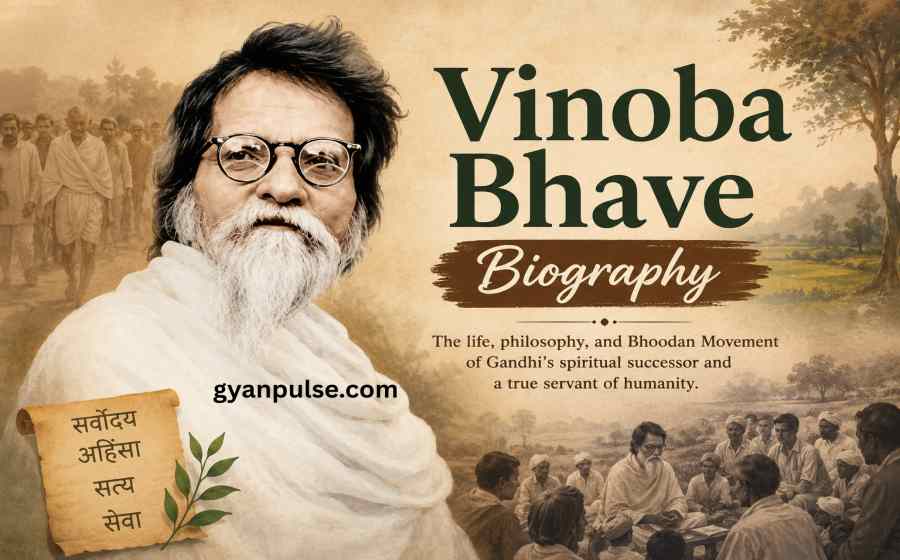
Vinoba Bhave Biography – Life, Bhoodan Movement and Inspiration
Vinoba Bhave Biography: Explore the life, philosophy, Bhoodan Movement, achievements and inspiring journey of Gandhi’s spiritual successor.
Vinoba Bhave Biography
Vinoba Bhave, widely known as Acharya Vinoba Bhave, was one of India’s most respected freedom fighters, social reformers, and spiritual leaders. He is remembered as the “spiritual successor of Mahatma Gandhi” and the pioneer of the Bhoodan (Land Gift) Movement. His life was dedicated to non-violence, selfless service, and uplifting the poor and marginalized.
Table of Contents
Early Life and Education
Vinoba Bhave was born on 11 September 1895 in Gagode, Maharashtra. From a young age, he showed deep interest in spirituality and service to humanity. Instead of pursuing a traditional career, he was drawn toward the teachings of Mahatma Gandhi. In 1916, he left his studies in Banaras to join Gandhi at Sabarmati Ashram.
At the Ashram, Vinoba Bhave embraced the principles of truth, simplicity, and non-violence. He became a close disciple of Gandhi and played a significant role in spreading Gandhian philosophy across India.
Role in Freedom Movement
Vinoba Bhave played an active role in India’s freedom movement, always supporting the fight for independence through peaceful and non-violent ways. During the Quit India Movement of 1942, he was jailed for his involvement in non-violent protests. Even in prison, he spread knowledge by teaching fellow prisoners and encouraging them toward constructive work.
His leadership and simple lifestyle made him a symbol of moral strength during India’s fight for independence.
Bhoodan Movement (Land Gift Movement)
The most remarkable contribution of Vinoba Bhave was the Bhoodan Movement, launched in 1951 in Telangana. While visiting a village, he appealed to wealthy landowners to donate land to the poor farmers. Inspired by his sincerity, landlords started donating land voluntarily.
This movement spread across the nation and became a peaceful revolution for social justice. By walking thousands of kilometers and visiting villages, Vinoba collected millions of acres of land for distribution among the landless.
Spirituality and Philosophy
Vinoba believed that true freedom lies in equality, simplicity, and self-reliance. His philosophy was deeply rooted in Bhagavad Gita, and he translated it into Marathi to make it accessible to common people.
He lived a life of discipline and considered non-violence (ahimsa) as the highest virtue. He also advocated for the use of Shanti Sena (peace army) to resolve conflicts without violence.
Inspirational Points from Vinoba Bhave’s Life
- Selfless Service – He dedicated his life to the upliftment of the poor without expecting anything in return.
- Non-Violence as Strength – He proved that social transformation can be achieved through non-violent methods.
- Simplicity in Living – His humble lifestyle teaches us the value of living with minimum needs.
- Spiritual Leadership – By blending spirituality with social service, he showed a holistic path of development.
- Vision of Equality – His Bhoodan Movement reflected his dream of a society without exploitation or inequality.
Legacy and Recognition
Vinoba Bhave received India’s first Ramon Magsaysay Award (1958) for community leadership and later the Bharat Ratna (1983), India’s highest civilian award.
He passed away on 15 November 1982, leaving behind a legacy of compassion, truth, and equality. Even today, his life inspires millions to live with simplicity and work for social justice.
Vinoba Bhave’s Lasting Influence on Society
Acharya Vinoba Bhave’s contribution went beyond politics and social reform; he created a moral vision for building a more compassionate society. His belief that social change should emerge through understanding, kindness, and voluntary action made him unique among leaders of his time.
Through his teachings and movements, he encouraged people to think beyond personal interests and work for collective welfare. His ideals of peace, equality, and human dignity continue to remain relevant in the modern world, inspiring individuals to create positive change through ethical values and selfless service.
Summary
Vinoba Bhave’s life was a shining example of how one person’s faith in truth and non-violence can change society. His Bhoodan Movement continues to inspire initiatives of social reform and equality. He will always be remembered as a true Gandhian and servant of humanity.
Also Check: Biography