
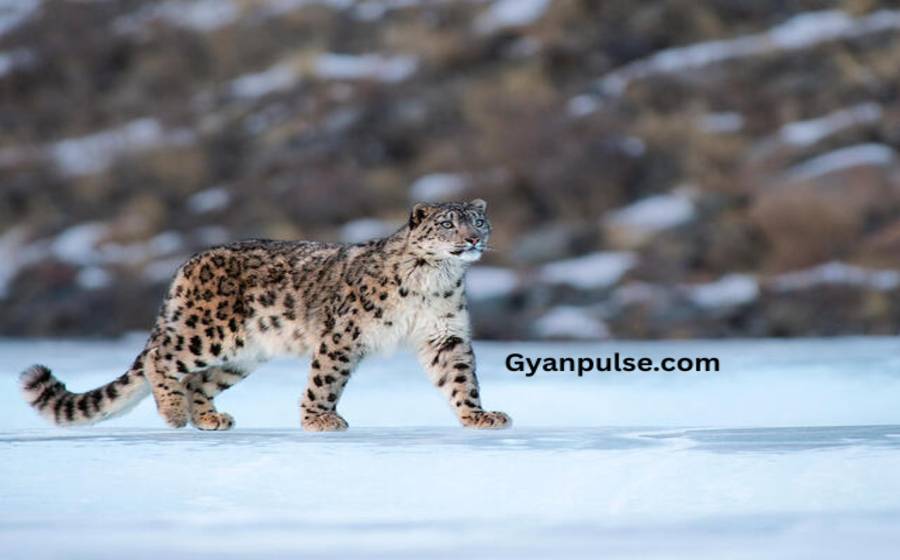
Snow Leopard count Rises Sharply in Himachal Pradesh
Snow Leopard count Rises Sharply in Himachal Pradesh as conservation efforts and community participation help increase wildlife population growth.
Snow Leopard count Rises Sharply in Himachal Pradesh
Recent surveys show a big rise in the snow leopard population in Himachal Pradesh. According to the Forest Department’s Wildlife Wing, the number has grown from 51 in 2021 to 83 in 2025. This count covers high-altitude regions and does not include cubs.
The survey also brought other exciting findings: the first confirmed sighting of Pallas’s cat in Kinnaur and the rediscovery of the rare woolly flying squirrel in Lahaul.
Table of Contents
Detailed Population Count
Himachal Pradesh carried out its second full survey of snow leopard numbers between 2024 and 2025. The first survey was held from 2018 to 2021. Unlike the earlier effort, the latest count was finished in just one year, showing better planning and teamwork.
The survey was done with support from the Nature Conservation Foundation. With this, Himachal Pradesh became the first state in India to scientifically and thoroughly estimate its snow leopard population.
Survey Process and Areas Covered
The survey spanned 26,000 square kilometres, covering Spiti Valley, Kinnaur, Pangi, Lahaul, and the Great Himalayan National Park. To track snow leopards and other wildlife, researchers set up about 271 camera traps.
From the footage, the team identified 44 individual snow leopards—the same as in the previous study. However, improved analysis methods led to a higher overall population estimate.
Snow leopard density was found to range between 0.16 and 0.53 per 100 square kilometres, with the highest numbers in Spiti, Pin Valley, Upper Kinnaur, and Tabo.
People’s Involvement and Wildlife Protection Impact
The survey revealed that snow leopards are found even outside protected areas like Kibber Wildlife Sanctuary and the Great Himalayan National Park. This highlights the need to actively involve local communities in conservation efforts.
Local youth and community members played an important role in the study, with an indigenous women’s group from Kibber making history by contributing to data analysis, the first such involvement worldwide. Their participation marks a step toward more inclusive and community-driven wildlife conservation.
Further Wildlife Discoveries
The camera traps also captured images of other mammals living alongside snow leopards. Other species spotted in the snow leopard habitat included blue sheep, Himalayan ibex, musk deer, Himalayan wolf, brown bear, common leopard, red fox, stone marten, mountain weasel, and yellow-throated marten.
Using ensemble modelling, researchers created updated maps showing where these prey species live, which will help guide future conservation efforts.
Key Takeaways and Future Plans
This survey offers a strong baseline for long-term monitoring of snow leopards in Himachal Pradesh. It demonstrates a cost-effective and scalable method for estimating wildlife populations.
The approach can be applied in other Himalayan states to support adaptive management of snow leopards and their habitats. Himachal Pradesh’s success shows how combining scientific methods with community involvement can greatly improve conservation outcomes.
Other Wildlife Sharing the Habitat
Himachal Pradesh has witnessed a significant increase in its snow leopard population, reflecting the success of ongoing conservation efforts. Recent surveys by the Forest Department’s Wildlife Wing, conducted in partnership with the Nature Conservation Foundation, show that the population has grown from 51 in 2021 to 83 in 2025. These figures cover high-altitude habitats and exclude cubs, highlighting the mature population growth.
The survey also revealed the presence of snow leopards outside protected areas, emphasizing the importance of community participation in conservation.
Local youth and indigenous groups played a key role in data collection and analysis. In addition, camera traps documented other wildlife like blue sheep, Himalayan ibex, musk deer, and brown bears, providing valuable insights into the ecosystem.
This success demonstrates how scientific monitoring combined with community engagement can ensure the long-term protection of snow leopards and their fragile habitats.
Community Participation Strengthening Snow Leopard Conservation
The remarkable increase in the snow leopard population in Himachal Pradesh reflects the positive impact of combining scientific research with active community participation. Local youth and indigenous groups played a crucial role in wildlife monitoring and data analysis, making conservation efforts more inclusive and effective. The survey also highlighted that snow leopards live beyond protected regions, showing the need for wider habitat protection. This successful model demonstrates that long-term wildlife conservation becomes stronger when local communities, technology, and scientific methods work together to preserve fragile mountain ecosystems.
Summary
The snow leopard population in Himachal Pradesh has increased significantly, rising from 51 in 2021 to 83 in 2025 due to successful conservation efforts. Scientific surveys, improved monitoring techniques, and strong community participation contributed to this achievement. The study also recorded other rare wildlife species, highlighting the importance of protecting Himalayan ecosystems through collaborative and sustainable conservation strategies.
Also Check: Current Affairs