Afforestation and Reforestation – Meaning, Importance and Key Differences
Learn about afforestation and reforestation, their meaning, differences, benefits and why planting trees is essential to fight climate change.
Afforestation and Reforestation
Forests are among the most important natural resources on our planet, providing countless benefits to both people and wildlife. They provide oxygen, store carbon dioxide, support wildlife, protect soil, and regulate the climate. However, due to deforestation, urbanization, and industrial growth, large areas of forests have been destroyed. To restore the balance of nature, two important solutions are widely promoted: afforestation and reforestation.
Even though people often use these two words as if they mean the same thing, they are actually a little different. Let’s understand their meanings in an easy and clear way.
Table of Contents
What is Afforestation?
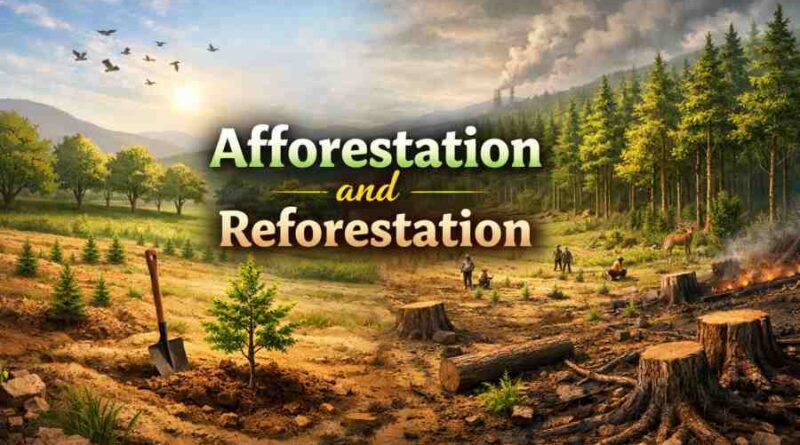
Afforestation means planting trees in places where there were no forests before. In simple words, it means creating a new forest on land that has not been forested for a long time or has never had trees before.
For example, planting trees on barren land, deserts, or agricultural land that is no longer in use is called afforestation.
Why is Afforestation Important?
Afforestation helps in:
- Reducing carbon dioxide levels in the atmosphere
- Preventing soil erosion
- Improving air quality
- Increasing rainfall in dry areas
- Creating habitats for wildlife
By planting trees in new areas, we increase green cover and help fight climate change.
What is Reforestation?
Reforestation means planting trees in areas where forests once existed but were destroyed due to deforestation, natural disasters, or human activities.
For example, if a forest area was cut down for construction or burned in a wildfire, planting trees again in the same area is called reforestation.
Why is Reforestation Important?
Reforestation helps in:
- Restoring lost ecosystems
- Protecting biodiversity
- Stabilizing soil
- Preventing floods
- Rebuilding wildlife habitats
It helps nature recover and return to its original condition.
Key Difference Between Afforestation and Reforestation
| Afforestation | Reforestation |
|---|---|
| Planting trees where there were no forests before | Replanting trees in areas where forests were destroyed |
| Creates a new forest | Restores an old forest |
| Done on barren or unused land | Done on deforested land |
Both methods aim to increase forest cover, but their starting points are different.
Role in Fighting Climate Change
Trees play a major role in controlling global warming. They absorb carbon dioxide, a major greenhouse gas, and release oxygen into the atmosphere. This process helps reduce the greenhouse effect.
When large-scale deforestation occurs, carbon stored in trees is released into the atmosphere, increasing global warming. Afforestation and reforestation help absorb this extra carbon and reduce climate change effects.
Many international programs and governments are promoting tree plantation drives to achieve environmental sustainability.
Environmental Benefits
- Improves Air Quality
Trees absorb harmful gases and release oxygen, making the air cleaner. - Prevents Soil Erosion
Tree roots hold the soil firmly and prevent it from being washed away by rain or wind. - Supports Wildlife
Forests are home to many birds, animals, and insects, giving them food, safety, and a place to live. - Maintains Water Cycle
Trees help in maintaining the water cycle by releasing moisture into the atmosphere. - Reduces Temperature
Forest areas are cooler than cities. More trees mean lower temperatures.
Economic and Social Benefits
Afforestation and reforestation also offer economic advantages:
- Provide timber and forest products
- Create job opportunities
- Support rural livelihoods
- Promote eco-tourism
- Improve community health
When managed properly, forests can support both people and the environment.
Global Efforts for Tree Plantation
Many countries have started large-scale programs to increase forest cover. For example, India has launched the Green India Mission under the National Action Plan on Climate Change. Similarly, several global initiatives encourage tree planting to restore degraded lands.
The United Nations has also declared the Decade on Ecosystem Restoration to promote forest recovery and environmental protection worldwide.
These efforts show that protecting forests is a global responsibility.
Challenges in Afforestation and Reforestation
Although tree planting sounds simple, it has challenges:
- Poor maintenance of planted trees
- Choosing unsuitable tree species
- Lack of community participation
- Climate conditions affecting growth
Planting trees is not enough; proper care and long-term management are equally important.
How Can Individuals Contribute?
Everyone can help in increasing forest cover. Here are simple steps:
- Participate in tree plantation drives
- Avoid cutting trees unnecessarily
- Support environmental campaigns
- Educate others about the importance of forests
- Reduce paper and wood wastage
Even planting one tree can make a difference.
Summary
Afforestation and reforestation are powerful tools to restore nature and fight climate change. While afforestation creates new forests on barren land, reforestation restores forests that were destroyed. Both methods help increase green cover, improve air quality, protect wildlife, and maintain ecological balance.
In today’s world, where environmental problems are growing rapidly, planting and protecting trees is not just an option, it is a necessity. If governments, communities, and individuals work together, we can rebuild forests and ensure a healthier planet for future generations.
Also Check: Environment