Ecosystem – Meaning, Types and Components of an Ecosystem
Learn the meaning of ecosystem and its different types in simple language. Understand components, functions and importance of ecosystems in detail.
Ecosystem
Our planet Earth is full of life. From the smallest microorganisms to giant trees and animals, every living being depends on its surroundings to survive. The relationship between living organisms and their environment forms what we call an ecosystem. Understanding ecosystems helps us understand how nature works and why it is important to protect it.
Table of Contents
Meaning of Ecosystem
An ecosystem is a community of living organisms (plants, animals, and microorganisms) interacting with each other and with their non-living surroundings such as air, water, soil, and sunlight. In simple words, it is a system where living and non-living components work together as a unit.
The word “ecosystem” is formed by combining two simple words:
- Eco meaning environment
- System meaning a group of interacting parts
So, an ecosystem is a system formed by the interaction of living organisms with their physical environment.
An ecosystem can be small, like a pond, or very large, like a forest or even the entire Earth.
Components of an Ecosystem
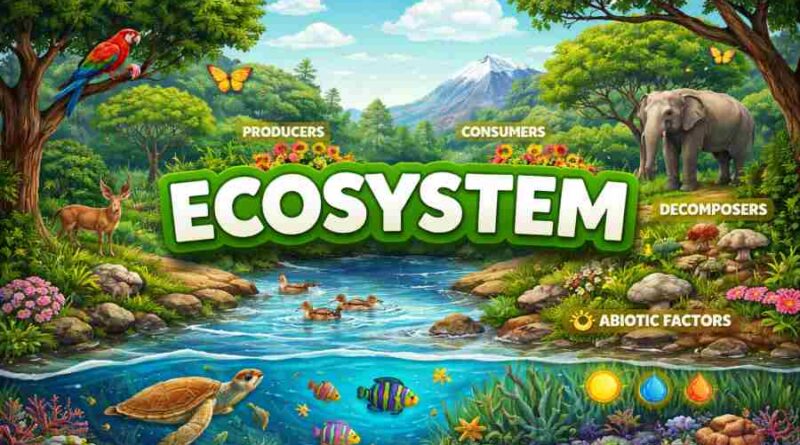
An ecosystem has two main components:
1. Biotic Components (Living Things)
These include all living organisms in the ecosystem. They are divided into three groups:
a) Producers:
These are green plants and algae that prepare their own food through photosynthesis using sunlight. They are the base of every ecosystem because they produce food for other organisms.
b) Consumers:
These are animals that depend on plants or other animals for food. They are of different types:
- Herbivores (plant-eaters)
- Carnivores (meat-eaters)
- Omnivores (eat both plants and animals)
c) Decomposers:
These include bacteria and fungi. They break down dead plants and animals into simpler substances. This process returns nutrients to the soil and keeps the ecosystem clean.
2. Abiotic Components (Non-Living Things)
These include physical and chemical factors such as:
- Sunlight
- Air
- Water
- Soil
- Temperature
- Minerals
Abiotic components provide the necessary conditions for living organisms to survive and grow.
Types of Eco systems
Ecosystems are mainly divided into two major categories: Natural Eco systems and Artificial Eco systems.
1. Natural Eco systems
Natural ecosystems are formed naturally without human intervention. They are further divided into two types:
a) Terrestrial Eco systems (Land-Based)
These eco systems exist on land. Some common examples include:
Forest Eco system:
Forests have a large number of trees and support a wide variety of plants and animals. They receive adequate rainfall and have rich biodiversity.
Grassland Eco system:
Grasslands are dominated by grasses rather than large trees. Animals such as deer, zebras, and lions are commonly found here.
Desert Eco system:
Deserts receive very little rainfall. Plants and animals in deserts are specially adapted to survive in hot and dry conditions.
Mountain Ecosystem:
Mountain regions have cold temperatures and less oxygen at high altitudes. The plants and animals here are adapted to extreme weather conditions.
b) Aquatic Ecosystems (Water-Based)
Aquatic eco systems are found in water. They are of two main types:
Freshwater Eco system:
These eco systems include rivers, lakes, ponds, and streams. The water found here contains very little salt, which is why they are called freshwater eco systems. They support a wide variety of plants, fish, insects, and other living organisms.
Marine Eco system:
These include oceans and seas. Marine eco systems cover a large part of the Earth’s surface and are rich in biodiversity.
2. Artificial Eco systems
Artificial eco systems are created and maintained by humans. They require human effort to survive and function properly.
Examples include:
- Gardens
- Crop fields
- Aquariums
- Parks
In artificial ecosystems, humans control factors like water supply, fertilizers, and pest control.
Functions of an Eco system
An eco system performs several important functions that maintain balance in nature.
1. Energy Flow
Energy from the sun is captured by plants and passed on to animals through food chains. This flow of energy keeps the eco system active.
2. Nutrient Cycling
Nutrients such as carbon, nitrogen, and oxygen circulate between living and non-living components. Decomposers play a key role in recycling nutrients.
3. Food Chain and Food Web
A food chain shows how energy moves from producers to consumers. Multiple food chains connected together form a food web. This ensures stability in the ecosystem.
4. Maintaining Ecological Balance
Every organism in an eco system has its own important role to play. When even one species disappears, it can upset the natural balance and affect many other living things in that eco system.
Importance of Eco systems
Eco systems are essential for sustaining life on Earth. We can understand their importance through the many vital benefits and services they provide to living organisms.
1. Provide Resources
Eco systems provide food, water, timber, medicines, and raw materials.
2. Support Biodiversity
They are home to millions of species. A healthy eco system supports a wide variety of plants and animals.
3. Regulate Climate
Forests and oceans help control temperature and rainfall patterns. They also absorb carbon dioxide, reducing the impact of global warming.
4. Purify Air and Water
Plants help keep the air clean by taking in carbon dioxide and giving out oxygen during photosynthesis. Similarly, wetlands and forests act like natural filters, removing harmful pollutants from water and keeping it clean.
5. Cultural and Recreational Value
Natural eco systems provide beautiful landscapes for tourism, relaxation, and inspiration.
Threats to Eco systems
Unfortunately, many eco systems are facing serious threats because of harmful human activities such as:
- Deforestation
- Pollution
- Climate change
- Urbanization
- Overexploitation of natural resources
These activities disturb ecological balance and harm biodiversity.
Summary
An eco system is a complex yet beautifully organized system where living and non-living components interact with each other. It can be as small as a pond or as large as the ocean. Eco systems are broadly classified into natural and artificial types, with further divisions such as terrestrial and aquatic ecosystems.
They play a vital role in maintaining life on Earth by providing resources, regulating climate, recycling nutrients, and supporting biodiversity. Protecting ecosystems is not just the responsibility of governments or organizations, it is the duty of every individual.
Also Check: Environment