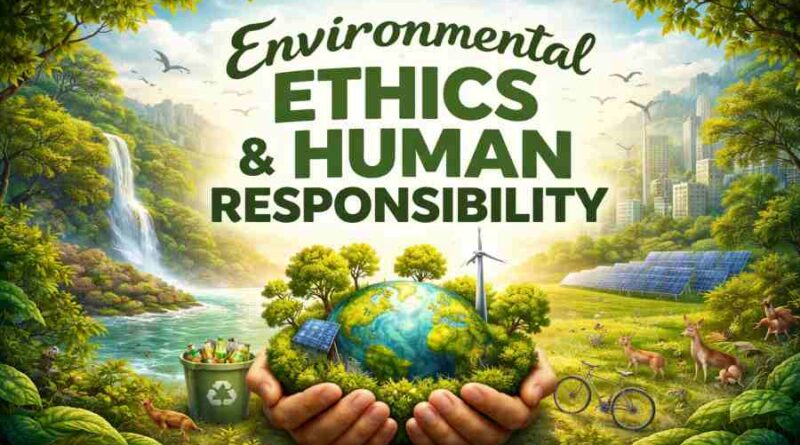
Environmental Ethics and Human Responsibility – Building a Sustainable Future
Explore Environmental Ethics and Human Responsibility, their importance, principles and how individuals can contribute to a sustainable and balanced future.
Environmental Ethics and Human Responsibility
Environmental ethics is a branch of philosophy that studies the relationship between human beings and the natural environment. It seeks to answer fundamental questions about how humans should interact with nature and what moral obligations we have toward the planet. In the modern world, where environmental degradation, climate change, and biodiversity loss are growing concerns, environmental ethics has become more relevant than ever. It emphasizes that humans are not separate from nature but an integral part of it, and therefore must act responsibly to protect it.
Table of Contents
Understanding Environmental Ethics
Environmental ethics revolves around the idea that nature has value beyond its usefulness to humans. Traditionally, human societies followed an anthropocentric approach, meaning they believed that humans are the most important entities, and nature exists primarily for human use. However, environmental ethics challenges this perspective by promoting alternative viewpoints such as biocentrism and ecocentrism.
Biocentrism suggests that all living organisms have intrinsic value and deserve moral consideration. Ecocentrism goes even further by emphasizing the value of entire ecosystems, including non-living elements like rivers, mountains, and soil. These perspectives encourage humans to respect nature and treat it with care rather than exploiting it for short-term benefits.
The Importance of Environmental Ethics
The importance of environmental ethics lies in its ability to guide human actions in a way that ensures sustainability. Without ethical considerations, natural resources may be overused, leading to environmental crises. Issues such as deforestation, pollution, global warming, and species extinction are often the result of unethical human behavior toward the environment.
Environmental ethics helps in:
- Promoting sustainable use of resources
- Encouraging conservation of biodiversity
- Reducing environmental pollution
- Protecting ecosystems for future generations
It also plays a crucial role in shaping environmental policies, laws, and international agreements. Governments and organizations use ethical principles to develop strategies that balance economic development with environmental protection.
Human Responsibility Toward the Environment
Human responsibility toward the environment is a central concept in environmental ethics. Since humans have the power to alter ecosystems significantly, they also bear the responsibility to protect and preserve them. This responsibility can be understood at both individual and collective levels.
Individual Responsibility
Every individual can contribute to environmental protection through simple yet effective actions, such as:
- Reducing waste and practicing recycling
- Conserving water and energy
- Using eco-friendly products
- Planting trees and supporting green initiatives
Individual choices, when combined, can lead to significant positive impacts on the environment. Adopting a sustainable lifestyle is not just a choice but a moral duty.
Collective Responsibility
While individual efforts are important, large-scale environmental protection requires collective action. Governments, industries, and communities must work together to address environmental challenges. This includes:
- Implementing strict environmental laws
- Promoting renewable energy sources
- Encouraging sustainable agriculture and industry
- Supporting environmental education and awareness
International cooperation is also essential, as environmental issues like climate change and ocean pollution transcend national boundaries.
Ethical Principles Guiding Environmental Responsibility
Several ethical principles guide human responsibility toward the environment:
- Sustainability: Ensuring that natural resources are used in a way that does not compromise the ability of future generations to meet their needs.
- Stewardship: Viewing humans as caretakers of the Earth, responsible for maintaining its health and balance.
- Justice: Promoting fairness in the distribution of environmental benefits and burdens, ensuring that no community suffers disproportionately.
- Respect for Nature: Recognizing the inherent value of all living and non-living components of the environment.
These principles provide a framework for making ethical decisions related to environmental issues.
Challenges in Practicing Environmental Ethics
Despite its importance, implementing environmental ethics in real life can be challenging. Economic growth often takes precedence over environmental protection, leading to unsustainable practices. Many industries prioritize profit over ecological balance, resulting in pollution and resource depletion.
Lack of awareness and education also hinders the adoption of ethical environmental practices. In many regions, people are unaware of the long-term consequences of their actions. Additionally, political and social factors can influence environmental decision-making, making it difficult to enforce ethical standards.
The Role of Education and Awareness
Education plays a vital role in promoting environmental ethics. By teaching individuals about the importance of nature and the consequences of environmental degradation, society can foster a sense of responsibility. Schools, colleges, and media platforms can help spread awareness and encourage sustainable behavior.
Environmental education not only informs but also inspires action. It helps individuals understand that even small efforts can contribute to a larger goal of environmental conservation.
Summary
Environmental ethics and human responsibility are deeply interconnected. As the dominant species on Earth, humans have both the power and the duty to protect the environment. By adopting ethical principles and taking responsibility for our actions, we can ensure a sustainable and healthy planet for future generations.
The path to sustainability requires a shift in mindset, from exploitation to conservation, from short-term gains to long-term well-being. When individuals and societies embrace environmental ethics, they contribute to a balanced and harmonious relationship with nature.
Also Check: Environment