Food Chain and Food Web – Energy Flow in Ecosystems
Learn the difference between food chain and food web in simple language. Understand producers, consumers, decomposers and how energy flows in an ecosystem.
Food Chain and Food Web
Every living organism needs food to survive. Plants, animals, and even tiny microorganisms depend on one another for energy. This transfer of energy from one organism to another is explained through the concepts of the food chain and the food web. These concepts help us understand how ecosystems function and remain balanced.
Table of Contents
What is a Food Chain?
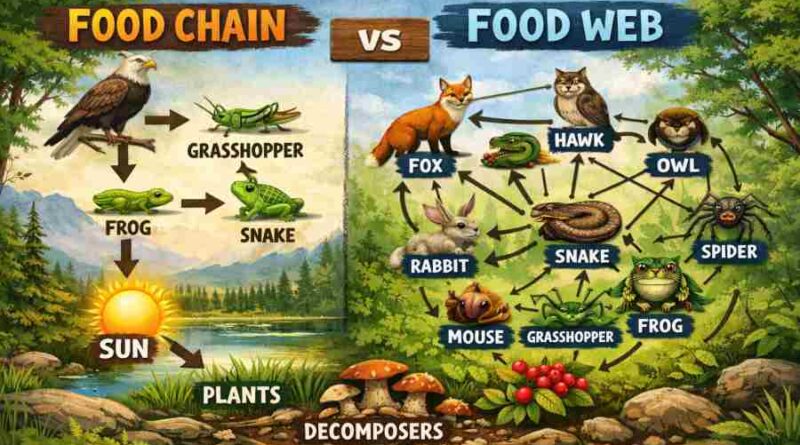
A food chain is a simple diagram that shows how energy passes from one living organism to another. It represents a single, straight pathway of energy flow in an ecosystem.
A food chain usually begins with the Sun. The Sun is the main source of energy for almost all life on Earth. Plants capture sunlight and use it to prepare their own food through a process called photosynthesis. From there, energy moves step by step to different organisms.
Basic Structure of a Food Chain
A typical food chain has the following components:
1. Producers
Producers are green plants and algae that make their own food using sunlight. They form the base of every food chain. Without producers, life on Earth would not exist.
Example: Grass, trees, shrubs, phytoplankton.
2. Primary Consumers
These are herbivores that eat plants.
Example: Rabbit, deer, grasshopper, cow.
3. Secondary Consumers
These are carnivores or omnivores that eat herbivores.
Example: Frog, snake, small birds.
4. Tertiary Consumers
These are top predators that eat other carnivores.
Example: Eagle, tiger, lion.
5. Decomposers
Decomposers such as bacteria and fungi break down dead plants and animals into simple substances. They return nutrients to the soil, which helps plants grow again.
Example of a Simple Food Chain:
Grass → Grasshopper → Frog → Snake → Eagle
This shows a straight-line flow of energy from plants to the top predator.
Types of Food Chains
Food chains are mainly of two types:
1. Grazing Food Chain
It starts with green plants and moves to herbivores and then to carnivores.
Example: Grass → Deer → Tiger
2. Detritus Food Chain
It begins with dead organic matter (detritus) and moves to decomposers and small organisms.
Example: Dead leaves → Earthworm → Bird
Both types are important for maintaining ecological balance.
What is a Food Web?
In nature, organisms rarely depend on just one source of food. Most animals eat more than one type of food. Because of this, many food chains are interconnected. This complex network of interconnected food chains is called a food web.
A food web shows multiple pathways through which energy flows in an ecosystem. It gives a more realistic picture of nature than a simple food chain.
For example, a grasshopper may be eaten by a frog, a bird, or a lizard. Similarly, a bird may eat insects, seeds, and worms. These multiple feeding relationships form a web-like structure.
Difference Between Food Chain and Food Web
| Food Chain | Food Web |
|---|---|
| Shows a single pathway of energy flow | Shows multiple interconnected pathways |
| Simple and straight | Complex and network-like |
| Less stable | More stable |
| One organism depends on one food source | Organisms have multiple food options |
A food web is more stable because if one species disappears, others can still survive by finding alternative food sources.
Trophic Levels in Food Chain and Food Web
Each step in a food chain or food web is called a trophic level.
- First Trophic Level – Producers
- Second Trophic Level – Primary Consumers
- Third Trophic Level – Secondary Consumers
- Fourth Trophic Level – Tertiary Consumers
Energy decreases as we move up the trophic levels. Only about 10% of the energy is transferred from one level to the next. The rest is lost as heat. This is known as the 10% Law of Energy Transfer.
Because of this energy loss, food chains usually do not have more than four or five levels.
Importance of Food Chain and Food Web
Food chains and food webs are extremely important for the environment. Their importance can be understood in the following ways:
1. Maintain Ecological Balance
They regulate population sizes of different species. Predators control the number of herbivores, and herbivores control plant growth.
2. Help in Energy Transfer
They explain how energy moves from the Sun to plants and then to animals.
3. Show Interdependence
They show that all organisms are interconnected. Even small organisms play a big role in maintaining balance.
4. Support Biodiversity
A strong and complex food web supports rich biodiversity and ecosystem stability.
What Happens If a Food Chain is Disturbed?
If one organism disappears from a food chain, it can disturb the entire ecosystem.
For example:
- If predators are removed, herbivores may increase rapidly.
- Excess herbivores may overgraze plants.
- This can lead to soil erosion and habitat destruction.
Such disturbances can create a chain reaction known as an ecological imbalance.
Human activities such as deforestation, pollution, overfishing, and climate change are disturbing many food chains and food webs around the world.
Food Chain and Food Web in Aquatic Ecosystems
Food chains also exist in oceans, rivers, and lakes.
Example of an aquatic food chain:
Phytoplankton → Zooplankton → Small Fish → Large Fish → Shark
In aquatic ecosystems, tiny organisms like phytoplankton play the role of producers. They form the base of the marine food web.
Summary
Food chains and food webs are fundamental concepts in ecology. A food chain shows a simple, straight pathway of energy flow, while a food web shows a complex network of interconnected food chains.
Both are essential for understanding how ecosystems function. They highlight the interdependence of living organisms and the importance of maintaining ecological balance.
Protecting ecosystems means protecting the delicate relationships within food chains and food webs. When we conserve nature, we help maintain the balance that supports all life on Earth.
Understanding these concepts not only increases our knowledge but also encourages us to respect and protect the environment.
Also Check: Environment