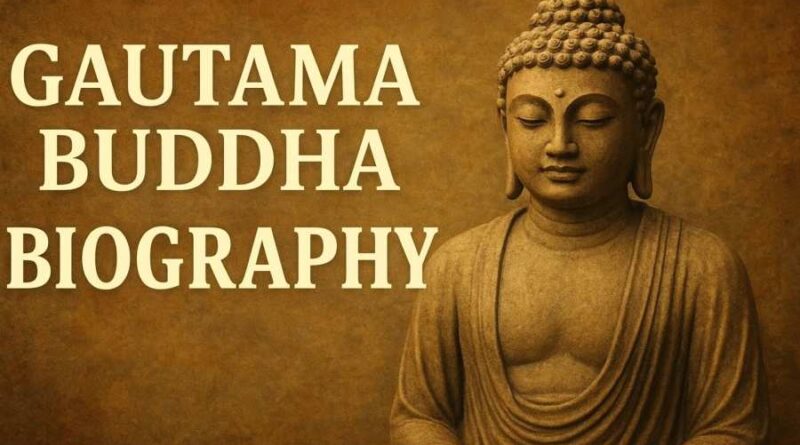
Gautama Buddha Biography – The Enlightened Journey That Shaped the Path of Peace
Discover the inspiring Gautama Buddha biography, exploring his life, enlightenment, teachings, and timeless influence on humanity.
Gautama Buddha Biography Introduction
Gautama Buddha, also known as Siddhartha Gautama, is one of the most influential spiritual teachers in world history. He founded Buddhism, a philosophy and way of life followed by millions across the globe. Born as a prince, Siddhartha chose a path of renunciation, deep meditation, and self-realization to understand the nature of human suffering. His teachings of compassion, mindfulness, and wisdom continue to guide people toward inner peace and ethical living even after more than 2,500 years.
Table of Contents
Early Life and Birth
Siddhartha Gautama was born around the 6th century BCE in Lumbini, located in present-day Nepal. He belonged to the Shakya clan, and his father, King Suddhodana, ruled the region. His mother, Queen Maya Devi, passed away shortly after his birth, and he was raised by his aunt, Mahapajapati Gotami.
According to tradition, astrologers predicted that Siddhartha would become either a great king or a great spiritual leader. Wanting his son to be a powerful ruler, King Suddhodana shielded him from all forms of suffering and hardship. Siddhartha grew up in luxury, surrounded by comfort, education, and pleasure.
Life in the Palace and the Great Renunciation
Siddhartha lived a family life with Princess Yasodhara and their son, Rahula, before renouncing the palace. Despite living a life of wealth and happiness, he felt a deep sense of emptiness. At the age of 29, Siddhartha ventured outside the palace and encountered what are known as the Four Sights: an old man, a sick man, a dead body, and a wandering ascetic. These experiences deeply shook him and made him realize that suffering is unavoidable in human life.
Moved by this realization, Siddhartha renounced his royal life, family, and possessions in search of truth. This moment is known as the Great Renunciation, marking the beginning of his spiritual journey.
Search for Truth and Enlightenment
For several years, Siddhartha practiced extreme asceticism, subjecting his body to severe hardships. However, he realized that self-torture was not the path to enlightenment. He adopted the Middle Way, a balanced approach avoiding both extreme luxury and extreme self-denial.
At the age of 35, Siddhartha meditated deeply beneath the Bodhi tree in Bodh Gaya, India, where his life-changing spiritual awakening began. After intense meditation, he attained enlightenment and became the Buddha, meaning “the Enlightened One.” He gained profound insight into the nature of existence, suffering, and liberation.
Teachings of Gautama Buddha
The core of Buddha’s teachings is centered on wisdom, ethical conduct, and mental discipline. His teachings are simple yet deeply transformative.
The Four Noble Truths
- Life involves suffering (Dukkha)
- Suffering arises from desire and attachment
- Suffering can be ended
- Buddha taught that suffering can be ended by living according to the Noble Eightfold Path.
The Noble Eightfold Path
The Eightfold Path guides individuals toward ethical and mindful living through right understanding, intention, speech, action, livelihood, effort, mindfulness, and concentration.
Buddha emphasized compassion, non-violence, meditation, and self-awareness as tools for achieving inner peace and enlightenment.
Spread of Buddhism
After attaining enlightenment, Buddha spent over 45 years traveling across northern India, teaching people from all walks of life. He welcomed kings, merchants, farmers, and even outcasts into his teachings. Buddha’s disciples established a spiritual brotherhood, which became known as the Sangha.
Buddhism gradually spread across Asia, influencing countries such as Sri Lanka, China, Japan, Thailand, Tibet, and Myanmar. Over time, different schools of Buddhism emerged, including Theravada, Mahayana, and Vajrayana.
Death and Mahaparinirvana
Gautama Buddha spent his final moments in Kushinagar, India, where he passed away at the age of 80. His death is known as Mahaparinirvana, representing the final release from the cycle of birth and rebirth. Before his passing, he encouraged his followers to rely on his teachings and walk the path with diligence and mindfulness.
Also Read: Sundar Pichai Biography – From a Small Indian Home to Leading Google and Alphabet
Legacy and Global Influence
Gautama Buddha’s teachings have had a lasting impact on philosophy, psychology, ethics, and spirituality. His message of peace, compassion, and mindfulness is practiced not only in religious contexts but also in modern wellness, education, and mental health practices.
Buddha’s life demonstrates that true happiness comes from inner understanding, not external possessions. His timeless wisdom continues to inspire humanity to seek harmony within and with the world.
5 Inspirations from Gautama Buddha’s Life
- Seek Inner Peace: True happiness lies within, not in material wealth.
- Follow the Middle Way: Balance is the key to a meaningful life.
- Practice Compassion: Kindness toward all beings leads to harmony.
- Be Mindful: Awareness of thoughts and actions brings clarity.
- Never Stop Learning: Self-discovery is a lifelong journey.
Summary
The Gautama Buddha biography is not just the story of a spiritual leader but a guide to conscious living. His journey from a sheltered prince to an enlightened teacher reminds us that wisdom arises from experience, reflection, and compassion. Even today, Buddha’s teachings continue to light the path toward peace, self-realization, and a more humane world.
Also Check: Biography