Morarji Desai Biography – The 4th Prime Minister of India Who Strengthened Indian Democracy
Morarji Desai Biography: Discover his life, political journey, key achievements and inspiring lessons as India’s first non-Congress Prime Minister.
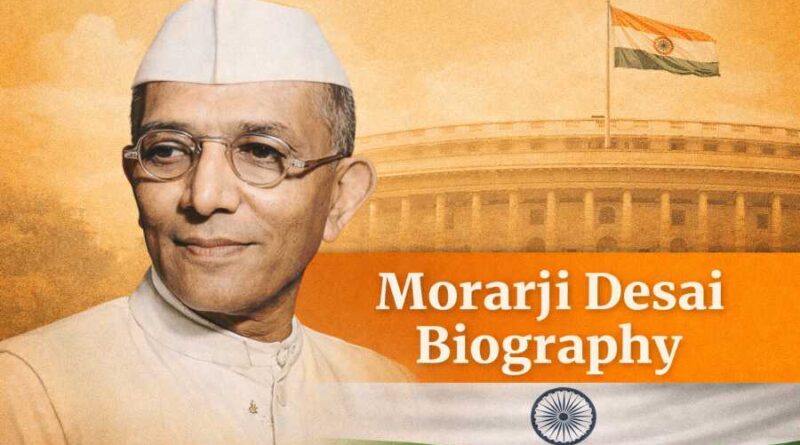
Morarji Desai Biography
Morarji Desai was one of the most respected and disciplined leaders in Indian politics. Known for his honesty, simplicity, and strong principles, he played a significant role in shaping modern Indian democracy. He became the first Prime Minister of India who did not belong to the Indian National Congress party, marking an important turning point in the country’s political history.
Table of Contents
Early Life and Education
Morarji Desai was born on February 29, 1896, in Bhadeli village in present-day Gujarat. He was born into a simple family, and his father was a school teacher. From a young age, Desai was known for his disciplined lifestyle and serious attitude toward education.
He completed his schooling in Gujarat and later graduated from Wilson College in Mumbai. After completing his education, he joined the provincial civil service of Bombay. However, his desire to serve the nation soon led him to leave his government job and join India’s freedom struggle.
Role in India’s Freedom Movement
Morarji Desai actively participated in the Indian independence movement under the leadership of Mahatma Gandhi. He joined the Civil Disobedience Movement and later took part in the Quit India Movement in 1942. During this time, he was imprisoned several times by the British government.
His dedication to freedom and justice made him a respected leader among his colleagues. He strongly believed in non-violence and followed Gandhian principles throughout his life.
Political Career After Independence
After India gained independence in 1947, Morarji Desai continued to serve the country through politics. He became the Chief Minister of Bombay State (now Maharashtra and Gujarat) in 1952. During his tenure, he focused on administrative reforms, law and order, and economic development.
Later, he served in important positions in the central government, including Finance Minister and Deputy Prime Minister. He was known for his strict financial discipline and honest administration. As Finance Minister, he introduced several measures to control inflation and improve the country’s economic stability.
Becoming Prime Minister
In 1977, after the Emergency period declared by Prime Minister Indira Gandhi ended, general elections were held. The Janata Party, a coalition of opposition parties, won the election. Morarji Desai became the Prime Minister of India at the age of 81.
This was a historic moment because he became the first non-Congress Prime Minister of India. His leadership symbolized the strength of democracy in the country. The peaceful transfer of power after the Emergency restored public faith in democratic institutions.
As Prime Minister, Morarji Desai worked to restore civil liberties and strengthen democratic values. He lifted press censorship, released political prisoners, and ensured that fundamental rights were respected again.
Major Contributions and Policies
During his tenure as Prime Minister (1977-1979), Morarji Desai focused on:
- Restoring democracy after the Emergency
- Promoting transparency in governance
- Improving relations with neighboring countries
- Strengthening anti-corruption measures
He believed in simple living and high thinking. Even as Prime Minister, he maintained a very simple lifestyle. He avoided luxury and lived according to strict personal discipline.
Although his government lasted only about two years, it played a crucial role in protecting India’s democratic framework. Internal conflicts within the Janata Party eventually led to his resignation in 1979.
Awards and Recognition
Morarji Desai received several honors for his contributions. He was awarded the Bharat Ratna, India’s highest civilian award, in 1991. Interestingly, he was also honored with Pakistan’s highest civilian award, the Nishan-e-Pakistan, for improving relations between the two countries.
He passed away on April 10, 1995, at the age of 99. His long life was a reflection of his disciplined habits and strong willpower.
Personality and Values
Morarji Desai was known for his strict routine, honesty, and moral integrity. He believed in yoga, natural health practices, and self-control. His disciplined lifestyle became an example for many people.
He never compromised on his principles, even when facing political challenges. His courage to stand firm during difficult times earned him respect across party lines.
5 Inspirational Lessons from Morarji Desai’s Life
1. Discipline Leads to Long-Term Success
Morarji Desai followed a strict daily routine throughout his life. His discipline helped him remain active and focused even in old age.
2. Honesty Builds True Respect
He was widely respected for his integrity. His clean image in politics proves that honesty creates lasting trust.
3. Stand Firm on Principles
Desai never compromised on his values. He showed that strong principles are more important than short-term political gains.
4. Age is Just a Number
He became Prime Minister at 81, proving that determination and experience matter more than age.
5. Democracy Must Be Protected
His leadership after the Emergency strengthened democratic values in India. He demonstrated that protecting freedom and rights is the duty of every leader.
Summary
Morarji Desai was not just a politician; he was a symbol of discipline, democracy, and dedication. His journey from a small village in Gujarat to becoming the Prime Minister of India is truly inspiring. He proved that strong values, honesty, and commitment to public service can leave a lasting impact on a nation.
His life continues to inspire generations to work with integrity and courage for the betterment of society.
Also Check: Biography