
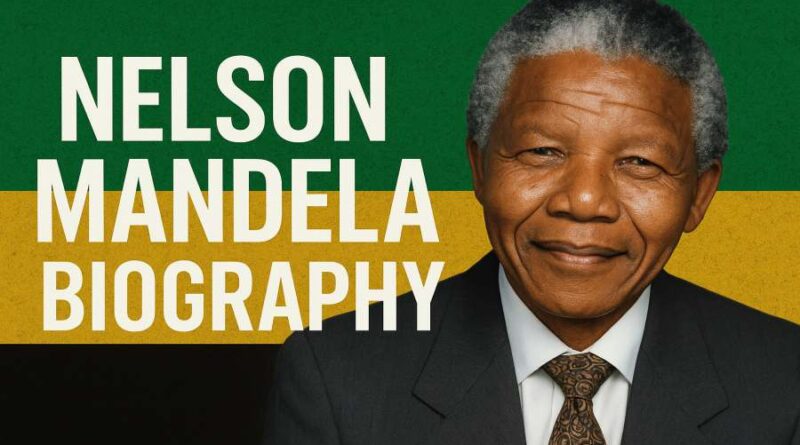
Nelson Mandela Biography – Life, Struggle, Leadership & Legacy of Madiba
A brief and inspiring Nelson Mandela Biography highlighting his early life, struggle against apartheid, leadership, and lasting legacy.
Nelson Mandela Biography
Nelson Mandela, often remembered as “Madiba,” is one of the most influential figures of the 20th century. His life stands as a powerful symbol of courage, justice, and the longest fight against racial segregation. Mandela’s journey from a village boy in rural South Africa to becoming the first Black President of the country is a story of resilience and hope. His leadership not only transformed South Africa but also inspired millions around the world.
Table of Contents
Early Life and Education
Nelson Rolihlahla Mandela was born on July 18, 1918, in the small village of Mvezo, located in the Eastern Cape of South Africa. He belonged to the Thembu royal family, but despite the prestige, his childhood was simple and deeply rooted in traditional African culture. The name “Rolihlahla” means “troublemaker,” which interestingly foreshadowed his future role as a revolutionary voice against injustice.
Mandela attended local mission schools where he developed a love for learning. Later, he moved to Johannesburg, where he completed his Bachelor of Arts degree from the University of South Africa. His exposure to African nationalism, inequality, and racial discrimination during his student years shaped his political ideology.
Entry Into Politics
Mandela’s political journey began in earnest when he joined the African National Congress (ANC) in 1943. South Africa, at the time, was governed by apartheid laws-an institutionalized system of racial segregation enforced by the white minority government. Mandela and his colleagues in the ANC Youth League believed in mass mobilization and non-violent resistance to fight for equal rights.
Throughout the 1950s, Mandela became a leading voice in campaigns against apartheid laws. He stood firmly for justice, even when faced with arrests, harassment, and increasing government pressure.
Imprisonment and the Rivonia Trial
Mandela’s political activities eventually led to charges of sabotage and conspiracy. In 1964, after the famous Rivonia Trial, he was sentenced to life imprisonment. He spent 27 years behind bars, most of them in the harsh conditions of Robben Island.
Despite the confinement, Mandela’s spirit remained unbroken. He continued to study, write, and inspire fellow prisoners. His message of peace, equality, and dignity spread far beyond the prison walls. International campaigns demanding his release grew stronger each year, turning him into a global symbol of resistance against apartheid.
Freedom and Completion of the Long Struggle
Mandela walked free from prison on February 11, 1990, marking the start of a new chapter in South Africa’s fight for freedom. His release marked the beginning of a crucial phase in South African history. Mandela immediately resumed his political work and led negotiations with the government to dismantle apartheid.
His efforts helped South Africa avoid a civil war during the transition to democracy. In 1993, Mandela and then-President F.W. de Klerk were awarded the Nobel Peace Prize for their joint efforts in ending apartheid peacefully.
Becoming South Africa’s First Black President
In 1994, South Africa conducted its first-ever democratic elections, giving all citizens the chance to vote equally for the first time. The ANC won with a landslide victory, and Nelson Mandela became the country’s first Black President. His presidency emphasized national unity, reconciliation between racial groups, and rebuilding a divided nation.
Mandela also focused on improving education, healthcare, and human rights. His leadership style was rooted in humility, forgiveness, and the belief that no society can progress without equality.
Life After Presidency
Mandela served only one term and stepped down in 1999, setting an example of democratic leadership. He continued his humanitarian work through the Nelson Mandela Foundation. His campaigns for global peace, children’s welfare, and HIV/AIDS awareness further strengthened his influence worldwide.
Nelson Mandela passed away on December 5, 2013, but his legacy continues to inspire generations.
Also Read: Amrita Pritam Biography – Life, Literature, Struggles & Legacy of the Punjabi Literary Icon
Legacy
Nelson Mandela’s life proved that even the most unjust systems can be changed through determination and moral strength. He is remembered not just as a political leader, but as a universal icon of freedom, peace, and human rights.
5 Inspirations from Nelson Mandela’s Life
- “Courage is not the absence of fear, but the triumph over it.”
Mandela taught the world that bravery lies in taking action even when afraid. - Never lose hope, even in the darkest moments.
His 27 years in prison showed the power of patience and belief in a better future. - Forgiveness can heal nations.
Instead of revenge, Mandela chose reconciliation, leading South Africa toward unity. - Education is the path to freedom.
Mandela believed that learning empowers individuals and transforms societies. - Leadership means serving others first.
His humility and dedication to public welfare define true leadership.
Also Check: Biography