Ozone Layer, Its Importance and Earth’s Invisible Shield Protecting Life
Ozone Layer protects Earth from harmful UV rays. Learn its importance, causes of depletion, effects on life and global efforts to restore it.
Ozone Layer
The Earth is the only known planet that supports life, and one of the main reasons is the presence of a protective layer high above us in the atmosphere, the ozone layer. Though we cannot see it with our eyes, it plays a powerful role in protecting all living organisms from harmful radiation coming from the Sun. Without it, life on Earth would face serious dangers.
Table of Contents
What is the Ozone Layer?
The ozone layer is a region in the Earth’s stratosphere that contains a high concentration of ozone gas. Ozone is a special form of oxygen. While normal oxygen has two oxygen atoms (O₂), ozone has three oxygen atoms (O₃).
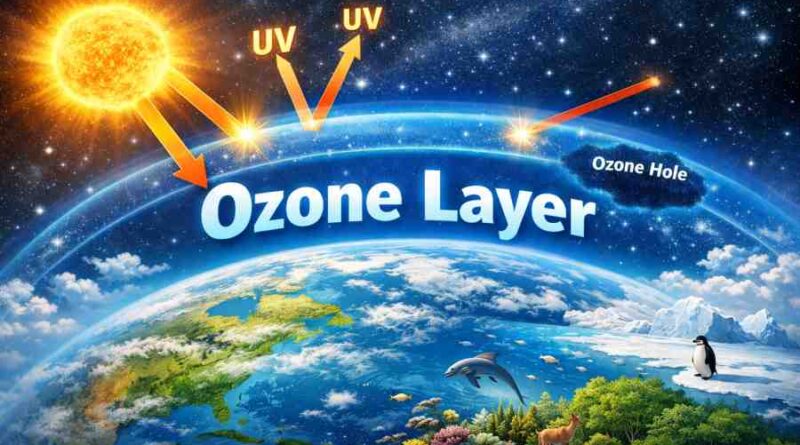
This layer is located about 15 to 35 kilometers above the Earth’s surface. Even though ozone is present in very small amounts compared to other gases in the atmosphere, it has a very important function, it absorbs most of the Sun’s harmful ultraviolet (UV) radiation.
How the Ozone Layer Protects Life
The Sun gives us light and warmth, which are necessary for life. However, along with visible light, the Sun also emits ultraviolet radiation. Some types of UV rays are harmful to living organisms.
There are three main types of UV radiation:
- UVA – Least harmful, reaches the Earth’s surface.
- UVB – Partially absorbed by the ozone layer; can cause skin damage.
- UVC – Most harmful; almost completely absorbed by the ozone layer.
This layer acts like a natural shield. It absorbs most of the UVB and almost all UVC rays, preventing them from reaching the Earth’s surface. Without this protection, humans, animals, and plants would be exposed to dangerous levels of radiation.
Importance of the Ozone Layer
This layer is extremely important for several reasons:
1. Protects Human Health
If harmful UV rays reach the Earth in large amounts, they can cause:
- Skin cancer
- Cataracts (eye damage)
- Weakened immune system
By filtering UV radiation, the ozone layer helps reduce these health risks.
2. Protects Plants and Crops
Plants are sensitive to ultraviolet radiation. Excess UV rays can reduce crop yield, damage plant tissues and affect food production. This layer ensures that plants receive only safe levels of sunlight.
3. Protects Marine Life
Marine ecosystems, especially tiny organisms like plankton, are highly sensitive to UV radiation. Plankton forms the base of the ocean food chain. If plankton is damaged, it affects fish and other marine animals. The ozone layer plays a key role in maintaining ocean life.
4. Maintains Ecosystem Balance
By protecting humans, animals, plants, and marine organisms, this layer helps maintain ecological balance. It supports biodiversity and ensures the survival of different species.
What is Ozone Depletion?
Ozone depletion means the gradual thinning of this layer, which reduces its ability to protect Earth from harmful ultraviolet (UV) rays. Scientists first discovered serious ozone thinning over Antarctica in the 1980s. This area became known as the “ozone hole.”
The ozone hole is not a complete hole but a region where the ozone concentration is extremely low.
Causes of Ozone Depletion
The main cause of ozone depletion is the release of harmful chemicals into the atmosphere. These chemicals include:
- Chlorofluorocarbons (CFCs)
- Halons
- Carbon tetrachloride
- Methyl chloroform
CFCs were widely used in refrigerators, air conditioners, aerosol sprays, and foam products.
When these chemicals reach the stratosphere, they break down under sunlight and release chlorine and bromine atoms. These atoms react with ozone molecules and destroy them. A single chlorine atom can break down thousands of ozone molecules, causing serious damage to the protective ozone layer.
Effects of Ozone Depletion
If this layer continues to thin, the following effects may occur:
1. Increased Health Problems
More UV radiation reaching the Earth can lead to higher cases of skin cancer and eye diseases.
2. Damage to Agriculture
Crop production may decrease due to excessive exposure to ultraviolet rays.
3. Harm to Wildlife
Animals, especially those living in high-altitude or polar regions, may suffer from increased radiation exposure.
4. Impact on Climate
Although ozone depletion and climate change are different issues, they are connected. Changes in the ozone layer can influence atmospheric temperatures and weather patterns.
Global Efforts to Protect the Ozone Layer
The world took strong action to address ozone depletion. In 1987, countries signed the Montreal Protocol, an international agreement to phase out ozone-depleting substances.
The Montreal Protocol is widely recognized as one of the most successful environmental agreements ever made, helping to protect and restore the ozone layer worldwide. Due to this treaty:
- Production of CFCs has been greatly reduced.
- Safer alternatives have been developed.
- The ozone layer is slowly recovering.
Scientists predict that if current efforts continue, the ozone layer may fully recover in the coming decades.
What Can We Do to Help?
Even though governments and industries play a major role, individuals can also contribute:
- Use eco-friendly products.
- Maintain air conditioners and refrigerators properly.
- Avoid products containing harmful chemicals.
- Spread awareness about ozone protection.
Small actions, when taken by millions of people, can create a big impact.
Summary
The ozone layer is like an invisible shield that protects life on Earth from harmful ultraviolet radiation. Without it, humans, animals, plants, and marine ecosystems would face serious threats. Although human activities caused ozone depletion in the past, global cooperation through the Montreal Protocol has shown that positive change is possible.
Protecting the ozone layer is not just an environmental responsibility – it is a duty to safeguard our health, food supply, and future generations. By understanding its importance and supporting eco-friendly practices, we can ensure that this natural shield continues to protect life on Earth for years to come.
Also Check: Environment