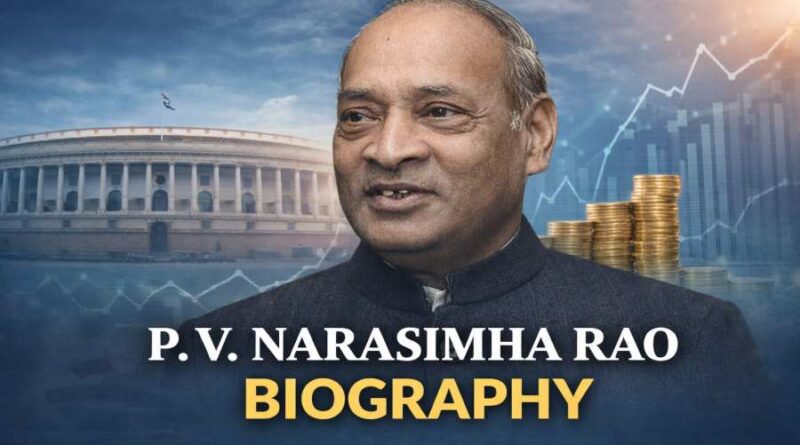
PV Narasimha Rao Biography – The Silent Reformer Who Transformed India’s Economy and 9th Prime Minister of India
Read the PV Narasimha Rao Biography to learn how India’s 9th PM introduced historic economic reforms and led the country through a crucial period of change.
PV Narasimha Rao Biography
P. V. Narasimha Rao was one of the most influential political leaders in modern Indian history. Known for his calm personality, intellectual depth, and strategic thinking, he served as the 9th Prime Minister of India from 1991 to 1996. Rao is widely remembered as the leader who initiated major economic reforms that helped transform India’s economy and open it to the world.
Despite leading the country during a difficult economic crisis, he successfully implemented policies that changed the direction of India’s growth. His leadership, patience, and political skill earned him the nickname “The Silent Reformer.”
Table of Contents
Early Life and Education
Pamulaparti Venkata Narasimha Rao was born on June 28, 1921, in a small village called Laknepalli in present-day Telangana. He was later adopted by a farming family from Vangara, where he spent most of his childhood.
Rao was a brilliant student from a young age. He studied at Osmania University and later completed his law degree at Nagpur University. Apart from academics, he had a deep interest in literature and languages.
One of the most remarkable things about Rao was his knowledge of languages. He was fluent in Telugu, Hindi, English, Marathi, Sanskrit, and several other languages, and he even learned some foreign languages such as Spanish and French.
Entry into Politics
P. V. Narasimha Rao joined the Indian freedom movement during the struggle against British rule. Inspired by leaders like Mahatma Gandhi, he actively participated in political activities.
After India gained independence in 1947, Rao joined the Indian National Congress. His political career began in the Andhra Pradesh Legislative Assembly, where he served in several important positions.
His dedication and administrative skills soon made him a respected leader in the state.
Chief Minister of Andhra Pradesh
In 1971, Rao became the Chief Minister of Andhra Pradesh. During his tenure, he focused on land reforms and education. His policies aimed to improve the conditions of farmers and reduce social inequality.
Although his term ended in 1973 due to political changes, Rao gained valuable experience in governance and administration. This experience later helped him in national politics.
Role in National Politics
Rao later moved to national politics and served in the central government under Prime Minister Indira Gandhi and Rajiv Gandhi.
He handled several important ministries, including:
- Foreign Affairs
- Defence
- Home Affairs
- Human Resource Development
As Foreign Minister, Rao played a key role in strengthening India’s international relations and diplomatic ties.
Prime Minister of India (1991-1996)
In 1991, India faced a serious economic crisis. The country had very low foreign exchange reserves and was close to financial collapse. During this difficult time, P. V. Narasimha Rao became the Prime Minister.
His government introduced historic economic reforms in partnership with Finance Minister Manmohan Singh.
These reforms included:
- Liberalization of the economy
- Reduction of government control over industries
- Encouraging foreign investment
- Privatization of some public sector companies
These policies helped stabilize India’s economy and laid the foundation for rapid economic growth in the coming decades.
Many economists consider Rao the architect of India’s economic liberalization.
Challenges During His Leadership
Rao’s tenure also faced several challenges. One of the most controversial events during his time was the Babri Masjid demolition in Ayodhya in 1992, which led to widespread political and social tensions in the country.
Despite facing criticism and political pressure, Rao managed to complete his full five-year term as Prime Minister, which was a rare achievement for a minority government.
Literary Contributions
Apart from politics, Rao was also a talented writer and scholar. He wrote novels, essays, and translated literary works into different languages.
One of his well-known novels is The Insider, which reflects his experiences in Indian politics.
His deep knowledge of literature and philosophy made him one of the most intellectual leaders in Indian politics.
5 Inspirational Lessons from P. V. Narasimha Rao
1. Stay Calm in Difficult Situations
Rao led India during a major economic crisis but remained calm and focused on solutions.
2. Knowledge is a Powerful Tool
His love for learning and languages made him a highly knowledgeable leader.
3. Silent Work Can Create Big Impact
Even without dramatic speeches, his policies changed India’s future.
4. Adapt to Changing Times
Rao understood the need for economic reforms and adapted policies accordingly.
5. Leadership Requires Courage
Introducing major economic reforms during a crisis required bold and courageous decisions.
Legacy
P. V. Narasimha Rao passed away on December 23, 2004, in New Delhi. Today, he is remembered as one of the most important leaders who helped modernize India’s economy. Although his contributions were sometimes underappreciated during his lifetime, historians now recognize his crucial role in shaping India’s economic future. His policies helped transform India into one of the fastest-growing economies in the world.
Also Check: Biography