Satyajit Ray Biography – Life, Achievements, and Legacy of India’s Legendary Filmmaker
Discover the inspiring journey of Satyajit Ray in this detailed Satyajit Ray Biography, covering his childhood, films, awards, and lasting contribution to world cinema.
Satyajit Ray Biography
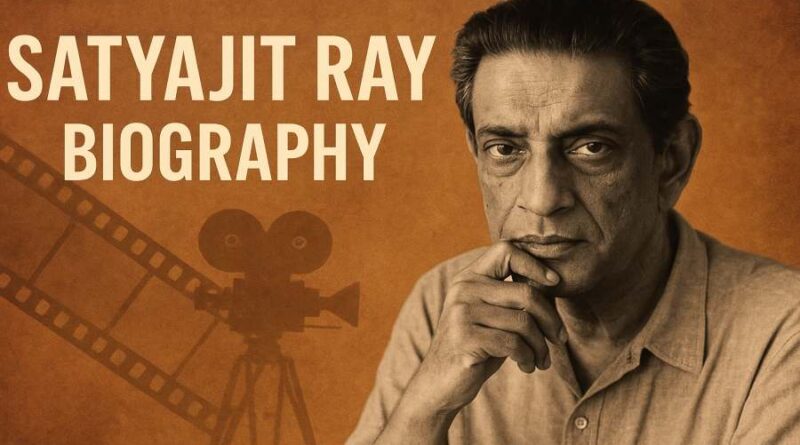
Satyajit Ray was one of the most influential filmmakers in world cinema and a pioneering figure in Indian film history. Known for his realistic storytelling, emotional depth, and remarkable cinematography, Ray reshaped the way Indian cinema was perceived globally. His works are admired for their artistic brilliance and humanistic approach, making him a timeless icon of creativity and intellect.
Table of Contents
Early Life and Background
Satyajit Ray was born on May 2, 1921, in Calcutta (now Kolkata), into a distinguished Bengali family well known for its contributions to literature, art, and culture. His grandfather, Upendrakishore Ray Chowdhury, was a famous writer and publisher, while his father, Sukumar Ray, was a renowned poet and humorist. Ray grew up in an environment filled with creativity, which strongly influenced his worldview.
After completing his early education, Ray joined Presidency College in Kolkata and later studied at Visva-Bharati University, founded by Rabindranath Tagore. Although he initially felt out of place, the serene environment and exposure to rural Bengal shaped his understanding of simplicity, realism, and human values-elements that later appeared in his films.
Entry into Creativity and Early Career
Ray began his professional life as a graphic designer and commercial artist. He worked with a British advertising agency, where he developed strong skills in design, illustration, and visual composition. These talents significantly influenced his film posters, book covers, and title sequences later in his career.
During this period, he co-founded the Calcutta Film Society in 1947, which played a key role in introducing world cinema to India. Ray watched films by international masters like Vittorio De Sica, John Ford, and Jean Renoir. His meeting with Renoir during the filming of The River in India motivated Ray further to explore filmmaking.
The Making of Pather Panchali
In 1955, Satyajit Ray made his directorial debut with Pather Panchali, a landmark film adapted from Bibhutibhushan Bandyopadhyay’s novel. The film was shot with a shoestring budget and an inexperienced crew, but Ray’s vision was powerful. Pather Panchali received worldwide acclaim, winning several international awards, including the Best Human Document at the Cannes Film Festival. It became the first part of the iconic Apu Trilogy, followed by Aparajito and Apur Sansar.
These films not only established Ray as a global filmmaker but also laid the foundation for India’s presence in world cinema.
Major Works and Career Milestones
Over nearly four decades, Ray created more than 30 films, including feature films, documentaries, and short films. Each of his works reflected human struggles, social realities, and emotional depth. Some of his notable creations include:
- Charulata (1964) – A masterpiece exploring loneliness and inner emotions.
- Mahanagar (1963) – A story about women’s empowerment and societal changes.
- Shatranj Ke Khilari (1977) – His first Hindi film, based on Indian history under British rule.
- Goopy Gyne Bagha Byne (1968) – A beloved fantasy musical for all ages.
Ray was not only a filmmaker but also a talented writer, illustrator, and composer. His fictional detective Feluda and scientist Professor Shonku remain extremely popular in Bengali literature.
Awards and Recognition
Satyajit Ray received numerous honours during his lifetime, including:
- 32 National Film Awards
- Golden Lion at Venice Film Festival
- Academy Honorary Award (Oscar) in 1992 for lifetime achievements
- Bharat Ratna, India’s highest civilian award
Even during his last days, Ray accepted his Oscar from his hospital bed, a moment remembered across the world as a tribute to his extraordinary contributions.
Also Read: Sarojini Naidu Biography – Life, Struggles, Literary Journey & Legacy of the Nightingale of India
Personal Life
Ray married Bijoya Ray in 1949, and they had one son, Sandip Ray, who also became a filmmaker. Ray was known for his disciplined lifestyle, deep reading habits, and immense respect for art and culture. He preferred a quiet creative life and often spent long hours detailing his scripts, costumes, set designs, and music for his films.
Legacy
Satyajit Ray’s legacy is everlasting. His films continue to be studied in film schools worldwide, inspiring countless directors and writers. His storytelling method, simple yet emotionally rich, reshaped Indian cinema’s identity. Ray remains a symbol of artistic excellence, intellectual depth, and cultural pride.
He not only elevated Indian cinema to global heights but also proved that powerful stories can be told with honesty, realism, and compassion.
5 Inspirations from Satyajit Ray
- Create with honesty – Ray’s films show that genuine storytelling always connects with people.
- Keep learning – His exposure to world cinema shaped his growth as an artist.
- Stay dedicated – Even with limited resources, he created Pather Panchali, proving commitment leads to excellence.
- Embrace simplicity – He believed that beauty lies in the natural world and human emotions.
- Be multi-skilled – Ray’s talent in writing, music, and design made his creations richer and unique.
Also Check: Biography