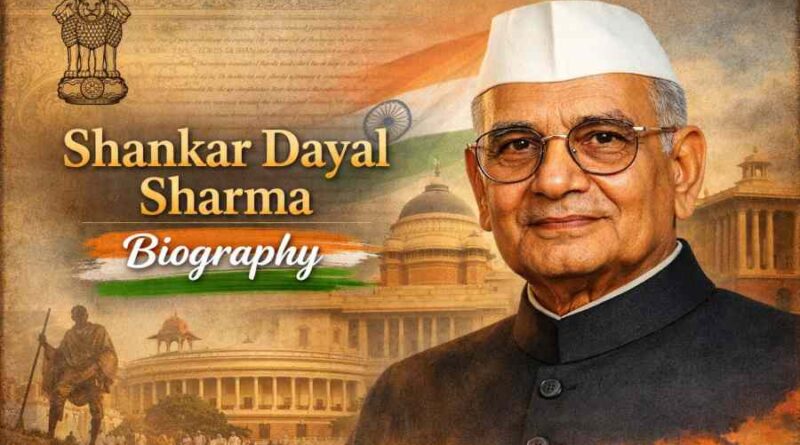
Shankar Dayal Sharma Biography – Life, Political Journey and Legacy of India’s 9th President
Shankar Dayal Sharma Biography explores the life, presidency, political journey and constitutional legacy of India’s 9th President.
Shankar Dayal Sharma Biography Introduction
Shankar Dayal Sharma was one of India’s most respected statesmen, known for his deep constitutional knowledge, unwavering commitment to democracy, and dignified public life. Serving as the 9th President of India from 1992 to 1997, he played a crucial role during a politically sensitive period marked by coalition governments and economic transition. His life reflects the values of integrity, discipline, and dedication to the Indian Constitution.
Table of Contents
Early Life and Education
Shankar Dayal Sharma was born on 19 August 1918 in Bhopal, then part of the princely state of Bhopal. He grew up in a scholarly and culturally rich environment that shaped his intellectual outlook from an early age. His father was an educationist, which greatly influenced Sharma’s respect for learning and public service.
He pursued higher education at Agra University, where he studied law. Later, he went to the University of Cambridge (Fitzwilliam College) in the United Kingdom, gaining exposure to global political thought and constitutional principles. This international academic experience played a vital role in shaping his legal and democratic values.
Role in India’s Freedom Movement
During his youth, Shankar Dayal Sharma was actively involved in the Indian freedom struggle. He participated in movements led by the Indian National Congress and faced imprisonment for opposing British colonial rule. His dedication to India’s independence was not symbolic but practical, involving personal sacrifice and courage.
The freedom movement laid the foundation for his lifelong commitment to democracy, civil liberties, and constitutional governance.
Early Political Career
After independence, Sharma began his formal political career within the Indian National Congress. His sharp legal mind and administrative skills quickly earned him recognition. He was appointed as the Chief Minister of Bhopal (1952–1956), where he focused on administrative reforms and integration with the Indian Union.
Following the reorganization of states, he served as Chief Minister of Madhya Pradesh (1957–1960). His tenure was marked by emphasis on governance, education, and institutional stability.
Governor and Vice-Presidential Roles
Shankar Dayal Sharma went on to serve as the Governor of Andhra Pradesh, Punjab, and Maharashtra, handling complex political situations with constitutional discipline. His role as governor was widely appreciated for impartiality and respect for democratic processes.
In 1987, he was elected as the Vice President of India, also serving as the Chairman of the Rajya Sabha. During this time, he gained admiration for his balanced conduct, firm control of parliamentary proceedings, and respect for opposition voices.
President of India (1992-1997)
In 1992, Shankar Dayal Sharma became the 9th President of India. His presidency coincided with a period of major political instability, frequent changes in government, and economic reforms. Despite these challenges, he upheld the Constitution with remarkable restraint and wisdom.
He is especially remembered for ensuring that constitutional values were never compromised, even under political pressure. His firm yet dignified handling of constitutional crises strengthened the credibility of the President’s office.
Sharma believed that the President should act as the guardian of the Constitution, not as a political authority, a principle he followed throughout his tenure.
Personal Life
Shankar Dayal Sharma was married to Vimala Sharma, who was known for her simplicity and social engagement. He led a disciplined personal life, valuing reading, reflection, and dialogue.
He was widely respected for his humility, soft-spoken nature, and ethical conduct. Even his critics acknowledged his moral authority and constitutional expertise.
Death and Legacy
Shankar Dayal Sharma passed away on 26 December 1999. His death marked the end of an era of principled leadership in Indian politics.
His legacy lives on as a symbol of constitutional morality, democratic restraint, and public service without personal ambition. He remains an inspiration for administrators, lawyers, and political leaders across India.
5 Key Inspirations from Shankar Dayal Sharma’s Life
- Constitution Above Politics – He proved that constitutional duty must always rise above political interests.
- Integrity in Public Life – His career was free from corruption and controversy.
- Power with Restraint – As President, he used authority wisely and sparingly.
- Commitment to Democracy – He respected institutions and democratic debate.
- Lifelong Learning – His intellectual depth showed the value of education in leadership.
Summary
The Shankar Dayal Sharma Biography is a powerful reminder that leadership rooted in values, wisdom, and constitutional discipline can guide a nation even during uncertain times. His life continues to inspire generations to serve the country with honesty, balance, and respect for democratic ideals.
Also Check: Biography