
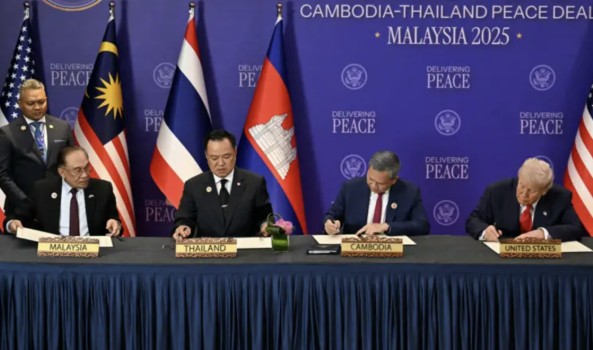
Thailand and Cambodia Sign KL Peace Accord in Malaysia, Brokered by Donald Trump
Discover how Thailand and Cambodia Sign KL Peace Accord to end decades of border disputes, boost regional peace, and strengthen diplomatic and economic ties.
Thailand and Cambodia Sign KL Peace Accord
Thailand and Cambodia have signed the “KL Peace Accord,” a historic deal designed to end decades of border disputes between the two Southeast Asian neighbors. The signing ceremony took place in Kuala Lumpur on October 26, 2025, and was attended by U.S. President Donald Trump, who called the agreement a “major step toward lasting peace and prosperity” in the region.
Table of Contents
KL Peace Accord Brings an End to the Long-Running Border Dispute
The accord was signed by Thai Prime Minister Anutin Charnvirakul and Cambodian Prime Minister Hun Manet during the 47th ASEAN Summit. It officially ends years of occasional clashes along the 817-kilometer border, which had resulted in more than two dozen casualties. The agreement also reaffirms the July ceasefire, which brought an end to five days of fighting earlier this year after diplomatic efforts led by the United States.
Donald Trump’s Mediation and Economic Leverage
President Donald Trump’s active involvement played a key role in convincing both nations to reach common ground. His administration reportedly used trade pressure, cautioning that ongoing conflicts could affect each country’s tariff negotiations with the United States.
At the signing ceremony, Trump also unveiled new U.S. trade and mineral agreements with Cambodia and Thailand, further strengthening America’s economic presence in the peace process. “When we make deals, we also make peace,” Trump remarked, emphasizing the deal-driven diplomacy behind his mediation efforts.
The Importance of ASEAN in Maintaining Stability
The KL Peace Accord creates an ASEAN Observer Team responsible for monitoring progress and ensuring that tensions do not flare up again. Malaysia, as the ASEAN Chair for 2025, has highlighted “Inclusivity and Sustainability” as key themes for regional collaboration. The agreement is widely seen as a significant victory for ASEAN diplomacy and a milestone in Southeast Asia’s efforts to prevent future conflicts.
Important Points for Exams
- The KL Peace Accord was officially signed on October 26, 2025, at the 47th ASEAN Summit in Kuala Lumpur.
- The agreement resolves long-standing disputes over the Preah Vihear and Prasat Ta Muen Thom temple areas.
- An ASEAN Observer Team has been set up to monitor the border and ensure both countries follow the accord.
- Donald Trump’s mediation linked the peace process to U.S. trade negotiations with Thailand and Cambodia.
Also Read: Queen Sirikit of Thailand Dies at 93, Remembering the Beloved Mother of the Nation
Historic Conflict Over Ancient Temples
The long-standing conflict between Thailand and Cambodia centers on the ancient Hindu temples of Preah Vihear and Prasat Ta Muen Thom, located in the Dangrek mountain range. Skirmishes in 2011 near these sites, which caused at least 16 deaths, raised international concern and even prompted UN Security Council involvement. Under the new accord, both countries have agreed to collaborate on heritage preservation, signaling a shift from conflict to cooperation along their shared border.
Strengthening Bilateral Relations
The KL Peace Accord is expected to strengthen diplomatic and economic ties between Thailand and Cambodia. By fostering trust and cooperation, both nations can focus on cross-border trade, tourism, and infrastructure projects. The agreement marks a new chapter of collaboration, reducing the risk of future conflicts and encouraging regional prosperity.
Cultural and Tourism Opportunities
With tensions eased, the historic temple regions are likely to see a boost in cultural tourism. Joint initiatives for preservation and tourism promotion will allow visitors to safely explore the Preah Vihear and Prasat Ta Muen Thom temples, while also showcasing the shared heritage and traditions of both countries to the global audience.
Global Implications of the Accord
The KL Peace Accord sets a precedent for peaceful conflict resolution in Southeast Asia. It highlights the role of international mediation, trade diplomacy, and regional organizations like ASEAN in resolving disputes. Observers worldwide view the agreement as a model for balancing sovereignty, security, and economic interests in contested border areas.
Also Check: Current Affairs