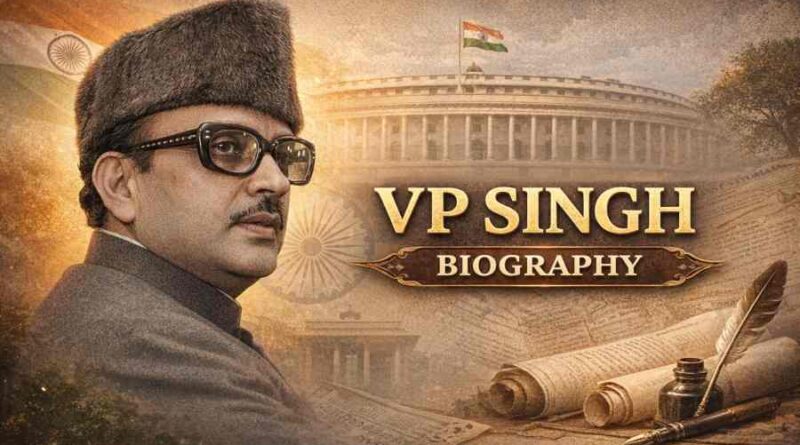
VP Singh Biography – The 7th Prime Minister of India who became a Symbol of Social Justice
VP Singh Biography: Learn about the life, political journey, achievements and legacy of India’s 7th PM who became a symbol of honesty and social justice.
VP Singh Biography
Vishwanath Pratap Singh, popularly known as V. P. Singh, was one of the most influential political leaders in modern Indian history. He served as the 7th Prime Minister of India and is widely remembered for his strong stand against corruption and his historic decision to implement the Mandal Commission recommendations. His leadership played an important role in shaping Indian politics during the late 20th century.
V. P. Singh earned the reputation of being an honest and courageous politician who challenged powerful systems for the sake of justice and equality. His political journey, filled with bold decisions and controversies, continues to inspire many people across India.
Table of Contents
Early Life and Education
V. P. Singh was born on 25 June 1931 in Allahabad (now Prayagraj), Uttar Pradesh, into a royal family. He was later adopted by the Raja of Manda, which made him the Raja of Manda Estate. Despite coming from a wealthy background, Singh developed a deep sense of social responsibility from an early age.
He completed his schooling in Allahabad and later studied at Allahabad University and Pune University. During his student life, he showed a strong interest in social work and politics. He believed that education should not only provide knowledge but also encourage people to serve society.
Entry into Politics
V. P. Singh entered politics in the 1960s and quickly gained recognition for his administrative abilities and honest image. He joined the Indian National Congress, one of the major political parties in India.
In 1969, he was elected to the Uttar Pradesh Legislative Assembly. His dedication to public service helped him gain popularity among the people. Over time, he became known for his efforts to address social issues and improve governance.
Chief Minister of Uttar Pradesh
In 1980, V. P. Singh became the Chief Minister of Uttar Pradesh, India’s most populous state. During his tenure, he focused on controlling dacoity (banditry) in rural areas, which was a serious issue at that time.
He took strong actions against criminal gangs operating in parts of the state, particularly in the Chambal region. His strict policies helped improve law and order, although they also brought criticism from some groups. Nevertheless, Singh’s leadership demonstrated his determination to tackle difficult problems.
Role in the Central Government
V. P. Singh later moved to national politics and served in important positions in the central government. Under the leadership of Rajiv Gandhi, he became the Finance Minister of India in 1984. During this time, Singh introduced several reforms aimed at improving the country’s financial system. He also launched campaigns against tax evasion and black money, which earned him a reputation as a clean and strict administrator.
Later, he was appointed Defence Minister of India. During this period, allegations of corruption related to the Bofors defence deal surfaced. V. P. Singh demanded a thorough investigation into the matter, which eventually led to political tensions within the government.
Becoming the Prime Minister of India
In 1989, V. P. Singh formed the National Front coalition with the support of several political parties. The coalition won the general elections, and he became the Prime Minister of India on 2 December 1989.
His government focused on promoting transparency, social justice, and accountability in governance. One of the most significant decisions during his tenure was implementing the recommendations of the Mandal Commission.
The Mandal Commission recommended reservation (affirmative action) in government jobs for Other Backward Classes (OBCs). This decision aimed to improve opportunities for socially and economically disadvantaged communities.
However, the implementation of the Mandal Commission recommendations led to widespread protests and political debates across the country. Despite the controversy, Singh stood firm in his belief that social equality was necessary for India’s progress.
Challenges and Resignation
V. P. Singh’s government faced several political challenges. The coalition depended on support from different parties with varying ideologies, which made governance difficult.
In 1990, political tensions increased after the arrest of L. K. Advani during the Ram Rath Yatra movement. This decision led to the withdrawal of support by the Bharatiya Janata Party from Singh’s government.
As a result, his government lost its majority in Parliament, and he resigned as Prime Minister in November 1990 after serving for less than a year.
Later Life
After leaving office, V. P. Singh remained active in social and political discussions. However, he gradually stepped away from active politics. In his later years, he also focused on painting and writing poetry, which reflected his creative side.
He was diagnosed with multiple myeloma, a type of cancer, and faced several health challenges. Despite this, he continued to support social justice movements.
V. P. Singh passed away on 27 November 2008 in New Delhi, leaving behind a legacy of courage and integrity in Indian politics.
5 Inspirations from V. P. Singh’s Life
- Stand for Truth: Even when facing powerful opponents, V. P. Singh never hesitated to speak against corruption.
- Work for Social Justice: His efforts to uplift backward communities show the importance of equality in society.
- Courage in Leadership: Great leaders make bold decisions even when they are controversial.
- Integrity Matters: Singh’s honest image proved that politics can be guided by strong moral values.
- Serve Society: True success lies in contributing to the welfare of people.
Legacy
V. P. Singh is remembered as a leader who challenged corruption and worked for social equality. His decision to implement the Mandal Commission recommendations permanently changed the political and social landscape of India.
Although his tenure as Prime Minister was short, his impact on Indian politics remains significant. Many people regard him as a symbol of honesty and moral courage.
Also Check: Biography