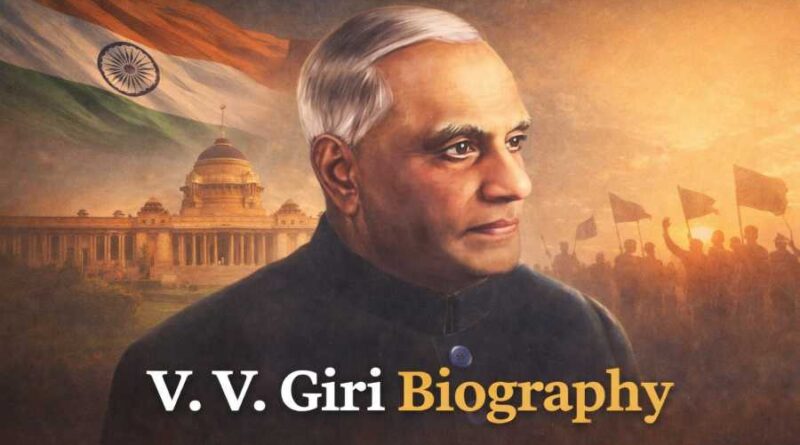
VV Giri Biography – The Voice of Labour and the Fourth President of India
Explore the inspiring VV Giri Biography, India’s fourth President, a freedom fighter, labour leader and statesman who championed workers’ rights and democratic values.
VV Giri Biography
Varahagiri Venkata Giri, popularly known as V. V. Giri, was one of India’s most respected freedom fighters, labour leaders, and statesmen. He served as the fourth President of India from 1969 to 1974 and is remembered for his lifelong commitment to workers’ rights, social justice, and democratic ideals. His journey from a revolutionary nationalist to the highest constitutional office of the country reflects dedication, courage, and integrity.
Table of Contents
Early Life and Education
VV Giri was born on 10 August 1894 in Berhampur, in present-day Odisha, into a Telugu-speaking Brahmin family. His father, Venkata Giri, was a lawyer and an active member of the Indian National Congress, which greatly influenced young Giri’s political thinking. From an early age, he was exposed to nationalist ideas and the struggle against British colonial rule.
Giri pursued his early education in India and later went to Ireland for higher studies. He enrolled at University College Dublin, where he studied law. During his stay in Ireland, he came into contact with Irish nationalists who were fighting for independence from British rule. This experience deeply shaped his political outlook and strengthened his belief in non-imperialism, freedom, and workers’ rights.
Role in the Freedom Struggle
VV Giri actively participated in India’s freedom movement after returning from Ireland. He became associated with revolutionary nationalist activities and supported movements that challenged British authority. Due to his involvement in anti-colonial activities, he faced surveillance and restrictions imposed by the British government.
However, Giri gradually shifted his focus towards organized labour movements, believing that political freedom would be incomplete without social and economic justice for workers. He joined the Indian National Congress and worked closely with leaders who emphasized mass participation and grassroots mobilization.
Champion of Labour Rights
A major part of V. V. Giri’s legacy lies in his dedicated work for the rights and welfare of Indian workers. He emerged as a leading trade unionist and played a crucial role in organizing workers across industries. Giri was associated with the All India Trade Union Congress (AITUC) and later became its president.
He believed that industrial harmony could be achieved through dialogue, collective bargaining, and mutual respect between employers and employees. His views were progressive for his time, emphasizing dignity of labour and fair wages. Internationally, he represented India at the International Labour Organization (ILO) and earned global recognition for his expertise in labour relations.
In 1957, V. V. Giri became the first Indian to be elected as President of the International Labour Conference, a significant achievement that highlighted India’s growing stature on the global stage.
Political Career After Independence
After India gained independence in 1947, V. V. Giri held several important positions in the government. He served as India’s High Commissioner to Ceylon (now Sri Lanka), where he worked to strengthen diplomatic relations.
Giri later entered active parliamentary politics and was appointed as the Union Minister for Labour. In this role, he introduced several reforms aimed at protecting workers’ interests and improving industrial relations. His policies reflected his deep understanding of labour issues and commitment to social welfare.
He became the Vice President of India after his election in 1967. As Vice President, he served as the ex-officio Chairman of the Rajya Sabha and was known for conducting parliamentary proceedings with fairness, discipline, and dignity.
Election as President of India
The presidential election of 1969 was one of the most dramatic in Indian political history. After the death of President Zakir Husain, V. V. Giri took charge as the Acting President of India. He later resigned from this position to contest the presidential election as an independent candidate.
With the support of Prime Minister Indira Gandhi and a section of the ruling party, Giri won the election and became the fourth President of India. His victory marked a significant moment in Indian politics, highlighting the importance of conscience voting and democratic choice.
Presidency and Contributions
V. V. Giri served as President of India from 1969 to 1974. His tenure coincided with a period of political and economic change in the country. As President, he upheld the Constitution and played his role with restraint and wisdom.
He supported policies aimed at reducing inequality and promoting social justice. Though the President’s role is largely ceremonial, Giri used his moral authority to emphasize the importance of democracy, secularism, and workers’ welfare.
He maintained cordial relations with political leaders across party lines and earned respect for his simplicity and humility. His presidency reinforced the idea that the highest office in the land should remain above partisan politics.
Later Life and Death
After completing his term as President, V. V. Giri retired from public life. He spent his later years reflecting on India’s political journey and the labour movement he had helped shape. In recognition of his immense contribution to the nation, he was awarded the Bharat Ratna, India’s highest civilian award, in 1975.
V. V. Giri passed away on 24 June 1980. His death marked the end of an era, but his legacy continues to inspire leaders, workers, and citizens alike.
Legacy of V. V. Giri
V. V. Giri is remembered as the “President of the People,” particularly the working class. His life stands as a testament to the power of dedication, ethical leadership, and service to society. From the freedom struggle to labour reforms and constitutional responsibility, his contributions remain deeply embedded in India’s democratic fabric.
5 Inspirations from VV Giri’s Life
- Respect for Labour: True national progress is impossible without dignity and justice for workers.
- Courage of Conviction: Standing by one’s principles, even in difficult political situations, defines real leadership.
- Democratic Values: Institutions thrive when fairness, dialogue, and constitutional ethics are respected.
- Global Outlook: Learning from international movements can strengthen national development.
- Simple Living, High Thinking: Humility and integrity matter more than power or position.
Also Check: Biography