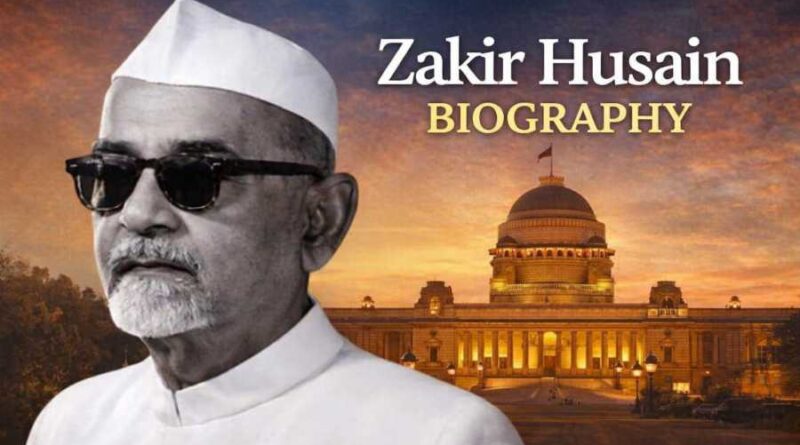
Zakir Husain Biography – Life, Education Reforms and Legacy of India’s third President
Read the detailed Zakir Husain Biography, India’s third President, renowned educationist, freedom fighter, and Bharat Ratna awardee who shaped modern Indian education.
Zakir Husain Biography
Dr. Zakir Husain was one of India’s most respected scholars, educationists, and statesmen. Known for his humility, intellectual depth, and commitment to nation-building, he served as the third President of India and was the first Muslim to hold this constitutional post. His life was dedicated not to power or politics alone, but to education, social reform, and the moral upliftment of society. Even today, he is remembered as a symbol of integrity, simplicity, and enlightened leadership.
Table of Contents
Early Life and Background
Zakir Husain was born on 8 February 1897 in Hyderabad, then part of the princely state under British India. His family soon moved to Kaimganj in Uttar Pradesh, where he spent much of his childhood. He grew up in an environment that valued learning, discipline, and ethical conduct.
Tragedy struck early in his life when he lost his father at a young age. Despite financial and emotional challenges, Zakir Husain displayed exceptional academic talent. His determination and love for knowledge helped him rise above difficulties and laid the foundation for his future role as a national thinker and reformer.
Education and Academic Excellence
Zakir Husain was a brilliant student from the beginning. He pursued higher education at Aligarh Muslim University (AMU), where he was deeply influenced by reformist ideas and the spirit of nationalism. Later, he went to Germany for advanced studies and earned a PhD in Economics.
During his stay in Europe, Zakir Husain closely observed modern education systems. Instead of being attracted by material success abroad, he returned to India with a strong desire to use his knowledge for the country’s development. His exposure to Western education strengthened his belief that India needed an education system rooted in its own culture while being open to modern ideas.
Role in Indian Freedom Movement
Although Zakir Husain was not a mass leader in the traditional political sense, he played a vital role in India’s freedom struggle through intellectual resistance and educational reform. He was associated with leaders like Mahatma Gandhi, who deeply influenced his philosophy of life.
He believed that true freedom could only be achieved when people were educated, self-reliant, and morally strong. Zakir Husain supported the Non-Cooperation Movement and remained committed to Gandhian ideals of simplicity, truth, and service. His contribution proved that nation-building required thinkers and teachers as much as political leaders.
Contribution to Education
Zakir Husain’s greatest legacy lies in the field of education. He was one of the founders of Jamia Millia Islamia, an institution established to promote national education free from colonial influence. He later became its Vice-Chancellor, shaping it into a center of excellence.
As an educationist, he strongly advocated:
- Learning through productive work
- Value-based education
- Integration of moral, intellectual, and physical development
He also served as the Chairman of the University Grants Commission (UGC) and later as the Governor of Bihar, where he continued to promote educational and cultural growth. His ideas helped shape India’s modern education policy and remain relevant even today.
Political Career and Presidency
Zakir Husain’s entry into high constitutional roles came naturally due to his reputation for honesty and wisdom. He served as the Vice President of India from 1962 to 1967. In 1967, he was elected as the President of India, becoming the first person to rise from an academic background to the highest office of the nation.
As President, he emphasized unity, secularism, and democratic values. Sadly, his tenure was cut short due to his untimely death on 3 May 1969, making him the first Indian President to die while in office. Despite this, his presidency left a lasting impression marked by dignity and moral authority.
Awards and Honors
In recognition of his outstanding contribution to education and public service, Zakir Husain was awarded the Bharat Ratna, India’s highest civilian honor, in 1963. This award reflected not only his achievements but also the respect he commanded across political and social boundaries.
Several institutions, roads, and universities in India are named after him, ensuring that future generations remember his service to the nation.
Personal Life and Values
Zakir Husain lived a simple and disciplined life. He believed that public office was a responsibility, not a privilege. Known for his humility, he avoided luxury and maintained close connections with students and scholars.
His writings and speeches reveal a deep concern for social harmony, national unity, and ethical leadership. He believed that education without character was incomplete and dangerous for society.
5 Inspirations from Zakir Husain’s Life
- Education is the strongest tool for nation-building
- True leadership is rooted in humility and integrity
- Knowledge must serve society, not personal ambition
- Cultural values and modern education can coexist
- A simple life with high ideals creates lasting impact
Dr. Zakir Husain’s life stands as a timeless example of how intellect, ethics, and dedication can shape a nation’s destiny
Death and Legacy
Dr. Zakir Husain passed away on 3 May 1969, leaving the nation in mourning. His death was a great loss, but his ideas continue to guide India’s educational and moral framework.
He is remembered not merely as a President, but as a teacher of the nation, whose life demonstrated how knowledge, integrity, and service can transform society.
Also Check: Biography