
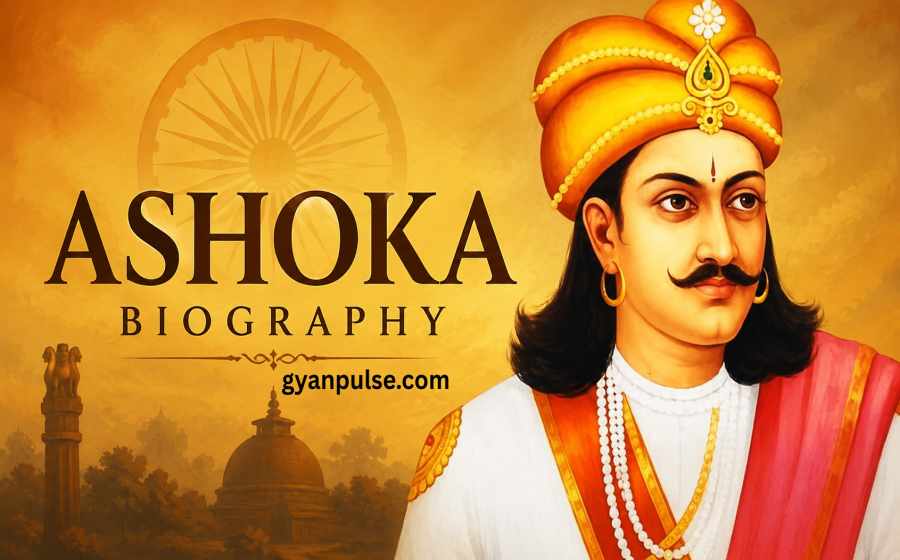
Ashoka Biography The Great Mauryan Emperor – From Fierce Conqueror To The Emperor of Dharma
Ashoka Biography: Explore the life of Emperor Ashoka, his transformation after the Kalinga War, embrace of Buddhism and legacy of peace and justice in India.
Ashoka Biography
Ashoka, widely known as Ashoka the Great, stands among the most influential and transformative rulers in world history. He was the third emperor of the Maurya Dynasty, ruling most of the Indian subcontinent from around 268 BCE to 232 BCE. His life story is remarkable not only for the vast empire he governed but also for the profound moral transformation he underwent, turning from a brutal conqueror into a compassionate ruler guided by peace, ethics, and humanity.
Table of Contents
Early Life and Background
Ashoka was born to Emperor Bindusara, the Mauryan ruler, and Subhadrangi (Dharma). As a prince, Ashoka was known for his intelligence, strong will, and exceptional administrative skills. However, he also earned a reputation for being fierce, ambitious, and sometimes ruthless. Unlike his elder brothers, Ashoka was often sent to distant provinces such as Ujjain and Taxila to suppress rebellions, where he proved himself as a capable military commander and governor.
These early experiences shaped Ashoka into a decisive leader but also strengthened his inclination toward harsh methods to maintain control.
Ascension to the Throne
After the death of Bindusara, a power struggle erupted among the princes. Ashoka emerged victorious and ascended the throne around 268 BCE. Historical accounts suggest that his rise involved significant bloodshed, reinforcing his image as a strict and fearsome ruler during the early years of his reign.
Once crowned emperor, Ashoka focused on expanding the Mauryan Empire further, aiming to establish undisputed dominance across the Indian subcontinent.
The Kalinga War: A Turning Point
The turning point of Ashoka’s life was the Kalinga War fought around 261 BCE. Kalinga, situated in present-day Odisha, was a rich and self-governing kingdom. Driven by his desire to expand the empire, Ashoka decided to invade the region and led a large-scale military attack.
The war resulted in immense devastation. According to Ashoka’s own inscriptions, over 100,000 people were killed, many more wounded, and countless families displaced. Seeing the immense pain, loss of lives, and widespread destruction caused by his own ambition deeply shook Ashoka. This realization became a powerful moment that completely changed the direction of his life.
Ashoka experienced intense remorse and guilt, leading him to renounce violence and warfare forever.
Embrace of Buddhism and Dharma
Following the Kalinga War, Ashoka embraced Buddhism and adopted the philosophy of Dharma, which emphasized non-violence, compassion, tolerance, and moral living. Rather than ruling through fear, Ashoka chose to govern through ethical principles and public welfare.
He did not impose Buddhism by force. Instead, he encouraged its values while respecting all religions, including Hinduism, Jainism, and other belief systems. Religious tolerance became a cornerstone of his administration.
Administration and Welfare Policies
Ashoka revolutionized governance in ancient India by placing people’s welfare at the center of his rule. His policies included:
- Establishing hospitals for humans and animals
- Planting trees and building rest houses along roads
- Digging wells to provide clean drinking water
- Appointing special officers called Dharma Mahamatras to ensure ethical governance
He communicated his ideas through rock and pillar edicts, written in simple language so common people could understand them. These inscriptions remain one of the most important historical sources about his reign.
Global Expansion of Buddhist Teachings
Ashoka played a key role in taking Buddhism beyond India. He sent Buddhist missionaries to places like Sri Lanka, Southeast Asia, Central Asia, and the Middle East. His son Mahinda and daughter Sanghamitta made a lasting impact by helping establish Buddhism firmly in Sri Lanka. Under Ashoka’s patronage, Buddhism transformed from a regional spiritual movement into a global religion.
Ashoka’s Symbolic Legacy
Ashoka’s legacy lives on in modern India. The Ashoka Chakra, a 24-spoked wheel symbolizing righteousness and progress, is featured on the Indian national flag. The Lion Capital of Ashoka at Sarnath is India’s national emblem, representing power guided by moral responsibility.
These symbols reflect Ashoka’s enduring message that true strength lies in justice, compassion, and ethical leadership.
5 Key Inspirations from Ashoka’s Life
- Transformation Is Possible – Even the most aggressive individuals can change through self-reflection.
- Power with Compassion – True leadership balances authority with empathy.
- Non-Violence as Strength – Peaceful values can unite diverse populations.
- Religious Tolerance – Respect for all beliefs creates social harmony.
- Governance for Public Welfare – A ruler’s duty is to serve the people, not dominate them.
Ashoka’s journey from a feared conqueror to a global symbol of peace makes his biography not just a historical account, but a powerful lesson for humanity across generations.
Death and Historical Significance
Ashoka died around 232 BCE, leaving behind an empire rooted not just in territorial expansion but in moral governance. Though the Mauryan Empire declined after his death, his ideals continued to influence Indian philosophy, political thought, and global history.
Historians regard Ashoka as one of the earliest rulers to practice welfare-state governance, making him a timeless example of enlightened leadership.
Ashoka’s Enduring Legacy
Ashoka’s influence extends far beyond the boundaries of the Mauryan Empire, making him one of history’s most respected rulers. His commitment to justice, compassion, and ethical governance inspired generations of leaders and shaped the spread of Buddhism across Asia. The principles he promoted through his edicts, peace, religious harmony, and public welfare, remain relevant even today. Ashoka’s remarkable transformation demonstrates that true greatness is measured not by military victories but by the positive impact a leader leaves on society and humanity.
Summary
Ashoka the Great was a powerful Mauryan emperor whose life stands as a rare example of moral transformation in history. After witnessing the immense suffering caused by the Kalinga War, he renounced violence and adopted the path of Dharma, focusing on compassion, justice, and public welfare.
Through ethical governance, religious tolerance, and the promotion of Buddhism across Asia, Ashoka reshaped the idea of kingship from conquest to service. His edicts, symbols, and values continue to inspire the world, proving that true greatness lies not in domination, but in humanity and peace.
Also Check: Biography