
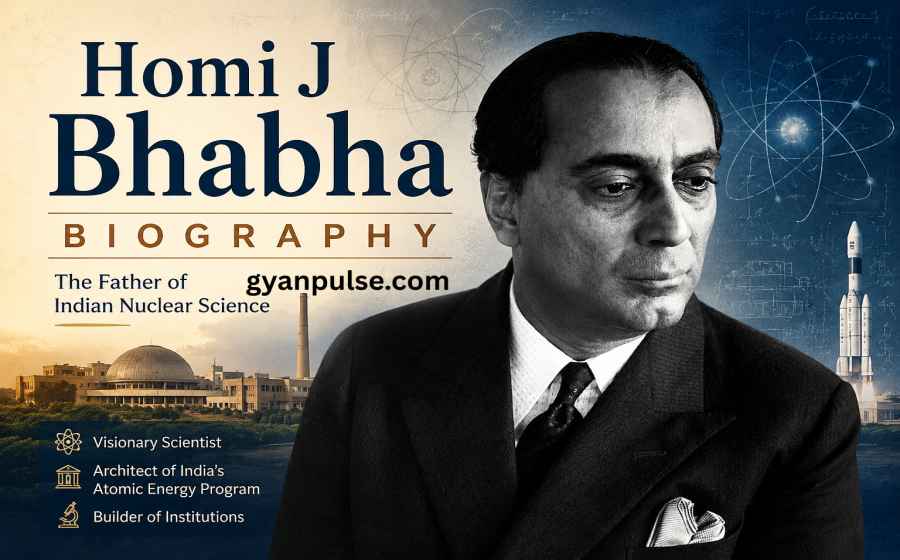
Homi J Bhabha Biography – Father of Indian Nuclear Science and Legacy
Explore Homi J Bhabha Biography, his role in India’s nuclear program, scientific achievements, inspiring life journey and lasting legacy.
Homi J Bhabha Biography
Homi Jehangir Bhabha was an eminent Indian nuclear physicist, visionary scientist, and pioneering leader who played a crucial role in shaping India’s nuclear science and atomic energy program. Born on October 30, 1909, in Mumbai, India, Bhabha is best remembered as the architect of India’s nuclear energy framework, earning him the title “Father of Indian Nuclear Science” His relentless pursuit of scientific excellence and dedication to India’s technological advancement made him a national hero and global scientific icon.
Table of Contents
Early Life and Education
Homi J Bhabha was born into a well-educated and affluent Parsi family in Mumbai. He completed his early education in India before moving to the University of Cambridge, England, where he studied engineering at Gonville and Caius College. However, his passion for physics soon took precedence over engineering, and he switched to theoretical physics, where he made a significant mark with his research in quantum theory and cosmic ray studies.
Contributions to Nuclear Science
In the early 1930s, Bhabha’s research gained global recognition. He formulated what came to be known as the Bhabha Scattering Theory, which explained the scattering of electrons and positrons and became an essential aspect of quantum electrodynamics. His deep understanding of atomic and subatomic processes led to numerous published papers that contributed significantly to particle physics.
Returning to India in the late 1930s, Bhabha envisioned the importance of nuclear energy for India’s growth and technological independence. In 1944, he established the Tata Institute of Fundamental Research (TIFR) in Mumbai, which became India’s premier center for advanced research in nuclear and high-energy physics.
Father of India’s Atomic Energy Program
Recognizing the strategic importance of nuclear energy, Homi Bhabha was appointed the first chairman of the Atomic Energy Commission of India in 1948. Under his leadership, India embarked on an ambitious nuclear program focused on research, power generation, and indigenous development of nuclear technology. Bhabha’s forward-thinking approach led to the commissioning of India’s first nuclear reactor, Apsara, in 1956, marking the nation’s entry into the global nuclear arena.
His strategic vision laid the foundation for the peaceful use of nuclear energy and the pursuit of scientific self-reliance. He advocated for international cooperation in atomic energy, while emphasizing national security and scientific progress.
Tragic Demise
Homi J. Bhabha’s life came to an untimely end in a plane crash on January 24, 1966, while he was on an official visit to Europe. His death was a significant loss for India and the global scientific community. However, his legacy continues to inspire generations of scientists and policymakers.
Legacy and Impact
Bhabha’s contribution extended beyond nuclear science. He was a firm believer in the power of education, scientific inquiry, and research. His emphasis on scientific institutions like TIFR and Bhabha Atomic Research Centre (BARC) created a robust foundation for India’s continued advancements in nuclear science, space research, and fundamental physics.
5 Inspirational Lessons from Homi Jehangir Bhabha’s Life
- Visionary Thinking – Bhabha foresaw the critical role of nuclear science in nation-building long before it became mainstream, showing how vision can guide a nation’s future.
- Relentless Pursuit of Knowledge – His switch from engineering to theoretical physics reflects the importance of following one’s passion and curiosity without fear of societal expectations.
- Scientific Patriotism – Bhabha dedicated his expertise to India’s progress, showing that science and national development can go hand in hand.
- Building Institutions for the Future – His establishment of TIFR and BARC highlights the power of institutions in creating long-lasting scientific impact.
- Balancing Global Collaboration with National Interests – Bhabha encouraged international partnerships but remained focused on India’s self-reliance in science and technology.
Homi J Bhabha’s Vision for Scientific India
One of the most remarkable aspects of Homi J Bhabha’s life was his ability to combine scientific brilliance with nation-building. He believed that advanced research and technological innovation were essential for India’s future progress. Through his leadership, India not only entered the field of nuclear science but also developed strong research institutions that continue to shape the country’s scientific achievements today. His visionary approach inspired generations of scientists to contribute toward national development with dedication, discipline, and innovation.
Summary
Homi J Bhabha was a visionary Indian scientist who laid the foundation of India’s nuclear energy and atomic research programs. Known as the “Father of Indian Nuclear Science,” he established major institutions like TIFR and played a key role in advancing scientific research in India. His dedication, leadership, and innovative thinking continue to inspire scientists and contribute to the nation’s technological growth.
Also Check: Biography