
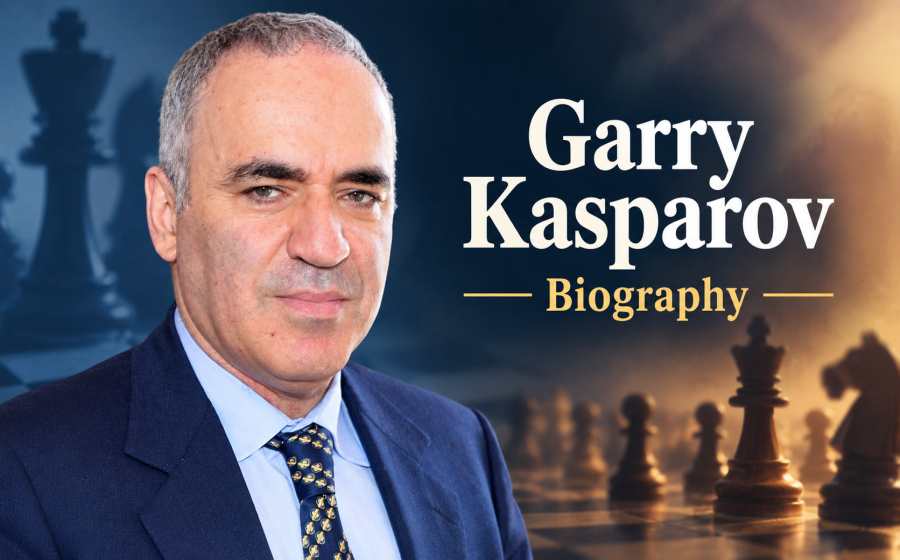
Garry Kasparov Biography – The Chess Genius Who Changed the World of Chess
Explore Garry Kasparov Biography, his early life, chess career, world championship victories, Deep Blue match, achievements and 5 inspiring lessons.
Garry Kasparov Biography
Garry Kasparov is one of the most influential chess grandmasters in history. Known for his extraordinary intelligence, aggressive playing style, strategic thinking, and competitive spirit, he dominated international chess for many years. He became the youngest undisputed World Chess Champion in 1985 at the age of 22, after defeating the reigning champion Anatoly Karpov. His achievements established him as a legendary figure in the world of chess.
However, Kasparov’s life is not limited to winning chess tournaments. He has also made contributions as an author, political activist, public speaker, and advocate for chess education. His famous matches against the IBM supercomputer Deep Blue brought worldwide attention to the relationship between human intelligence and artificial intelligence. His journey offers valuable lessons about dedication, preparation, courage, and continuous learning.
Table of Contents
Early Life and Family Background
Garry Kasparov was born on April 13, 1963, in Baku, which was then part of the Soviet Union and is now the capital of Azerbaijan. His birth name was Garik Kimovich Weinstein. He later adopted the surname Kasparov from his mother, Klara Kasparova.
Kasparov developed an interest in chess during childhood. He learned the game after observing his parents working on chess problems. His mother played a particularly important role in recognizing his talent and supporting his development. Instead of treating chess as a simple hobby, his family helped him pursue it seriously.
As a young boy, Kasparov demonstrated exceptional analytical ability and a strong desire to improve. He joined a chess school associated with former world champion Mikhail Botvinnik, where he received structured training and guidance. This experience helped him develop the technical knowledge and disciplined approach necessary for professional competition.
His progress was remarkable. He became the Soviet Union’s under-18 chess champion at the age of 12 and won the World Junior Chess Championship in 1980 at the age of 17. These achievements established him as one of the most promising young players of his generation.
Beginning of His Professional Chess Career
Kasparov’s rise through international chess was rapid. His combination of deep calculation, creative attacking ideas, opening preparation, and determination made him a formidable opponent. He earned the Grandmaster title in 1980 and soon began competing against some of the strongest players in the world.
In 1982, he won the Moscow Interzonal Tournament, helping him qualify for the Candidates cycle. This competition determined who would challenge the reigning World Chess Champion. Kasparov then defeated several elite opponents, including Alexander Beliavsky, Viktor Korchnoi, and Vasily Smyslov.
These victories demonstrated that his talent was supported by serious preparation and the ability to perform under pressure. He earned the opportunity to challenge Anatoly Karpov, one of the most accomplished chess players of that era.
Garry Kasparov and Anatoly Karpov: A Historic Rivalry
The rivalry between Garry Kasparov and Anatoly Karpov is considered one of the greatest rivalries in chess history. Their contrasting styles made their matches particularly fascinating. Karpov was widely respected for his positional understanding and precise technique, while Kasparov often sought dynamic positions, active piece play, and complicated tactical opportunities.
Their first World Championship match began in Moscow in 1984. It became an extraordinary contest that lasted for months and included many games. The match was eventually terminated without a winner, creating considerable controversy.
The two players met again in 1985. This time, Kasparov won by a score of 13–11 and became the youngest undisputed World Chess Champion at that time, aged 22.
Kasparov subsequently defended his title against Karpov in 1986, 1987, and 1990. Each encounter tested his preparation, resilience, and ability to adapt. Their rivalry helped define an important period in modern chess and produced games that players continue to study.
Major Achievements and Chess Records
Garry Kasparov’s career includes numerous remarkable accomplishments that secured his place among chess’s all-time greats.
Some of his most notable achievements include:
- Youngest undisputed World Champion: He won the title in 1985 at the age of 22.
- Long reign at the top: He remained the world’s highest-rated player for much of his professional career and retired from competitive chess in 2005 while still ranked No. 1.
- Exceptional peak rating: He reached a FIDE rating of 2851 in 1999, a record that remained unsurpassed until Magnus Carlsen exceeded it in 2013.
- Successful title defenses: He retained the championship in several major matches, including three rematches against Karpov.
- Tournament dominance: He achieved outstanding results in elite tournaments around the world.
- Chess education: Through the Kasparov Chess Foundation, he has supported efforts to bring chess into educational settings.
His achievements reflect not only natural ability but also extensive preparation, practical experience, and a willingness to improve his understanding of the game.
Garry Kasparov and the Deep Blue Computer
One of the most famous chapters of Kasparov’s career involved his matches against IBM’s Deep Blue supercomputer.
In 1996, Kasparov played a six-game match against Deep Blue and won the match, although he lost the opening game. The encounter attracted global attention because it demonstrated the growing strength of computer chess.
In 1997, Kasparov faced an upgraded version of Deep Blue in a rematch. This time, the computer won the match by 3½–2½. Kasparov’s defeat became a landmark moment in the development of artificial intelligence and computer technology.
The matches raised important questions about the relationship between human creativity and machine calculation. They also helped make computer chess a subject of international public interest.
Kasparov’s career demonstrates that technological progress can challenge even the most accomplished experts. It also highlights the importance of adapting to new tools and methods rather than relying entirely on past success.
Life Beyond Professional Chess
In 2005, Kasparov retired from professional competitive chess. At that point, he was still the world’s highest-rated player. Rather than ending his public career, retirement allowed him to concentrate more heavily on writing, political activity, and public discussion.
He became involved in Russian opposition politics and advocated democratic reforms. He has also written books about chess, strategy, decision-making, and political issues. His book How Life Imitates Chess explores how strategic thinking and preparation can be applied beyond the chessboard.
Kasparov has spoken to audiences in business, education, and technology about leadership, planning, and the importance of making decisions under uncertainty. Through his educational initiatives, he has also promoted chess as a tool for developing concentration, logical reasoning, and problem-solving skills.
His work beyond competitive chess shows how knowledge and experience from one field can influence other areas of society.
Personal Qualities and Playing Style
Kasparov became famous for his energetic and ambitious approach to chess. He often preferred positions that offered active possibilities and required opponents to make difficult decisions. His preparation was exceptionally detailed, especially in opening theory, and he was known for combining tactical imagination with long-term strategic planning.
Several qualities contributed to his success:
Analytical thinking: He examined complicated positions and searched for opportunities that other players might overlook.
Preparation: He invested significant time in studying opponents, opening variations, and possible plans.
Adaptability: He regularly updated his methods as chess theory and computer technology developed.
Competitive determination: He continued fighting in difficult positions and worked to recover from setbacks.
Intellectual curiosity: His interests expanded beyond chess into politics, technology, education, and strategic decision-making.
These characteristics helped make Kasparov a champion and an influential thinker beyond the game itself.
5 Inspirational Lessons from Garry Kasparov’s Life
1. Start Early, but Keep Learning
Kasparov discovered chess during childhood, but early talent alone did not guarantee success. Training, study, and guidance helped him develop his abilities. His journey shows that discovering an interest is only the beginning; consistent learning turns potential into achievement.
2. Hard Work Strengthens Natural Talent
Exceptional ability can provide an advantage, but preparation is essential for long-term success. Kasparov’s detailed study of openings, opponents, and positions demonstrates the value of practicing with a clear purpose.
3. Learn from Failure
His defeat against Deep Blue in 1997 became one of the most discussed moments of his career. Setbacks can be difficult to accept, but they also reveal the need to reconsider assumptions, learn new methods, and respond intelligently to change.
4. Think Before Making Important Decisions
Chess requires players to evaluate risks, anticipate consequences, and consider several possible outcomes. These habits are useful in education, careers, and everyday life. Kasparov’s career illustrates the value of thoughtful preparation rather than depending entirely on impulse.
5. Continue Growing Beyond Your Greatest Achievement
After retiring from professional chess, Kasparov pursued writing, education, and political activity. His journey demonstrates that achieving a major goal does not have to mark the end of personal development. New interests can create new opportunities to contribute to society.
Legacy of Garry Kasparov
Garry Kasparov’s legacy extends far beyond the trophies and championships he won. His rivalry with Anatoly Karpov helped define an era, while his encounters with Deep Blue became important milestones in the public understanding of artificial intelligence.
He is remembered for his aggressive playing style, remarkable preparation, sustained success at the highest level, and influence on how modern players approach chess. His work in education has also helped introduce the game to students who can use it to develop reasoning and problem-solving skills.
Although he retired from professional competitive chess in 2005, Kasparov remains an influential figure in discussions about chess, technology, strategy, and public life. His career continues to inspire aspiring chess players, students, and professionals who value discipline and intellectual growth.
Summary
Garry Kasparov’s biography is the story of a talented young player who became a world champion through dedication, preparation, and determination. From his early years in Baku to his historic victories over Anatoly Karpov and his memorable matches against Deep Blue, he has played a significant role in shaping modern chess.
His achievements demonstrate the importance of continuous learning, strategic thinking, and the ability to respond to challenges. Beyond chess, his writing, educational initiatives, and public activities have extended his influence to a wider audience.
Also Check: Biography