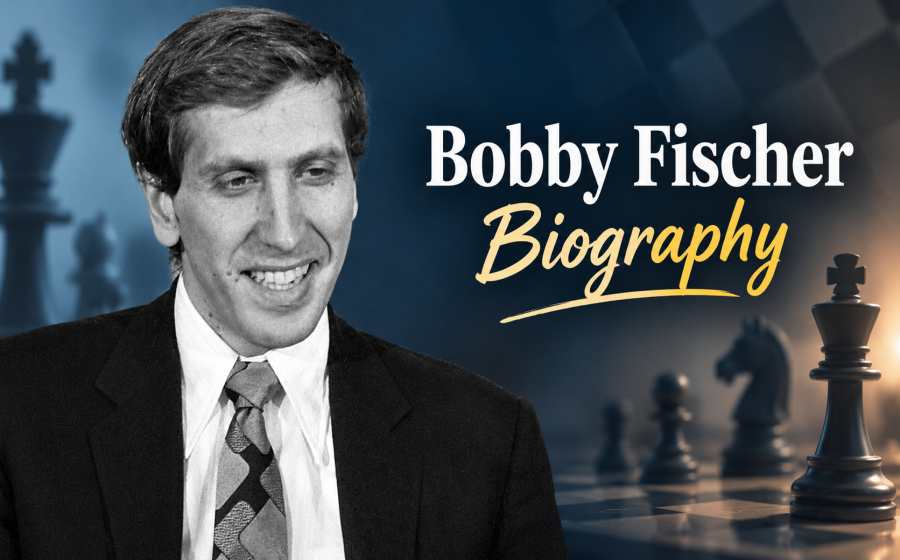
Bobby Fischer Biography – Life, Chess Career and Legacy
Explore Bobby Fischer Biography, from his early life and chess genius to his historic world championship, achievements, struggles and lasting legacy.
Bobby Fischer Biography
Bobby Fischer was one of the greatest chess players in history. Famous for his extraordinary intelligence, sharp strategic thinking, and determination, he transformed the world of competitive chess. His victory over Soviet grandmaster Boris Spassky in 1972 became one of the most celebrated moments in chess history. At a time when chess was closely associated with the Cold War rivalry between the United States and the Soviet Union, Fischer’s achievement attracted worldwide attention.
Although his career was marked by remarkable success, personal difficulties and controversy also shaped his life. His story remains an important subject for chess enthusiasts, students, and anyone interested in talent, discipline, ambition, and the complexities of human achievement.
Table of Contents
Early Life of Bobby Fischer
Bobby Fischer was born on March 9, 1943, in Chicago, Illinois, United States. His full name was Robert James Fischer. He spent much of his childhood in Brooklyn, New York, where he developed an interest in chess at a young age.
Fischer learned to play chess when he was approximately six years old. His sister introduced him to the game, and he soon began studying chess books and practicing independently. What started as a childhood hobby quickly became a serious passion.
Unlike many children who played chess casually, Fischer showed an unusual ability to recognize patterns, calculate variations, and plan several moves ahead. He spent countless hours studying games and improving his skills. His dedication helped him progress rapidly and attracted attention from experienced chess players.
His early life demonstrated how a strong interest, combined with consistent practice, can help a person develop exceptional abilities.
Bobby Fischer’s Rise in Chess
Fischer’s talent became increasingly clear during his teenage years. In 1956, he gained national attention after winning a brilliant game against Donald Byrne, which became known as the “Game of the Century.” The game demonstrated his creativity, tactical imagination, and ability to find unexpected combinations.
In 1957, Fischer won the United States Junior Chess Championship. The following year, in 1958, he won the U.S. Chess Championship at just 14 years old, becoming the youngest winner of the national title at that time.
His success earned him international recognition. In 1958, Fischer also became the youngest grandmaster in chess history at that time, achieving the title when he was only 15 years old. His accomplishment established him as one of the most promising chess talents of his generation.
Fischer continued competing in major international tournaments, facing experienced grandmasters and strengthening his reputation. His opening preparation, positional understanding, and tactical accuracy made him a formidable opponent.
Bobby Fischer’s Playing Style and Strengths
Bobby Fischer was admired for his deep understanding of chess and his ability to combine strategic planning with precise calculation. He preferred positions in which he could gradually build an advantage and then convert it into a win.
Some of his major strengths included:
- Opening preparation: Fischer studied chess openings extensively and often entered the middle game with a clear plan.
- Tactical vision: He could identify combinations and opportunities that other players might overlook.
- Endgame technique: He was particularly skilled at converting small advantages into victories.
- Concentration: Fischer could devote intense attention to complicated positions for long periods.
- Competitive determination: He approached matches with a strong desire to win and prepared carefully for his opponents.
Fischer’s influence also extended beyond the chessboard. He spoke publicly about playing conditions, tournament organization, and professional standards. His demands sometimes created conflicts, but they also drew attention to the importance of fair treatment and proper arrangements for elite competitors.
The Historic 1972 World Chess Championship
The most famous chapter of Bobby Fischer’s career came in 1972, when he challenged Soviet grandmaster Boris Spassky for the World Chess Championship in Reykjavík, Iceland.
During that period, Soviet players had dominated the world championship for decades. Fischer’s challenge therefore attracted attention far beyond the chess community. The match became a symbolic sporting contest during the Cold War, with many people viewing it as a confrontation between American and Soviet chess traditions.
The championship began amid disagreements over arrangements and playing conditions. Fischer initially failed to appear for the second game, creating uncertainty about whether the match would continue. Eventually, he returned to the competition.
Fischer then delivered an extraordinary performance. He defeated Spassky by a score of 12½–8½, winning the championship after 21 games. With this victory, Fischer became the first American-born world chess champion under the modern championship system.
His triumph made him an international celebrity and inspired a new wave of interest in chess, particularly in the United States. The match remains one of the most famous sporting events in the history of the game.
Why Bobby Fischer Did Not Defend His Title
After becoming world champion, Fischer largely withdrew from competitive chess. His absence surprised fans and experts because he was still considered one of the strongest players in the world.
In 1975, Fischer was scheduled to defend his title against Anatoly Karpov. However, disagreements over championship conditions could not be resolved. Fischer did not participate, and the International Chess Federation, known as FIDE, awarded the title to Karpov.
Fischer’s decision marked a major turning point in his career. Despite his extraordinary ability, he remained away from official competitive chess for many years.
His withdrawal illustrates a complicated aspect of his story: professional success does not always lead to a conventional career, especially when personal convictions and institutional disagreements become difficult to reconcile.
Later Life and Return to Chess
Fischer lived much of his later life away from the international chess spotlight. In 1992, he returned for a rematch against Boris Spassky, held in what was then Yugoslavia. Fischer won the match, demonstrating that he retained considerable chess strength despite his long absence from official competition.
However, the event also brought legal and political controversy because the United States had imposed sanctions relating to the conflict in the region. Fischer faced legal difficulties connected with his participation and did not return to the United States.
He spent later years living in several countries, including Japan and Iceland. In 2005, he obtained Icelandic citizenship. Fischer died in Reykjavík on January 17, 2008, at the age of 64.
His later life was complicated, and his public statements sometimes attracted serious criticism. Nevertheless, his achievements as a chess player remain a significant part of the game’s history.
Major Achievements of Bobby Fischer
Bobby Fischer’s career included several remarkable accomplishments:
- Young U.S. Chess Champion: He won the U.S. Chess Championship at age 14 in 1958.
- Chess Grandmaster: He became a grandmaster at age 15, setting a record at the time.
- International Tournament Success: He won major tournaments and established himself among the world’s strongest players.
- 1972 World Chess Champion: He defeated Boris Spassky to become world champion.
- Influence on Modern Chess: His games, preparation methods, and competitive standards continue to be studied by players around the world.
Fischer also helped increase public interest in chess by showing that an individual player could challenge an established international system and achieve extraordinary success.
Five Inspirational Lessons from Bobby Fischer’s Life
1. Follow Your Passion Seriously
Fischer’s interest in chess began during childhood, but he developed his ability through sustained effort. His story reminds us that genuine interest can become a powerful source of motivation when supported by regular practice and learning.
2. Practice is Essential for Excellence
Natural talent alone cannot explain Fischer’s achievements. He devoted enormous time to studying openings, analyzing games, and preparing for opponents. His career demonstrates that improvement requires patience, repetition, and attention to detail.
3. Believe in Your Ability
Fischer competed against experienced players from a young age and eventually defeated the reigning world champion. His success shows the importance of developing confidence through preparation and being willing to face difficult challenges.
4. Prepare Before Facing Challenges
Fischer was known for studying his opponents and preparing deeply for major competitions. Students and professionals can apply the same principle by researching, planning, and identifying weaknesses before attempting an important task.
5. Success Also Requires Balance and Perspective
Fischer’s life was not defined by achievements alone. His conflicts, isolation, and controversies show that professional excellence does not automatically create personal well-being. Long-term success also benefits from emotional balance, constructive relationships, and the ability to work through disagreements.
Bobby Fischer’s Legacy
Bobby Fischer left a lasting mark on the world of chess. His 1972 championship victory challenged the established dominance of Soviet players and brought international attention to the game. His games continue to serve as valuable learning material for beginners, club players, and grandmasters.
Fischer also influenced expectations about preparation and professionalism in elite chess. Many players continue to study his opening choices, strategic ideas, and technical endgames. His famous games remain examples of how calculation, creativity, and determination can combine to produce exceptional results.
At the same time, his life reminds us that historical figures can be both extraordinarily talented and deeply complicated. Recognizing his chess achievements does not require overlooking the controversies surrounding his later years.
Summary
Bobby Fischer was a remarkable chess prodigy who became world champion through exceptional ability, extensive preparation, and intense competitive ambition. From winning the U.S. Championship as a teenager to defeating Boris Spassky in 1972, he created milestones that continue to inspire chess players worldwide.
His life included both extraordinary accomplishments and difficult personal chapters. For students and aspiring professionals, his story offers lessons about passion, practice, preparation, confidence, and the importance of maintaining balance. Bobby Fischer remains one of the most influential and memorable figures in the history of chess.
Also Check: Biography