
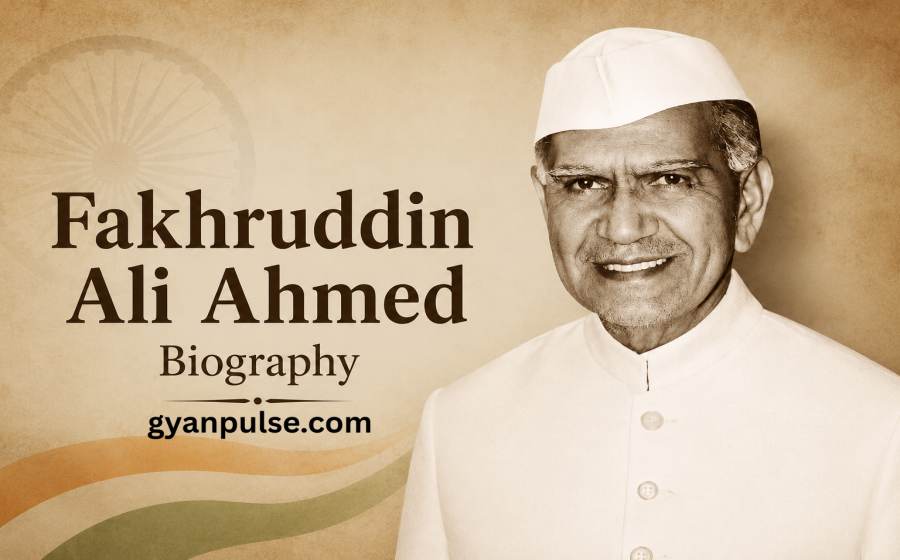
Fakhruddin Ali Ahmed Biography – Life, Presidency and Legacy of India’s Fifth President
Explore Fakhruddin Ali Ahmed Biography, covering his early life, political career, presidency, Emergency role, achievements and lasting legacy in India.
Fakhruddin Ali Ahmed Biography
Fakhruddin Ali Ahmed was the fifth President of India and one of the most significant political figures of the country during the post-independence era. Known for his legal acumen, loyalty to democratic institutions, and long association with the Indian National Congress, he played a crucial role in shaping modern Indian politics. His presidency is especially remembered for its association with the Emergency period, making him a key personality in India’s constitutional and political history.
Table of Contents
Early Life and Education
Fakhruddin Ali Ahmed was born on 13 May 1905 in New Delhi into a respected and educated family. His father, Col. Zalnur Ali Ahmed, was an officer in the Indian Medical Service and belonged to Assam, which deeply influenced Fakhruddin Ali Ahmed’s later political association with the state. From an early age, he showed exceptional academic ability and a keen interest in public affairs.
He received his early education in India and later went to England for higher studies. Fakhruddin Ali Ahmed studied at St. Stephen’s College, Delhi, and subsequently pursued law at St. Catharine’s College, Cambridge. He was also called to the Bar at the Inner Temple, London. His strong legal background later helped him build a successful career as a lawyer and constitutional expert.
Entry into Politics and Freedom Struggle
After returning to India, Fakhruddin Ali Ahmed began practicing law at the Gauhati High Court. Inspired by Mahatma Gandhi and the freedom movement, he soon joined the Indian National Congress and actively participated in India’s struggle for independence. He took part in the Quit India Movement and was imprisoned several times by the British authorities for his nationalist activities.
His dedication to the freedom struggle earned him respect among Congress leaders and the people of Assam. After independence, he emerged as a prominent political leader in the state and at the national level.
Political Career After Independence
Following India’s independence in 1947, Fakhruddin Ali Ahmed held several important positions in both state and central governments. He served as the Advocate General of Assam and later became a member of the Constituent Assembly of India, contributing to discussions on constitutional matters.
He was elected to the Lok Sabha and also served in the Rajya Sabha during his long parliamentary career. Fakhruddin Ali Ahmed held several key ministerial portfolios in the Union Government, including Food and Agriculture, Cooperation, Education, Industrial Development, and Company Laws. As a Union Minister, he was known for his administrative efficiency, simplicity, and commitment to public welfare.
Role as President of India
In 1974, Fakhruddin Ali Ahmed was elected as the fifth President of India, succeeding V. V. Giri. His election reflected the trust placed in him by the ruling leadership and his reputation as a disciplined and loyal constitutional authority. He assumed office at a time when India was facing political instability, economic challenges, and social unrest.
His presidency became historically significant due to the declaration of the Emergency in June 1975. Acting on the advice of the then Prime Minister Indira Gandhi, Fakhruddin Ali Ahmed signed the proclamation of Emergency under Article 352 of the Indian Constitution. This decision remains one of the most debated actions in Indian political history, as it led to the suspension of civil liberties and fundamental rights.
Emergency Period and Controversy
During the Emergency (1975–1977), the President’s role was largely seen as supportive of the executive decisions taken by the government. Fakhruddin Ali Ahmed approved several ordinances and constitutional amendments during this period. Critics argue that he could have exercised greater independence, while supporters believe he acted within the constitutional framework as advised by the Council of Ministers.
Despite the controversy, it is important to understand his actions in the context of India’s parliamentary system, where the President acts on the advice of the elected government.
Death and Legacy
Fakhruddin Ali Ahmed passed away suddenly on 11 February 1977 while still in office, becoming the second Indian President to die during his term. His death marked the end of a crucial chapter in Indian political history. He was laid to rest in New Delhi with full state honors.
His legacy is complex and multifaceted. While his presidency is often associated with the Emergency, his long career as a freedom fighter, parliamentarian, and minister reflects his deep commitment to the nation. Several institutions, including Fakhruddin Ali Ahmed Medical College in Assam, have been named in his honor, highlighting his lasting connection with the region.
5 Key Inspirations from Fakhruddin Ali Ahmed’s Life
- Commitment to Education: His academic excellence shows the importance of strong education in public life.
- Service Before Power: He dedicated decades to public service before becoming President.
- Respect for Institutions: His career reflects deep respect for constitutional and legal processes.
- Simplicity in Leadership: Despite holding high offices, he lived a simple and disciplined life.
- Dedication to the Nation: His lifelong involvement in politics was driven by national interest rather than personal gain.
Fakhruddin Ali Ahmed remains an important figure in Indian history, remembered for his contributions to law, politics, and governance, as well as for the significant constitutional events that occurred during his presidency.
Fakhruddin Ali Ahmed’s Enduring Place in Indian History
Fakhruddin Ali Ahmed’s life reflects the journey of a lawyer, freedom fighter, parliamentarian, minister, and President who witnessed several important phases of India’s political development. His contributions to public service and governance remain significant, while his role during the Emergency continues to invite discussion about constitutional responsibilities and presidential authority. His career offers valuable lessons about leadership, institutions, public duty, and the complexities of political decision-making in a democratic nation.
Summary
Fakhruddin Ali Ahmed was an Indian freedom fighter, lawyer, politician, and the fifth President of India. His long public career included important ministerial responsibilities and constitutional roles, while his presidency became closely linked with the Emergency of 1975–1977. His life remains significant for understanding India’s political history, leadership, public service, and constitutional system.
Also Check: Biography