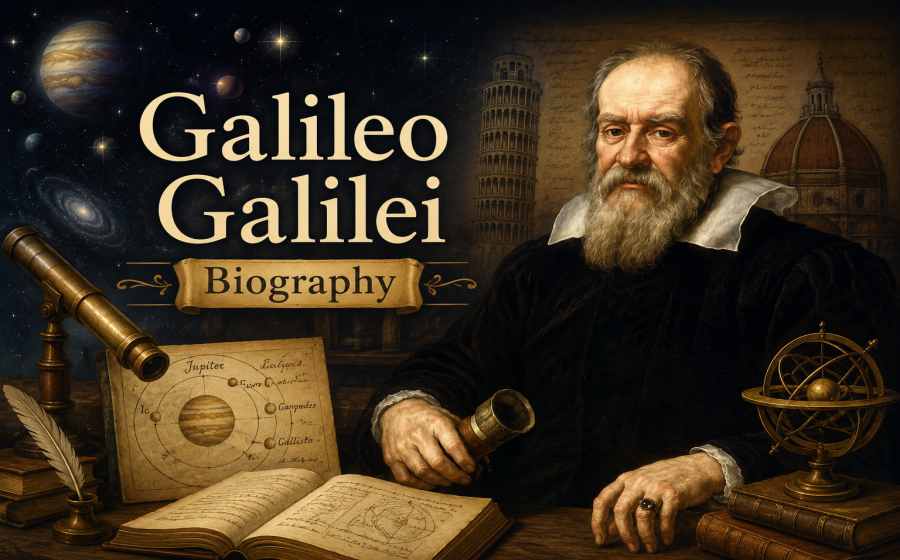
Galileo Galilei Biography – The Man Who Changed Science Forever
Discover Galileo Galilei Biography, his discoveries, inventions, struggles and how he transformed modern science and astronomy.
Galileo Galilei Biography
Galileo Galilei was one of the greatest scientists in human history and is widely known as the “Father of Modern Science” His observations and experiments changed the way people understood the universe. At a time when many accepted traditional beliefs without question, Galileo relied on observation, mathematics, and evidence. His courage to challenge old ideas laid the foundation for modern physics and astronomy.
Born during the Renaissance period, Galileo made remarkable contributions to science, including improvements to the telescope, discoveries about planets and moons, and important studies on motion. His work not only influenced future scientists but also transformed humanity’s understanding of nature and the universe.
Table of Contents
Early Life and Education
Galileo Galilei was born on February 15, 1564, in Pisa, Italy. He belonged to a middle-class family. His father, Vincenzo Galilei, was a musician and scholar who valued education and critical thinking. From a young age, Galileo showed curiosity and intelligence.
Initially, his father wanted him to study medicine because it was considered a stable profession. Galileo joined the University of Pisa in 1581 to study medicine. However, he became more interested in mathematics and natural philosophy. He was fascinated by numbers, patterns, and how the physical world worked.
Eventually, Galileo shifted his focus toward mathematics and science. Though he did not complete a medical degree, his passion for scientific learning led him toward a path that would change history.
Interest in Motion and Physics
Galileo became deeply interested in understanding how objects move. During his time, people believed the theories of ancient philosopher Aristotle, who claimed that heavier objects fall faster than lighter ones.
Galileo questioned this idea. According to popular stories, he dropped objects of different weights from the Leaning Tower of Pisa to test the theory. Whether the event happened exactly as described or not, his experiments showed that objects fall at nearly the same rate regardless of weight.
His approach was revolutionary because he used experimentation rather than simply accepting traditional teachings. He demonstrated that scientific knowledge should be based on evidence.
Galileo and the Telescope
One of Galileo’s most important achievements was improving the telescope. Around 1609, he heard about a device invented in Europe that could magnify distant objects. Galileo improved its design and created a much stronger telescope.
He then pointed his telescope toward the sky, becoming one of the first people to systematically observe the heavens.
His observations led to several groundbreaking discoveries:
- He discovered mountains and craters on the Moon.
- He observed that the Milky Way contained countless stars.
- He discovered four large moons orbiting Jupiter.
- He observed the phases of Venus.
- He noticed dark spots on the Sun, known as sunspots.
These discoveries challenged the long-held belief that everything revolved around Earth.
Support for the Sun-Centered Universe
At that time, most people followed the Earth-centered model proposed by ancient scholars. According to this belief, Earth remained at the center of the universe.
Galileo supported the theory proposed by Nicolaus Copernicus that the Sun was at the center and planets revolved around it. His observations of Venus and Jupiter provided strong evidence supporting this idea.
However, this view created controversy because it conflicted with widely accepted teachings of that period.
Conflict with Religious Authorities
Galileo’s support for the Sun-centered theory brought him into conflict with powerful religious authorities.
In 1632, Galileo published a book discussing different models of the universe. The book strongly supported the idea that Earth moved around the Sun.
As a result, he was summoned for trial by church authorities. In 1633, Galileo was found guilty of supporting ideas considered unacceptable at that time. He was forced to publicly withdraw his views and spent the rest of his life under house arrest.
Even while confined, Galileo continued studying and writing about science.
Later Life and Death
Despite restrictions placed upon him, Galileo continued working on scientific problems. During his later years, he studied motion and mechanics and wrote influential scientific works.
Galileo eventually lost his eyesight, but he continued discussing ideas with students and scholars.
He died on January 8, 1642, at the age of 77 in Arcetri, Italy.
Although his life ended in difficulty, his ideas continued to spread and influence future generations of scientists.
Galileo’s Contribution to Science
Galileo’s contributions remain essential in science today:
- Introduced systematic experimentation
- Improved telescope technology
- Discovered Jupiter’s moons
- Supported the heliocentric theory
- Studied falling objects and motion
- Contributed to modern physics
- Encouraged observation-based science
His work influenced famous scientists such as Isaac Newton and many others.
Legacy of Galileo Galilei
Galileo Galilei transformed the world by encouraging people to question assumptions and seek evidence. His willingness to challenge accepted beliefs showed the importance of critical thinking and scientific investigation.
Today, he is remembered as one of history’s most influential scientific minds. Schools, universities, space missions, and scientific institutions continue honoring his contributions.
His story proves that curiosity and determination can reshape human understanding and inspire generations.
5 Inspirations from Galileo Galilei
- Question accepted beliefs – Do not assume that old ideas are always correct.
- Trust evidence and learning – Facts and observation create stronger understanding.
- Stay curious – Curiosity can lead to life-changing discoveries.
- Keep working despite challenges – Obstacles should not stop progress.
- Knowledge can change the world – One person’s ideas can influence generations.
Summary
Galileo Galilei was a pioneering scientist whose discoveries changed humanity’s understanding of the universe. Through observation, experimentation, and critical thinking, he challenged traditional beliefs and laid the foundation for modern science. His work in astronomy and physics continues to influence scientific research even today. Galileo’s life remains an inspiring example of curiosity, courage, and dedication to truth, proving that the pursuit of knowledge can transform the world.
Also Check: Biography