
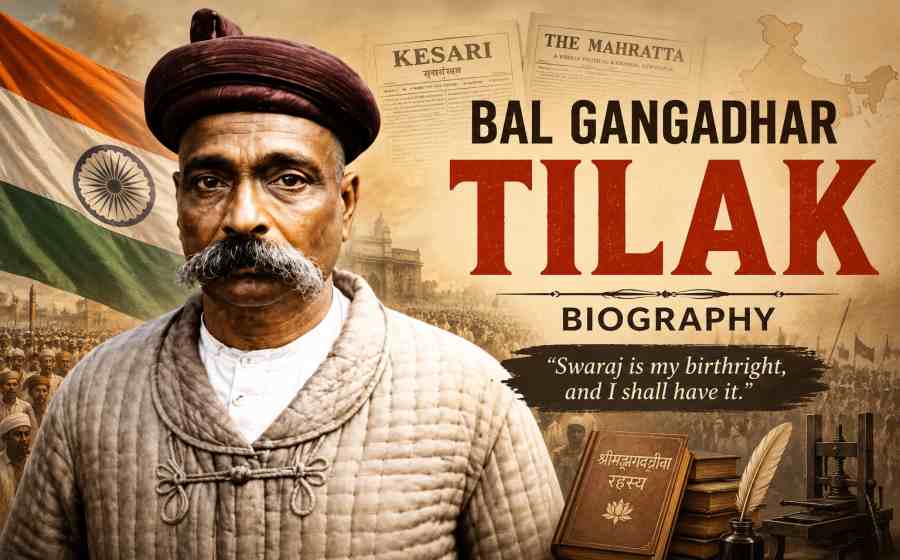
Bal Gangadhar Tilak Biography – The Father of Indian National Awakening
Explore the inspiring Bal Gangadhar Tilak Biography, his early life, freedom struggle, achievements and contributions to India’s independence movement.
Bal Gangadhar Tilak Biography
Bal Gangadhar Tilak was one of the most influential leaders in India’s freedom movement. He played a significant role in awakening nationalism among Indians during British rule. Known for his fearless leadership and strong patriotism, Tilak inspired millions through his speeches, writings, and social reforms. He is popularly remembered by his famous slogan, “Swaraj is my birthright, and I shall have it.”
He was often called Lokmanya, meaning “accepted by the people,” because of the immense respect and love he received from the Indian public. Bal Gangadhar Tilak not only fought against British rule but also worked to unite people through education and cultural activities.
Table of Contents
Early Life and Education
Bal Gangadhar Tilak was born on 23 July 1856 in Ratnagiri, Maharashtra, India. He was born into a well-educated Brahmin family. His father, Gangadhar Ramachandra Tilak, was a teacher and scholar of Sanskrit.
Tilak was a bright student from childhood. He was known for his intelligence, honesty, and determination. He completed his education at Deccan College in Pune and earned a degree in Mathematics. Later, he also studied law.
Even as a student, Tilak believed that education should create awareness and build strong character among people. He felt that the British education system was not enough to inspire patriotism in Indians.
Contribution to Education
Bal Gangadhar Tilak strongly believed that education could transform society. To improve education, he and his friends founded the New English School in Pune in 1880.
Later, they established the Deccan Education Society, aiming to provide quality education to Indians. The institution encouraged students to develop national pride and independent thinking.
Tilak wanted education to produce responsible citizens who could contribute to society and fight for justice.
Journalism and Political Activities
Tilak understood the power of newspapers in influencing public opinion. To spread awareness and inspire people, he started two newspapers:
- Kesari (Marathi language)
- Mahratta (English language)
Through these newspapers, he criticized British policies and encouraged Indians to demand their rights.
His articles were powerful and fearless. The British government considered his writings dangerous because they increased nationalist feelings among the public.
Role in India’s Freedom Struggle
Bal Gangadhar Tilak became one of the leading faces of the Indian independence movement. During that period, many leaders believed in peaceful and slow reforms. Tilak, however, wanted stronger action against British rule.
He was one of the leaders of the famous trio called Lal-Bal-Pal, consisting of:
- Lala Lajpat Rai
- Bal Gangadhar Tilak
- Bipin Chandra Pal
This group played a major role in spreading nationalism across India.
Tilak supported the Swadeshi Movement, encouraging Indians to use locally made products and boycott foreign goods. He believed economic independence was essential for political freedom.
Social and Cultural Contributions
Tilak realized that social unity was necessary for India’s progress. He transformed religious festivals into public celebrations to bring people together.
He popularized:
- Public Ganesh festivals
- Shivaji celebrations
These events helped unite people from different backgrounds and created awareness about nationalism.
Tilak used cultural activities as a tool to inspire patriotism and strengthen social unity.
Imprisonment and Challenges
The British government considered Tilak a threat because of his growing influence. In 1908, he was arrested and sentenced to six years of imprisonment in Mandalay, Burma (now Myanmar).
Even during imprisonment, Tilak continued writing and studying. During this period, he wrote one of his famous works:
Shrimad Bhagavad Gita Rahasya
The book explained his interpretation of the Bhagavad Gita and emphasized action, duty, and courage.
Home Rule Movement
After returning from prison, Tilak launched the Indian Home Rule Movement in 1916.
The movement demanded self-government for Indians. It increased political awareness and encouraged people to actively participate in the struggle for independence.
Tilak’s efforts inspired many future leaders who later played key roles in India’s freedom movement.
Death and Legacy
Bal Gangadhar Tilak passed away on 1 August 1920 in Mumbai. His death deeply saddened the nation, and thousands of people attended his funeral.
Although he did not live to see India become independent, his contributions laid a strong foundation for the freedom movement. His courage, leadership, and determination continue to inspire generations.
Today, Bal Gangadhar Tilak is remembered as one of India’s greatest freedom fighters and a pioneer of Indian nationalism.
5 Inspirations from Bal Gangadhar Tilak
- Fight for your rights with courage – Never remain silent against injustice.
- Education creates awareness – Knowledge can transform society.
- Leadership requires sacrifice – Great leaders often face difficulties.
- Unity makes a nation stronger – Working together brings progress.
- Stay committed to your goals – Persistence leads to success.
Summary
Bal Gangadhar Tilak dedicated his entire life to serving the nation. Through education, journalism, political activism, and social reforms, he awakened the spirit of patriotism among Indians. His famous slogan and fearless personality made him one of the strongest voices against British rule. His life teaches us that determination, courage, and love for one’s country can create lasting change.
Also Check: Biography