
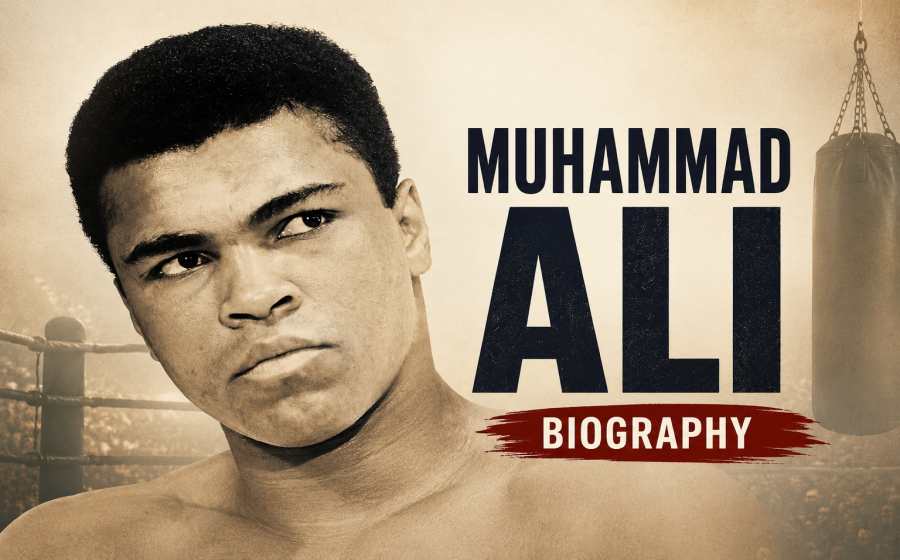
Muhammad Ali Biography – Inspiring Journey of The Greatest Boxer of All Time
Discover the inspiring Muhammad Ali biography, including his early life, boxing career, achievements, personal life and lessons from his remarkable journey.
Muhammad Ali Biography
Muhammad Ali was one of the most famous athletes in history and is widely regarded as one of the greatest boxers of all time. Beyond his achievements inside the boxing ring, Ali became a global symbol of courage, confidence, equality, and determination. His remarkable journey from a young boy in Louisville, Kentucky, to a world heavyweight champion inspired millions across generations.
Known for his quick footwork, powerful punches, and charismatic personality, Muhammad Ali transformed the sport of boxing and left a lasting impact on society. His life story is a powerful example of perseverance, self-belief, and standing up for one’s principles.
Table of Contents
Early Life and Childhood
Muhammad Ali was born as Cassius Marcellus Clay Jr. on January 17, 1942, in Louisville, Kentucky, United States. He grew up in a middle-class family and showed a strong interest in sports from an early age.
Ali’s journey into boxing began when he was just 12 years old. After his bicycle was stolen, he told a police officer that he wanted to find and fight the thief. The officer, who also trained young boxers, suggested that Ali learn boxing first. This unexpected incident changed the course of his life forever. He quickly developed his skills and became one of the most promising young boxers in America.
Amateur Boxing Career
Muhammad Ali achieved remarkable success as an amateur boxer. He won numerous regional and national championships before representing the United States at the 1960 Rome Olympics.
At just 18 years old, Ali won the gold medal in the light heavyweight division, bringing international recognition to his talent. The Olympic victory marked the beginning of an extraordinary boxing career. His speed, confidence, and unique boxing style impressed fans and experts around the world.
Rise to Professional Boxing Stardom
After the Olympics, Ali turned professional and quickly built an impressive winning record. His ability to predict victories and his entertaining pre-fight speeches made him a media sensation.
In 1964, he challenged heavyweight champion Sonny Liston. Many experts believed Ali had little chance of winning. However, he shocked the world by defeating Liston and becoming the World Heavyweight Champion at the age of 22.
Soon after winning the title, he announced his conversion to Islam and changed his name from Cassius Clay to Muhammad Ali.
Boxing Style and Success
Muhammad Ali revolutionized heavyweight boxing with his speed and movement. Unlike many heavyweight fighters who relied solely on strength, Ali combined agility, intelligence, and technique. His famous phrase, “Float like a butterfly, sting like a bee,” perfectly described his fighting style.
Some of his most memorable victories came against legendary opponents such as:
- Sonny Liston
- Joe Frazier
- George Foreman
- Ken Norton
- Leon Spinks
Ali participated in several historic matches that remain iconic in sports history.
The Fight of the Century
In 1971, Ali faced Joe Frazier in a highly anticipated bout known as the “Fight of the Century.” Although Ali suffered his first professional defeat, the rivalry became one of the greatest in boxing history.
The Rumble in the Jungle
In 1974, Ali fought George Foreman in Zaire (now the Democratic Republic of the Congo). Using his famous “rope-a-dope” strategy, he exhausted Foreman and regained the heavyweight championship.
The Thrilla in Manila
In 1975, Ali and Joe Frazier met for the third time in the Philippines. The match was one of the toughest and most intense boxing contests ever witnessed.
Challenges and Controversies
Muhammad Ali’s life was not without challenges. During the Vietnam War era, he refused military induction due to his religious beliefs and personal principles.
As a result, he faced legal battles, lost his boxing license, and was stripped of his heavyweight title. For several years, he was unable to compete professionally.
Despite criticism and setbacks, Ali remained firm in his beliefs. Eventually, the U.S. Supreme Court overturned his conviction, and he returned to boxing. His courage in standing up for his convictions earned him respect worldwide.
Personal Life
Muhammad Ali married multiple times and had several children. One of his daughters, Laila Ali, became a successful professional boxer and continued the family’s sporting legacy.
Outside boxing, Ali dedicated much of his life to humanitarian work, charitable causes, and promoting peace. He traveled around the world supporting social justice and helping people in need. His warm personality and generosity made him admired far beyond the world of sports.
Battle with Parkinson’s Disease
In 1984, Muhammad Ali was diagnosed with Parkinson’s disease, a neurological disorder that affected his movement and speech.
Despite his health challenges, Ali continued to inspire people with his resilience and positive attitude. He remained active in charitable activities and public appearances for many years.
One of his most memorable moments came during the 1996 Olympic Games in Atlanta, where he lit the Olympic cauldron, receiving a standing ovation from millions around the world.
Awards and Achievements
Some of Muhammad Ali’s major achievements include:
- Olympic Gold Medalist (1960)
- Three-time World Heavyweight Champion
- 56 Professional Wins
- One of the most influential athletes in history
- Presidential Medal of Freedom recipient
- International humanitarian and civil rights icon
His achievements extended far beyond boxing and made him a global cultural figure.
Death and Legacy
Muhammad Ali passed away on June 3, 2016, at the age of 74. His death was mourned across the world by athletes, leaders, and fans.
Today, he is remembered not only as a boxing champion but also as a symbol of courage, dignity, and perseverance. His influence continues to inspire athletes and ordinary people alike.
Muhammad Ali’s legacy proves that true greatness comes not only from victories but also from character, determination, and the willingness to stand for what is right.
5 Inspirational Lessons from Muhammad Ali’s Life
1. Believe in Yourself
Ali always believed in his abilities, even when others doubted him. Confidence played a major role in his success.
2. Never Fear Challenges
He faced some of the toughest opponents in history and never backed down from competition.
3. Stand by Your Principles
Ali remained committed to his beliefs despite criticism and personal sacrifice.
4. Turn Setbacks into Comebacks
After losing titles and facing suspensions, he returned stronger and regained championship glory.
5. Use Success to Help Others
Ali dedicated much of his life to humanitarian work, showing that greatness includes serving society.
Summary
Muhammad Ali remains one of the most influential sports personalities ever born. From winning Olympic gold and world championships to standing up for justice and inspiring millions, his life was a remarkable journey of courage and determination. His story continues to motivate people worldwide, proving that confidence, resilience, and strong values can create a legacy that lasts forever.
Also Check: Biography