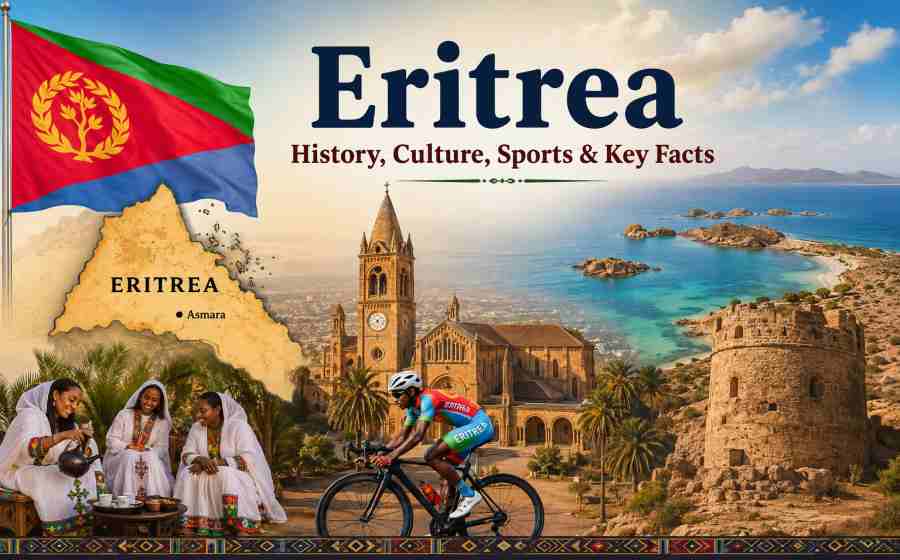
Eritrea – History, Culture, Sports and Key Facts about this East African Nation
Discover Eritrea’s history, culture, sports, geography, economy, traditions and key facts. Learn everything about this unique East African nation.
Eritrea
Eritrea is a fascinating country located in the Horn of Africa, known for its rich history, diverse cultures, scenic Red Sea coastline, and resilient people. Although it is one of the youngest independent nations in Africa, Eritrea possesses an ancient civilization that dates back thousands of years. The country has witnessed the rise and fall of powerful kingdoms, colonial rule, and a long struggle for independence before becoming a sovereign nation in 1993.
Today, Eritrea is recognized for its cultural diversity, historical landmarks, unique architecture, and traditional lifestyle. Despite facing economic and political challenges, the nation continues to preserve its heritage and natural beauty. This article explores Eritrea’s history, culture, sports, geography, economy, and other essential facts.
Table of Contents
Location and Geography
Eritrea is situated in northeastern Africa and shares borders with Sudan, Ethiopia, and Djibouti. To the east, it enjoys a long coastline along the Red Sea, stretching for nearly 1,200 kilometers.
The country’s landscape is incredibly diverse, featuring:
- Coastal plains
- Mountainous highlands
- Deserts
- Fertile valleys
- Islands in the Red Sea
The capital city is Asmara, often called the “Little Rome of Africa” because of its impressive Italian-style architecture.
Quick Facts
- Capital: Asmara
- Continent: Africa
- Official Languages: Tigrinya, Arabic, and English are widely used
- Currency: Eritrean Nakfa (ERN)
- Population: Around 3.7 million (estimated)
- Government: Presidential republic
- Independence: 24 May 1993
History of Eritrea
Ancient Civilization
Eritrea has been inhabited for thousands of years. Archaeological discoveries indicate that early human settlements existed here long before recorded history.
The region was once part of the ancient Kingdom of D’mt, followed by the powerful Kingdom of Aksum, one of Africa’s greatest civilizations. These kingdoms were major centers of trade connecting Africa, Arabia, and the Mediterranean.
Ottoman and Egyptian Influence
During the 16th century, parts of Eritrea came under Ottoman control due to its strategic location on the Red Sea. Later, Egypt also governed portions of the coastal region.
Italian Colonial Rule
Italy colonized Eritrea in 1890, making it Italy’s first African colony. During this period, roads, railways, ports, and impressive buildings were constructed, especially in Asmara.
Many of these colonial-era buildings remain standing today and contribute to the city’s unique architectural heritage.
British Administration
Following World War II, Britain administered Eritrea from 1941 until 1952.
Federation with Ethiopia
In 1952, Eritrea became federated with Ethiopia under United Nations supervision. However, Ethiopia later dissolved the federation and annexed Eritrea, triggering decades of conflict.
Independence Movement
Eritrea fought one of Africa’s longest independence wars, lasting nearly 30 years. Finally, after a UN-supervised referendum, Eritrea officially became an independent nation on 24 May 1993.
Culture of Eritrea
Eritrean culture reflects African, Arab, and Mediterranean influences.
Ethnic Diversity
The country officially recognizes nine ethnic groups, including:
- Tigrinya
- Tigre
- Afar
- Saho
- Bilen
- Kunama
- Nara
- Hedareb
- Rashaida
Each community preserves its own language, traditions, clothing, and customs.
Languages
Although Eritrea has no single official national language by law, Tigrinya, Arabic, and English are widely used in education, administration, and business.
Traditional Clothing
Traditional clothing varies among communities. Women often wear beautifully embroidered white dresses, while men wear loose robes and turbans during festivals and ceremonies.
Food and Cuisine
Eritrean cuisine is flavorful and similar in some ways to Ethiopian food.
Popular dishes include:
- Injera (flat sourdough bread)
- Zigni (spicy beef stew)
- Shiro
- Lentil stew
- Grilled meat
- Fresh seafood along the coast
Traditional coffee ceremonies are an important part of Eritrean hospitality.
Religion and Festivals
Religion plays an important role in Eritrean society.
The major religions are:
- Christianity
- Islam
Churches and mosques coexist peacefully in many communities, reflecting the country’s religious diversity.
Festivals
Some important celebrations include:
- Independence Day (24 May)
- Martyrs’ Day
- Orthodox Christian festivals
- Eid celebrations
- New Year festivals
Music, dancing, traditional clothing, and community gatherings are central to these events.
Economy
Eritrea’s economy mainly depends on:
- Agriculture
- Livestock
- Mining
- Fishing
- Small industries
Important agricultural products include:
- Sorghum
- Millet
- Maize
- Vegetables
- Fruits
Mining has become increasingly important, with resources such as:
- Gold
- Copper
- Zinc
- Potash
The Red Sea also supports fisheries and maritime trade.
Sports in Eritrea
Sports are becoming increasingly popular across Eritrea.
Cycling
Cycling is considered the country’s most successful sport. Eritrean cyclists regularly compete in international competitions and have earned recognition across Africa and Europe.
Football
Football is the most widely followed sport. Local leagues attract enthusiastic supporters, while the national team participates in regional competitions.
Athletics
Long-distance running and athletics continue to produce talented athletes representing Eritrea in international championships.
Other Sports
People also participate in:
- Basketball
- Volleyball
- Swimming
- Martial arts
Tourism
Although tourism remains limited, Eritrea offers many attractive destinations.
Popular places include:
- Asmara’s Art Deco architecture
- Dahlak Archipelago
- Red Sea beaches
- Ancient churches
- Historic railway
- National museums
Nature lovers enjoy coral reefs, diving opportunities, and desert landscapes.
Wildlife
Eritrea is home to a variety of wildlife, including:
- Gazelles
- Hyenas
- Ostriches
- Monkeys
- Camels
- Dolphins
- Sea turtles
- Numerous bird species
Marine biodiversity along the Red Sea is especially rich.
Education
Education has expanded steadily since independence.
The government has worked to improve:
- Primary education
- Secondary schools
- Technical education
- Higher education
Literacy rates have gradually improved, though rural education still faces challenges.
Climate
Eritrea experiences different climate zones because of its varied geography.
- Highlands have mild temperatures.
- Coastal areas are hot and humid.
- Western lowlands become extremely hot during summer.
Rainfall mainly occurs between June and September.
Interesting Facts About Eritrea
- Eritrea gained independence in 1993 after nearly 30 years of conflict.
- Asmara is famous for its remarkably preserved Italian modernist architecture.
- The country has over 350 islands in the Red Sea, many belonging to the Dahlak Archipelago.
- Cycling is one of Eritrea’s most celebrated sports.
- The Red Sea coastline is rich in coral reefs and marine life.
- Eritrea is among the youngest sovereign nations in Africa.
- Coffee ceremonies remain an important social tradition.
- The Nakfa, Eritrea’s currency, is named after a town significant in the independence struggle.
- The country’s diverse landscapes range from mountains to deserts and coastal plains.
- Eritrea’s cultural traditions reflect a blend of African, Arab, and Mediterranean influences.
Summary
Eritrea is a nation of remarkable resilience, ancient heritage, and cultural richness. From the powerful Kingdom of Aksum to its hard-fought independence in 1993, the country has experienced a unique historical journey. Its diverse ethnic communities, vibrant traditions, delicious cuisine, and growing sporting achievements make Eritrea an important part of Africa’s cultural landscape. While challenges remain, Eritrea continues to preserve its historical legacy and natural beauty, offering valuable insights into one of the continent’s most distinctive nations.
Also Check: General Knowledge