
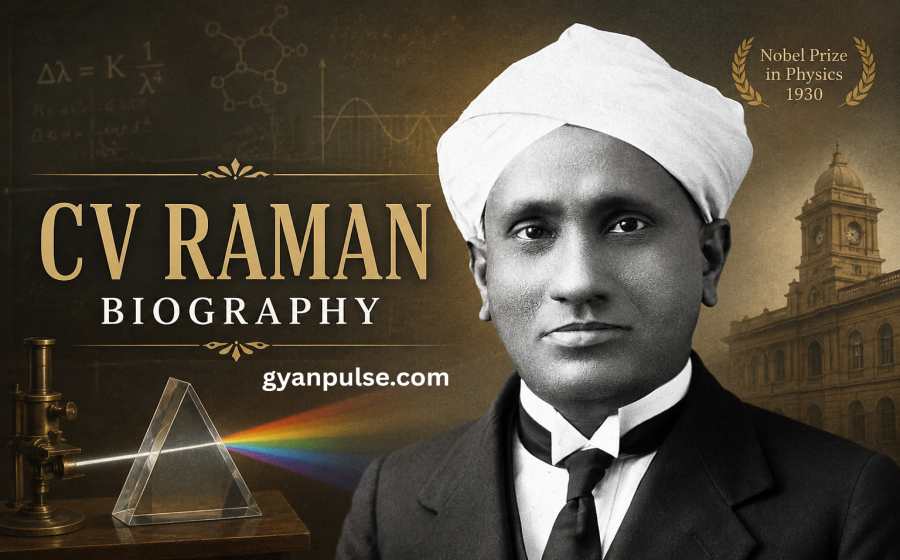
CV Raman Biography – Nobel Prize Winner and Discoverer of Raman Effect
Discover CV Raman Biography, the inspiring story of India’s Nobel Prize-winning physicist who discovered the Raman Effect and transformed science.
CV Raman Biography
Chandrasekhara Venkata Raman, popularly known as C. V. Raman, was a brilliant Indian physicist whose groundbreaking work in the field of light scattering earned him the prestigious Nobel Prize in Physics in 1930. His discovery, known as the Raman Effect, not only revolutionized the understanding of light and molecular interactions but also placed India on the global scientific map.
Table of Contents
Early Life and Education
C. V. Raman was born on November 7, 1888, in the city of Tiruchirapalli, located in Tamil Nadu, India. From a very young age, Raman exhibited exceptional intellectual ability, particularly in science and mathematics. His father, who taught mathematics and physics, greatly encouraged his interest in science from an early age.
Raman completed his early education at Presidency College in Madras (now Chennai), where he graduated with a degree in Physics, standing first in his class. His brilliance was immediately apparent, and he later went on to join the Indian Finance Service. Despite his administrative career, his passion for physics remained undiminished.
The Journey to Discovery
While serving as an accountant-general in Calcutta (now Kolkata), Raman actively pursued physics research in his spare time. His dedication led to significant studies on acoustics and the optical properties of liquids. It was during this period that he became deeply interested in the phenomenon of light scattering.
In 1928, Raman made his most famous scientific breakthrough. He discovered that when light passes through a transparent material, a small fraction of the light emerges at different wavelengths than the incident light. This phenomenon, later called the Raman Effect, provided critical insight into the molecular structure and interactions of materials.
Raman’s meticulous experiments confirmed that the scattered light carried information about the molecular vibrations of the substance it passed through. This discovery laid the foundation for what is now known as Raman Spectroscopy, widely used in chemical analysis, medical diagnostics, and material science.
Nobel Prize and Global Recognition
In 1930, C. V. Raman was awarded the Nobel Prize in Physics, becoming the first Asian and first Indian to receive this prestigious honor in the field of science. The Royal Swedish Academy of Sciences recognized his work as a monumental contribution to the understanding of molecular scattering of light.
Apart from winning the Nobel Prize, Raman’s discovery made him famous all around the world. His pioneering research demonstrated that India was capable of contributing significantly to modern science, inspiring generations of Indian scientists.
Contributions Beyond Raman Effect
C. V. Raman was not just limited to his Nobel-winning discovery. He had a deep interest in acoustics, optics, and crystal physics. His work on the diffraction of light, molecular dynamics, and acoustics helped establish several scientific theories.
In 1933, Raman established the Indian Academy of Sciences to encourage scientific research and teamwork across India. He was also the first Indian director of the Indian Institute of Science (IISc), Bangalore, where he encouraged original research and mentored several young scientists.
Legacy and Impact
C. V. Raman’s contributions went beyond his scientific discoveries. He firmly believed in promoting scientific temper and education among Indians. His advocacy for research and innovation laid the groundwork for the growth of India’s scientific infrastructure.
Raman passed away on November 21, 1970, but his legacy lives on. The Raman Effect remains a fundamental concept in physics and chemistry. Every year, India celebrates National Science Day on February 28th to honor his contributions and inspire the next generation of scientists.
Scientific Vision and Inspiration
Beyond his remarkable discoveries, C. V. Raman inspired countless young minds to pursue science with curiosity and determination. He believed that scientific research should be driven by independent thinking and practical experimentation rather than relying solely on foreign advancements.
Raman’s dedication to education and innovation encouraged the development of modern scientific institutions in India, helping the nation gain recognition in the global scientific community. His life continues to motivate students, researchers, and aspiring scientists to explore the wonders of physics and contribute to the progress of humanity.
Summary
The life of C. V. Raman stands as a symbol of dedication, intelligence, and scientific excellence. From his early passion for physics to the discovery of the Raman Effect, his achievements transformed the world of modern science and brought immense pride to India. His contributions to research, education, and innovation continue to inspire generations of scientists and students. Even today, Raman’s legacy remains alive through National Science Day and the widespread use of Raman Spectroscopy in various scientific fields.
Also Check: Biography