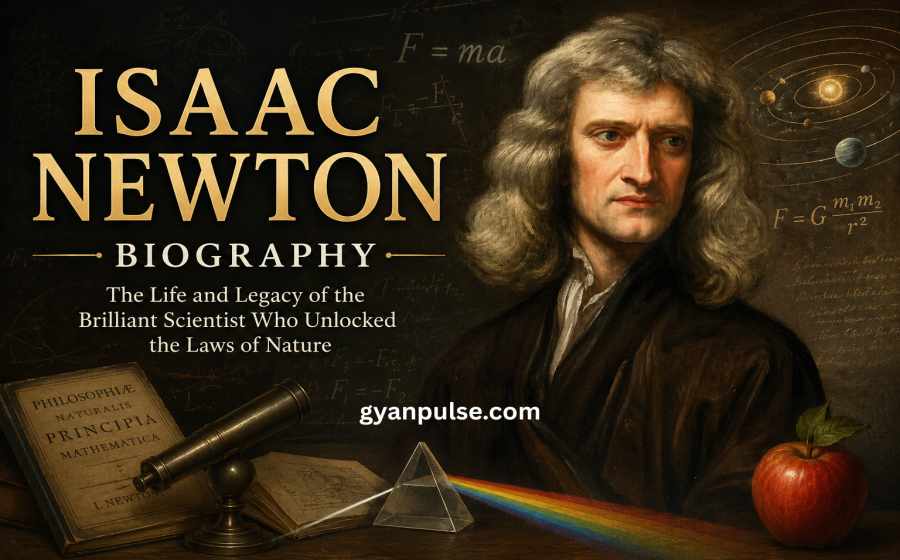
Isaac Newton Biography – Life, Discoveries and Contributions in Science
Discover the inspiring Isaac Newton Biography, covering his laws of motion, gravity, inventions, major discoveries and lasting scientific legacy.
Isaac Newton Biography
Isaac Newton, born on January 4, 1643, in Woolsthorpe, Lincolnshire, England, is regarded as one of the most influential scientists of all time. His pioneering work in physics, mathematics, and astronomy laid the foundation for classical mechanics and transformed the way humanity understands the natural world.
Table of Contents
Early Life and Education
Isaac Newton was born prematurely, and his early life was marked by hardships. His father died before his birth, and his mother remarried, leaving young Isaac in the care of his grandmother. Despite a difficult childhood, Newton showed an early aptitude for learning and mathematics. He attended the King’s School in Grantham and later enrolled at Trinity College, Cambridge, in 1661.
During his time at Cambridge, Newton became deeply interested in the works of earlier scientists such as Galileo Galilei, Johannes Kepler, and René Descartes. He began developing his ideas about physics, optics, and mathematics during a period when the university temporarily closed due to the plague (1665–1667). This “Annus Mirabilis” (Year of Wonders) allowed Newton to focus intensively on research in isolation.
Major Discoveries and Scientific Contributions
Laws of Motion
One of Newton’s most groundbreaking achievements was the formulation of the three laws of motion, which describe the relationship between a body and the forces acting upon it. These laws revolutionized the understanding of physical movement and remain fundamental in classical mechanics:
- First Law (Law of Inertia): A body remains at rest, or in uniform motion unless acted upon by an external force.
- Second Law (F=ma): The force acting on an object is equal to the mass of the object multiplied by its acceleration.
- Third Law: For every action, there is an equal and opposite reaction.
Universal Gravitation
Newton’s law of universal gravitation was another revolutionary concept. He proposed that every mass in the universe attracts every other mass with a force proportional to the product of their masses and inversely proportional to the square of the distance between their centers. This principle explained both terrestrial and celestial phenomena, including the orbits of planets and the behavior of falling objects.
Calculus
Although the development of calculus was independently carried out by both Isaac Newton and German mathematician Gottfried Wilhelm Leibniz, Newton’s method of “fluxions” laid the groundwork for modern calculus. His mathematical innovations provided powerful tools to solve problems in physics and engineering.
Optics and Light
Newton made significant contributions to the study of light and optics. He demonstrated that white light is composed of a spectrum of colors by passing it through a prism, leading to his theory of color. Newton also designed the first practical reflecting telescope, known as the Newtonian telescope, which improved observational accuracy and reduced chromatic aberration.
Later Life and Legacy
Isaac Newton’s influence extended beyond his scientific discoveries. In 1696, he was appointed Warden of the Royal Mint and later became the Master of the Mint. He played a crucial role in reforming England’s currency and fighting counterfeiting.
In 1703, Newton was elected President of the Royal Society, a position he held until his death. His seminal work, Philosophiæ Naturalis Principia Mathematica (Mathematical Principles of Natural Philosophy), published in 1687, remains one of the most important scientific books ever written.
Newton passed away on March 31, 1727, leaving an unparalleled legacy in science. His contributions continue to form the bedrock of physics, mathematics, and astronomy. His work not only explained the laws of nature but also inspired future generations of scientists to explore and understand the universe in greater depth.
Inspirational Quote
“If I have seen further, it is by standing on the shoulders of giants.” – Isaac Newton
Newton’s Influence on Modern Science
The impact of Isaac Newton’s discoveries continues to shape the modern world even centuries after his death. His laws of motion and universal gravitation became the foundation of classical physics and influenced countless scientific advancements in astronomy, engineering, and space exploration. Newton’s innovative thinking and dedication to understanding nature inspired future scientists such as Albert Einstein and Stephen Hawking. Today, his contributions remain essential in scientific education and research, proving why Isaac Newton is remembered as one of history’s greatest intellectual minds.
Summary
Isaac Newton was one of the greatest scientists in history whose discoveries transformed the understanding of physics, mathematics, and astronomy. From developing the laws of motion and universal gravitation to contributing to calculus and optics, his work laid the foundation for modern science. His groundbreaking ideas continue to influence scientific research, education, and technological progress around the world, making his legacy timeless and inspiring for future generations.
Also Check: Biography