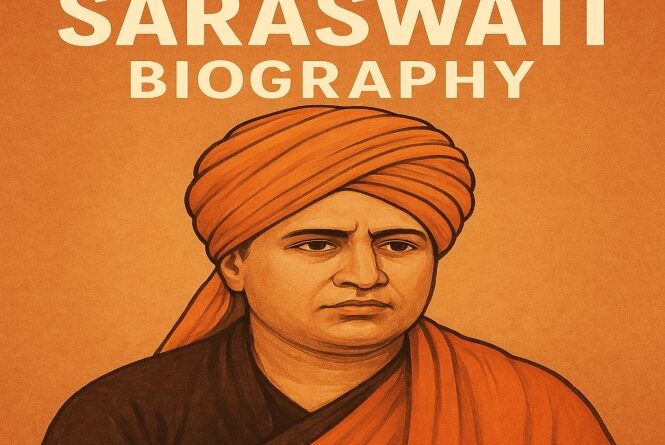
Dayananda Saraswati Biography, Life, Teachings & Inspirations, Full Details 2025
Explore the inspiring life of Dayananda Saraswati Biography, founder of Arya Samaj. Learn about his biography, teachings, social reforms, and 5 life lessons that continue to inspire.
Dayananda Saraswati Biography
Dayananda Saraswati, the founder of the Arya Samaj, was one of the most influential reformers of 19th-century India. Born on 12 February 1824 in Tankara, Gujarat, as Mool Shankar Tiwari, he dedicated his life to challenging social evils, reviving Vedic knowledge, and inspiring Indians to embrace truth and righteousness. His philosophy and reforms played a significant role in shaping modern India.
Table of Contents
Early Life and Education
Dayananda Saraswati was born into a traditional Hindu Brahmin family. From a young age, he was deeply curious about spiritual truths and often questioned blind beliefs. An incident during Shivaratri, when he saw rats eating the offerings made to Lord Shiva, made him doubt idol worship. This questioning nature led him on a journey to seek truth beyond rituals and superstitions.
Leaving home at the age of 22, he wandered across India as a renunciate in search of wisdom. During his travels, he studied under many saints and scholars and immersed himself in the Vedas, which later became the foundation of his teachings.
Founding of Arya Samaj
In 1875, Dayananda Saraswati started the Arya Samaj in Bombay (today’s Mumbai) to spread Vedic teachings and social reforms. The movement was based on the principles of the Vedas and promoted values such as truth, morality, and equality. It strongly opposed caste discrimination, idol worship, child marriage, and social evils while promoting education, especially for women.
The motto of Arya Samaj, “Krinvanto Vishwam Aryam” (Make the world noble), reflected his vision of a society based on justice, truth, and equality.
Social and Religious Reforms
Dayananda Saraswati worked fearlessly to reform Indian society. His key contributions included:
- Advocacy for women’s education and widow remarriage.
- Opposition to untouchability and rigid caste divisions.
- Promotion of Vedic studies and rational thinking.
- Criticism of blind faith, idol worship, and superstition.
- Campaigns against child marriage and polygamy.
His book Satyarth Prakash (The Light of Truth), published in 1875, became a guiding text for reformers and continues to inspire people today.
Also Read: Dr Vikram Sarabhai Biography – Father of India’s Space Program
Final Years and Legacy of Dayananda Saraswati
Dayananda Saraswati’s fearless truth-telling earned him both admirers and enemies. He died on 30 October 1883 in Ajmer, Rajasthan, due to poisoning, but his message continued to live through Arya Samaj institutions across India.
His legacy influenced India’s freedom movement, as leaders like Lala Lajpat Rai, Swami Shraddhanand, and even Mahatma Gandhi were inspired by his call for social justice and national pride.
5 Inspirational Life Lessons from Dayananda Saraswati
- Question Blind Beliefs – Never accept rituals without logic; seek truth through knowledge.
- Equality for All – Stand against discrimination and support justice for every human being.
- Power of Education – Knowledge is the true path to empowerment, especially for women and marginalized groups.
- Courage to Reform – True progress requires challenging traditions when they harm society.
- Live by Truth – Honesty, morality, and self-discipline are the foundation of a noble life.
Also Read: Homi J Bhabha Biography: Father of Indian Nuclear Science & Legacy
Conclusion
Dayananda Saraswati was more than a religious reformer-he was a visionary who sowed the seeds of modern Indian society. His emphasis on Vedic wisdom, rational thinking, and social justice continues to inspire millions. His life reminds us that true spirituality lies not in blind rituals but in the pursuit of truth and humanity.
Also Check: Current Affairs