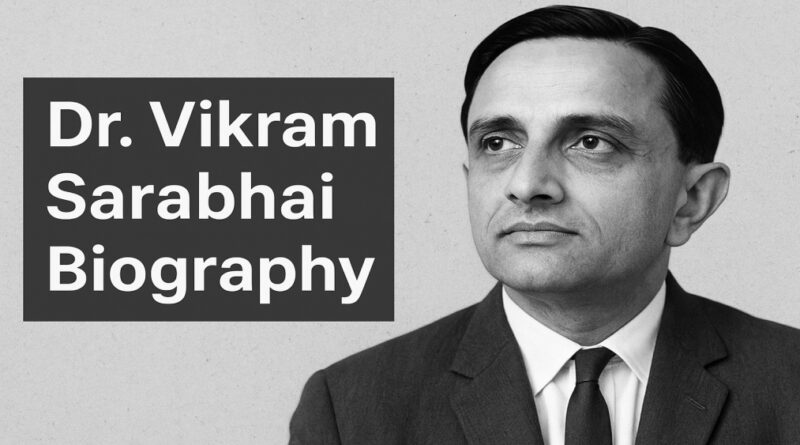
Dr Vikram Sarabhai Biography – Father of India’s Space Program, Full details 2025
Discover the inspiring life of Dr. Vikram Sarabhai Biography, the visionary scientist who founded the Indian Space Program. Learn about his achievements, contributions, and 5 inspirational lessons from his life.
Dr Vikram Sarabhai Biography
Dr Vikram Ambalal Sarabhai was born on August 12, 1919, in Ahmedabad, India, into a wealthy industrialist family. However, he was not just an heir to business wealth but a visionary whose passion for science and development propelled India into the space age. He is widely known as the Father of the Indian Space Program, thanks to his pioneering efforts in establishing India’s space research and development capabilities.
Table of Contents
Early Life and Education
Vikram Sarabhai Biography: Dr. Sarabhai showed exceptional intellectual promise from a young age. He completed his early education in India and later attended the University of Cambridge, where he studied natural sciences. His time at Cambridge shaped his scientific thinking, providing him a strong foundation in physics and a broad worldview about the power of science in societal development.
Vision for Indian Space Program
When India was newly independent, the nation faced numerous challenges, including poverty, illiteracy, and lack of technological infrastructure. Dr. Sarabhai was a firm believer that science and technology should play a critical role in addressing these problems. In 1962, he established the Indian National Committee for Space Research (INCOSPAR), which later became the Indian Space Research Organisation (ISRO).
Also Read : Dr. A.P.J. Abdul Kalam Biography
Dr. Sarabhai’s vision was clear – space technology should benefit the common people, not just serve scientific curiosity or military interests. Under his leadership, India launched its first satellite, Aryabhata, in 1975. He emphasized applications such as communication, weather forecasting, and remote sensing to support development goals like education, agriculture, and disaster management.
Major Contributions
- Establishment of ISRO: Dr. Sarabhai was instrumental in setting up the Indian Space Research Organisation in 1969, which has now become one of the world’s leading space agencies.
- Development of Satellite Technology: He championed the development and use of satellite technology for peaceful purposes, primarily focusing on enhancing telecommunications and weather services for India’s rural population.
- Indian Institute of Management Ahmedabad (IIMA): Besides science, Dr. Sarabhai was passionate about education. He played a key role in founding IIMA, one of India’s premier management institutes, to nurture future leaders in business and public administration.
- Promotion of Scientific Temper: He actively promoted the idea that scientific thinking should percolate society and guide decisions in governance and policy.
- International Collaborations: He established fruitful international partnerships, particularly with NASA, for technological and knowledge exchange, which accelerated India’s space capabilities.
Also Read : Isaac Newton Biography
Inspirational Lessons from Dr. Vikram Sarabhai’s Life
- Vision Beyond Personal Gain: He envisioned the use of space technology to solve real-world problems rather than for prestige or personal glory.
- Commitment to National Development: His work was motivated by the desire to uplift Indian society, especially focusing on rural and underprivileged sectors.
- Interdisciplinary Approach: He believed that science must interact with management, policy, and society to create holistic solutions.
- Leadership with Humility: Dr. Sarabhai led by example, combining visionary thinking with practical implementation, all while remaining humble and approachable.
- Unyielding Optimism: Even in the face of technological and resource limitations, he remained optimistic that India could achieve space milestones comparable to the world’s best.
Legacy
Dr. Vikram Sarabhai passed away on December 30, 1971, but his legacy continues to inspire generations of scientists and policymakers. Today, ISRO stands tall as a symbol of India’s space achievements, contributing significantly to satellite launches, planetary missions, and space research. His focus on applying space technology for the common good remains a guiding principle.
Dr. Sarabhai’s life teaches us that science, when aligned with the purpose of societal welfare, becomes a powerful tool for sustainable development.
Also Read : Albert Einstein Biography