Europe Continent – Area, Population, Countries, Culture, Languages and Important Facts
Explore complete GK information about the Europe Continent, including area, population, top countries, culture, languages, sports, economy, and important facts in an easy way.
Europe Continent
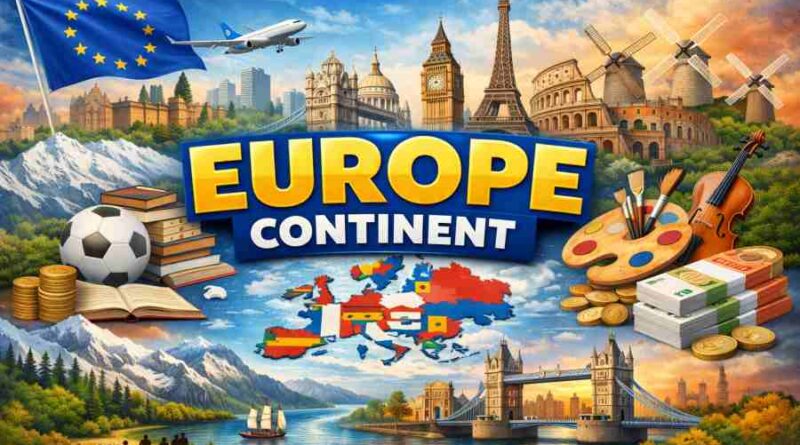
Europe is one of the most influential and historically rich continents in the world. Although it is smaller in size compared to Asia and Africa, Europe has played a major role in shaping global politics, culture, science, education, and economy. From ancient civilizations to modern technological advancements, the Europe continent holds great importance in world geography and general knowledge.
Table of Contents
Geographical Overview of Europe
Europe is located entirely in the Northern Hemisphere and partly in the Eastern Hemisphere. It is bordered by:
- Asia to the east
- Arctic Ocean to the north
- Atlantic Ocean to the west
- Mediterranean Sea to the south
The Ural Mountains, Ural River, Caspian Sea, and Caucasus Mountains form the natural boundary between Europe and Asia.
- Total Area: Approx. 10.18 million sq km
- Rank by Area: 6th largest continent
- Population: Over 745 million people
Top 5 Largest Countries in Europe by Area
Europe has both very large and very small countries. Below are the top 5 European countries by area:
- Russia (European part) – Largest country in Europe
- Ukraine – Largest country fully in Europe
- France – Includes mainland Europe and overseas regions
- Spain – Covers most of the Iberian Peninsula
- Sweden – Largest country in Northern Europe
Top 5 Most Populated Countries in Europe
Europe has a high population density in many regions. The top 5 countries by population are:
- Russia – Most populated country in Europe
- Germany – Economic powerhouse of Europe
- United Kingdom – Highly urbanized population
- France – Strong cultural and political influence
- Italy – Known for historical cities and heritage
Total Number of Countries in Europe
- Total Countries: 44-50 (depending on definition)
- Widely Accepted Number: 44 countries
- Partly European Countries: Russia, Turkey, Kazakhstan, Georgia
Europe is home to some of the smallest countries in the world, such as Vatican City, Monaco, and San Marino.
Climate of Europe
Europe experiences diverse climatic conditions due to its wide geographical range:
- Mediterranean Climate: Warm summers, mild winters (Italy, Spain, Greece)
- Oceanic Climate: Cool summers, mild winters (UK, France)
- Continental Climate: Hot summers, cold winters (Eastern Europe)
- Polar Climate: Extremely cold (Northern Scandinavia)
The Gulf Stream plays a major role in keeping Western Europe warmer than other regions at similar latitudes.
Culture and Traditions of Europe
European culture is one of the most diverse in the world. Each country has its own traditions, festivals, art forms, and lifestyle.
Key Cultural Features:
- Rich history of art, literature, music, and philosophy
- Birthplace of Renaissance, Industrial Revolution, and Enlightenment
- Famous festivals like Oktoberfest (Germany), Carnival of Venice, and La Tomatina (Spain)
European architecture ranges from ancient Roman structures to modern skyscrapers.
Languages Spoken in Europe
Europe is linguistically rich and diverse.
Major Language Families:
- Indo-European (English, French, German, Spanish, Russian)
- Uralic (Finnish, Hungarian)
- Altaic & Others (Turkish, Maltese)
Most Spoken Languages:
- English
- German
- French
- Russian
- Spanish
English is the most widely used second language across Europe.
Religion in Europe
Europe has been historically influenced by religion.
- Christianity – Dominant religion (Catholic, Protestant, Orthodox)
- Islam – Significant population in parts of Europe
- Judaism – Historical roots across Europe
- Secularism – Growing in modern Europe
Many European countries follow a secular government system.
Sports and Entertainment in Europe
Sports are an essential part of European life.
Most Popular Sports:
- Football (Soccer) – Most loved sport
- Tennis
- Cricket (UK)
- Rugby
- Formula 1 Racing
Europe hosts major global sports events like the UEFA Champions League, Wimbledon, and Formula 1 circuits.
Economy and Development
Europe is among the world’s most developed continents in terms of economy and infrastructure.
- Home to many developed nations
- Strong industries: Manufacturing, Banking, Tourism, Technology
- European Union (EU) promotes economic cooperation
- Euro (€) is a major global currency
Countries like Germany, France, and the UK play a major role in the global economy.
Important Rivers and Mountains
Major Rivers:
- Danube
- Rhine
- Volga (longest in Europe)
- Thames
Major Mountain Ranges:
- Alps
- Pyrenees
- Carpathians
- Caucasus
Important Facts About Europe
- Europe has the smallest country in the world – Vatican City
- The world’s oldest universities are in Europe
- Europe has the highest number of international tourists
- Many world wars and peace treaties originated here
Summary
The Europe Continent may be smaller in size, but its impact on world history, culture, economy, and education is enormous. With diverse countries, languages, climates, and traditions, Europe remains one of the most important continents in the world. Understanding Europe is essential for students preparing for GK, competitive exams, and general awareness.
Also Check: General Knowledge