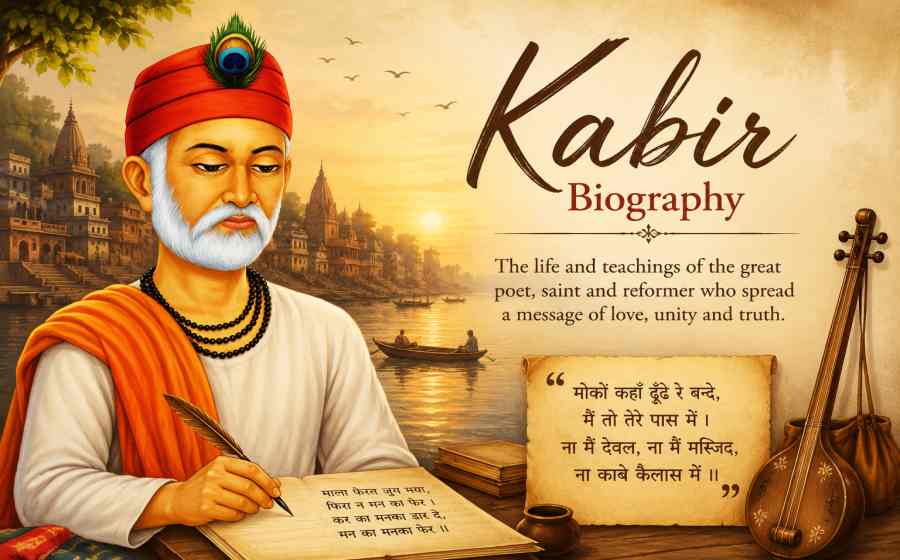
Kabir Biography – The Mystic Poet Saint Who Changed Indian Spiritual Thought
Explore the inspiring Kabir Biography, the legendary poet-saint whose teachings on humanity, equality and spirituality continue to inspire generations.
Kabir Biography
Kabir was one of India’s greatest spiritual poets and social reformers. He is remembered for his powerful verses, known as Dohas, which carried deep messages about humanity, devotion, truth, and equality. Kabir played a significant role in shaping the spiritual and social thinking of medieval India. His teachings rejected blind rituals and focused on inner purity and devotion to God.
Even centuries after his death, Kabir’s words continue to inspire millions of people because of their simplicity and universal message. He believed that all human beings are equal and that true religion lies in love, truth, and kindness.
Table of Contents
Early Life of Kabir
The exact date of Kabir’s birth remains uncertain, but historians generally believe that he was born around 1440 CE in Varanasi, India. Many stories and legends are associated with his birth. According to popular belief, he was found as an infant near Lahartara Lake and was adopted by a Muslim weaver couple named Niru and Nima.
Kabir grew up in a humble family and learned weaving as his profession. Despite belonging to a poor household, he possessed a deep curiosity about spiritual matters from an early age.
During that period, society was divided by caste systems and religious differences. Kabir observed discrimination and injustice around him, which later became major themes in his poetry.
Spiritual Journey
Kabir desired spiritual knowledge and guidance. It is believed that he became a disciple of Ramananda, one of the famous saints of the Bhakti movement.
A well-known story says that Kabir lay on the steps of the Ganges River where Ramananda usually came for morning prayers. When Ramananda accidentally stepped on him, he uttered the words “Ram Ram.” Kabir accepted these words as his spiritual initiation.
Kabir’s devotion was unique because he did not follow a single religion strictly. Instead, he taught that God is one and exists beyond religious boundaries.
Kabir’s Teachings and Philosophy
Kabir strongly criticized meaningless rituals and practices followed in the name of religion. He believed that true devotion comes from the heart rather than external actions.
His main teachings include:
1. Equality Among Humans
Kabir opposed the caste system and social discrimination. He believed every individual is equal before God.
2. Unity of Religions
Kabir tried to bridge the gap between Hindus and Muslims. He taught that God cannot be divided based on religion.
3. Inner Devotion
According to Kabir, people should seek God within themselves instead of searching in temples or mosques.
4. Importance of Truth
He encouraged people to live honestly and maintain simplicity in life.
5. Humanity Above Everything
Kabir believed love and compassion are the highest forms of spirituality.
Kabir’s Famous Dohas
Kabir’s teachings are mainly preserved through his short poems and couplets called Dohas. These simple yet meaningful lines continue to be studied in schools and literature.
Some famous examples include:
“Kal Kare So Aaj Kar, Aaj Kare So Ab.”
Meaning: Do not postpone today’s work for tomorrow.
“Bura Jo Dekhan Main Chala, Bura Na Milya Koi.”
Meaning: Before finding faults in others, look within yourself.
“Moko Kahan Dhoonde Re Bande.”
Meaning: God exists within every human being.
These verses contain life lessons that remain relevant even in modern society.
Contribution to Society
Kabir’s contribution extended beyond poetry. He challenged social injustice and inspired people to think independently.
His impact can be seen in:
- Growth of the Bhakti movement
- Promotion of religious harmony
- Opposition to social inequality
- Development of Hindi literature
- Inspiration for future saints and reformers
Kabir’s ideas influenced many spiritual leaders and poets across India.
Death and Legacy
Kabir is believed to have died around 1518 CE in Maghar, Uttar Pradesh. Stories about his death also carry symbolic meaning. According to tradition, after his death, both Hindus and Muslims wished to perform his last rites according to their customs. When they removed the cloth covering his body, flowers were found instead of his body. Both communities divided the flowers and performed their respective rituals.
This story reflected Kabir’s lifelong message of unity and harmony. Today, Kabir’s teachings continue to live through books, songs, and spiritual traditions. His poetry remains an important part of Indian culture and literature.
5 Inspirations from Kabir
- True spirituality comes from the heart, not rituals.
- Treat every human being equally regardless of caste or religion.
- Always seek truth and honesty in life.
- Self-reflection is more important than criticizing others.
- Love, kindness, and humanity create a better society.
Summary
Kabir was more than a poet; he was a visionary who challenged social divisions and emphasized humanity above religion. His simple yet powerful teachings continue to guide people toward truth, equality, and compassion. In a world often divided by differences, Kabir’s message of unity and love remains timeless.
Also Check: Biography