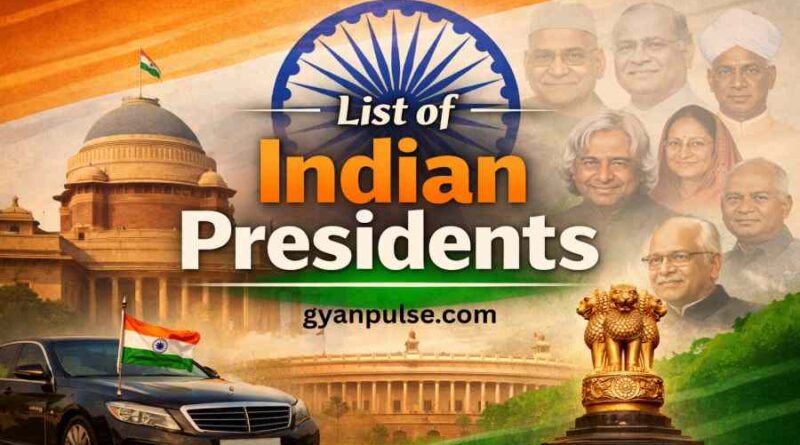
List of Indian Presidents from 1950 to 2026
Explore the List of Indian Presidents with terms, key facts, and important highlights. A helpful guide for students, GK lovers and competitive exam preparation.
List of Indian Presidents from 1950 to 2026
India became a republic on 26 January 1950, and since then, several leaders have served as the President of India, the constitutional head of the country. This comprehensive guide presents the complete list of Indian Presidents from 1950 to 2026, offering a clear overview of their terms, backgrounds, and historic significance. Designed especially for students, competitive exam aspirants, and GK enthusiasts, it helps readers understand how the role of the President has evolved since India became a republic and highlights key milestones in the nation’s constitutional journey.
Table of Contents
Here’s a chronological list of all Presidents along with interesting facts:
| No. | Name of the President | Term Period | Key Highlights |
|---|---|---|---|
| 1 | Dr. Rajendra Prasad | 1950–1962 | First President of India. Longest-serving. |
| 2 | Dr. Sarvepalli Radhakrishnan | 1962–1967 | Philosopher and celebrated teacher. |
| 3 | Dr. Zakir Husain | 1967–1969 | First Muslim President. Died in office. |
| 4 | V. V. Giri – Varahagiri Venkata Giri (Acting & Elected) | 1969–1974 | President elected as an independent. |
| 5 | Fakhruddin Ali Ahmed | 1974–1977 | Died in office during the Emergency. |
| 6 | Neelam Sanjiva Reddy | 1977–1982 | Youngest elected President at 64. |
| 7 | Giani Zail Singh | 1982–1987 | First Sikh President of India. |
| 8 | R. Venkataraman | 1987–1992 | Freedom fighter and lawyer. |
| 9 | Dr. Shankar Dayal Sharma | 1992–1997 | Former CM of Madhya Pradesh. |
| 10 | K. R. Narayanan | 1997–2002 | First Dalit President of India. |
| 11 | Dr. A. P. J. Abdul Kalam | 2002–2007 | Missile Man of India. Most loved President. |
| 12 | Pratibha Patil | 2007–2012 | First woman President of India. |
| 13 | Pranab Mukherjee | 2012–2017 | Veteran politician and finance expert. |
| 14 | Ram Nath Kovind | 2017–2022 | Second Dalit President. Former Bihar Governor. |
| 15 | Droupadi Murmu | 2022-Present (2026) | First tribal woman President of India. |
Presidents Who Died in Office
| No. | Name | Term | Date of Death | Key Fact |
|---|---|---|---|---|
| 1 | Dr. Zakir Husain | 1967–1969 | 3 May 1969 | First Indian President to die in office. |
| 2 | Fakhruddin Ali Ahmed | 1974–1977 | 11 February 1977 | Passed away during Emergency. |
Notes:
After Fakhruddin Ali Ahmed’s death, B. D. Jatti served as the acting President.
After Dr. Zakir Husain passed away, Varahagiri Venkata Giri took over as India’s acting President.
Interesting Facts
- Dr. Rajendra Prasad remains the only Indian President to have served two complete terms in office.
- Droupadi Murmu is the first Indian President born in independent India.
- APJ Abdul Kalam‘s presidency saw huge public engagement, especially with youth.
Role and Powers of the President of India
The President of India is the highest constitutional authority and the guardian of the Constitution. As the head of state, the President represents the nation at official functions and international events. Although the role is largely ceremonial, the President has important powers, including appointing the Prime Minister, Governors, and key officials.
In times of political instability, the President plays a crucial role in ensuring democratic continuity. The President also approves bills passed by Parliament, making them official laws, and acts as the supreme commander of India’s armed forces.
Also Read: First in India – List of First Male and Female Achievers
Election Process of the President
The President of India is elected every five years through an indirect election. The Electoral College consists of elected members of both Houses of Parliament and elected members of the Legislative Assemblies of all states and Union Territories. The voting follows a proportional representation system using a single transferable vote.
To win, a candidate must secure more than 50% of the total valid votes. This system ensures fair representation of both central and state governments, making the President’s position truly national and balanced in character.
Residence and Official Emblems
The official residence of the President of India is the Rashtrapati Bhavan in New Delhi, one of the largest and most magnificent presidential residences in the world. Spread over 320 acres, it includes the Mughal Gardens, ceremonial halls, and offices.
The President uses the national emblem and flag on all official documents and vehicles. The emblem, adapted from the Lion Capital of Ashoka, symbolizes power, courage, and truth. The President’s standard flag features the national tricolor with the state emblem in the center, reflecting dignity and authority.
List of Indian Presidents Useful for
- UPSC & State PSC
- SSC, Bank Exams
- School GK & Interviews
Knowing the list of Indian Presidents from 1950 to 2026 is essential for understanding India’s political and constitutional history. Each President has contributed uniquely, some by strengthening democratic values, others by guiding the nation through critical periods like emergencies or political transitions. This chronological list not only helps in exam preparation but also offers insights into leadership diversity, historic firsts, and the steady evolution of India’s highest constitutional office.
Also Check: General Knowledge