
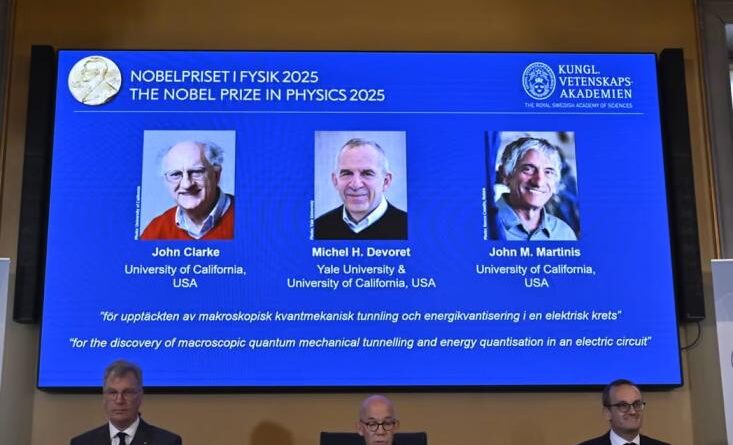
Nobel Prize 2025 in Physics Awarded for Quantum Mechanics Breakthrough
Discover the Nobel Prize 2025 in Physics winners and their groundbreaking quantum research, its impact on modern technology, global collaboration, and future innovations in computing and communication.
Nobel Prize 2025 in Physics Awarded
The 2025 Nobel Prize in Physics has been awarded for groundbreaking work in quantum physics. The winners carried out experiments that showed how quantum effects can appear on a large scale. Their discoveries have opened new doors for modern quantum technologies that influence our everyday lives and future innovations.
Table of Contents
Overview of the Nobel Prize in Physics
The Nobel Prize in Physics Founded in 1901 through the will of Alfred Nobel, this prize is among the world’s most respected honors in science. It recognizes remarkable achievements that expand our understanding of the physical world.
The Royal Swedish Academy of Sciences presents the award each year, along with a cash prize divided among the winners. Legendary scientists like Albert Einstein and Niels Bohr are among its notable recipients.
The Winners and Their Groundbreaking Work
In 2025, the Nobel Prize in Physics was awarded to John Clarke, Michel Devoret, and John Martinis for their groundbreaking research on superconducting electronic circuits. Starting in the mid-1980s, their experiments demonstrated that quantum effects, once thought to exist only at the microscopic level, could also appear on a macroscopic scale.
Their pioneering work opened new doors for practical applications of quantum mechanics, paving the way for modern quantum technologies like advanced computing and precision measurement.
The Impact of These Quantum Discoveries
These experiments showed that quantum physics isn’t limited to tiny particles. The researchers demonstrated that quantum states can be controlled in larger, macroscopic circuits, not just at the microscopic level.
This breakthrough laid the foundation for quantum technologies like computing, sensing, and cryptography, which could lead to faster computers, more secure communications, and highly precise measurement tools.
Quantum Physics and Its Role in Modern Technology
Quantum technology forms the backbone of many everyday devices. Key components like transistors in microchips operate based on quantum principles, powering computers, smartphones, and other digital systems.
The 2025 laureates highlighted that their research provides the foundation for much of today’s modern electronics. Even now, quantum mechanics continues to drive innovations across technology, shaping the devices we rely on every day.
Collaborative Efforts in Quantum Physics
The 2025 laureates represent diverse backgrounds and institutions. John Clarke, born in the UK, is based at the University of California, Berkeley. Michel Devoret, from France, holds roles at Yale University and UC Santa Barbara.
John Martinis, an American physicist, led Google’s Quantum Artificial Intelligence Lab. Their work highlights the global and collaborative nature of modern scientific research, showing how international partnerships drive breakthroughs in physics.
Also Read: Nobel Prize 2025 Awarded for Key Discovery of Immune System
Understanding the Significance of the 2025 Nobel Awards
The Nobel Prize in Physics is the second award presented each year, following the medicine prize, which often honors advances in areas like immune system research. The chemistry prize is awarded after physics.
Each prize is formally presented at the annual Nobel ceremony in Stockholm on December 10, marking the anniversary of Alfred Nobel’s death, while the Peace Prize is awarded separately in Oslo.
Future Prospects of Quantum Physics
The pioneering work of Clarke, Devoret, and Martinis is not just a milestone, it’s a springboard for the next generation of quantum innovations. Researchers worldwide are now building on their experiments to develop more powerful quantum computers, advanced sensors, and secure communication systems.
As quantum technologies evolve, they promise to redefine computing, healthcare, and communication, making our world faster, smarter, and more connected. The 2025 Nobel Prize thus highlights both the past achievements and the future potential of quantum physics.
Also Check: Current Affairs